Study in America from Pakistan 2026: Costs, Scholarships, and Requirements
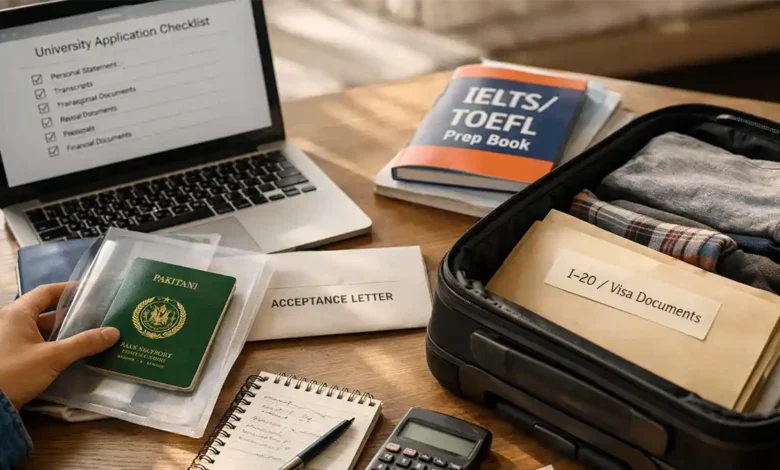
Study in America from Pakistan 2026 is not just a dream; it’s a serious plan with deadlines, documents, and a budget. The students who succeed are usually not the luckiest. They’re the ones who understand the full cost of attendance, choose the right pathway, prepare strong applications, and present a clear, consistent story for the F-1 visa.
If you’re applying from Pakistan, you’re likely asking the right questions:
- How much will the U.S. cost per year (tuition + living + hidden fees)?
- Which scholarships are realistic, and how do you actually win them?
- Do you need IELTS/TOEFL, SAT, GRE, or can you apply test optional?
- What does the embassy look for in an F-1 visa interview?
- What mistakes waste time, money, or cause refusal?
This guide answers those questions in plain English, with practical steps and up to date fee references where they matter.
Why Pakistani Students Still Choose the U.S. in 2026
The U.S. remains a top destination because it combines:
- Huge program variety (community colleges, state universities, elite private schools)
- Flexible academics (majors/minors, electives, interdisciplinary options)
- Strong research and industry links (especially in STEM, business, and health fields)
- Structured career pathways such as on campus work (within limits) and post study practical training
But the real advantage is options. If your budget is tight, you can plan a lower cost route. If your profile is strong, you can target merit awards or graduate funding. If you’re strategic, you can reduce cost without reducing quality.
Pick the Right Study Pathway (This Decides Your Cost and Funding)
Before scholarships and visas, decide your pathway. It shapes everything: cost, admissions requirements, and funding chances.
(1) Undergraduate (Bachelor’s)
Best for students coming after FSC/A-Levels/IB.
Funding reality: full scholarships exist, but they’re highly competitive. Partial scholarships are more common.
(2) Community College → Transfer (2 + 2)
A strong value option for many Pakistani families:
- Lower tuition for the first two years
- Smaller classes and structured academic support
- Transfer to a university for years 3–4 to complete the bachelor’s degree
(3) Graduate (Master’s / PhD)
Funding is generally better at graduate level, especially for research based programs:
- Research assistantships (RA)
- Teaching assistantships (TA)
- Tuition waivers and stipends (most common at PhD level)
(4) Short certificates / ESL pathways
Useful when you need language or academic preparation, but choose carefully. Your program should still connect to a credible academic plan.
Admissions Requirements for Pakistani Students (What You’ll Typically Need)
Different universities have different policies, but most require the same core documents.
Academic Records
Common requirements include:
- Transcripts/mark sheets (SSC/HSSC, A-Levels, or university transcripts)
- Degree certificates (if already graduated)
- Clear grading scale explanation (often included on transcripts; if not, request it)
English Language Proficiency
Most universities accept:
- IELTS Academic
- TOEFL iBT
- Some accept Duolingo English Test (DET), depending on the institution
Tip: Don’t assume accepted by many means accepted by your target department. Always confirm on the program’s official page.
Standardized Tests (SAT/ACT/GRE/GMAT)
Many universities are now test optional in some programs, but tests can still matter:
- For undergraduate scholarships, strong SAT/ACT can help
- For graduate admissions, GRE/GMAT may be optional but can strengthen your case in competitive pools
A simple rule: if your academic profile has gaps, a strong test score can compensate. If your academics and projects are already strong, focus more on SOP, research fit, and recommendations.
SOP / Personal Statement
Your statement should be:
- Specific (what you want to study and why)
- Evidence based (projects, internships, research, leadership)
- Program aligned (why this university/department)
- Career clear (how the degree fits your future)
Avoid generic lines like I want to study in the USA because it has the best education. Everyone writes that. It doesn’t help.
Letters of Recommendation (LORs)
Aim for recommenders who can prove impact:
- academic performance
- research skills
- discipline and integrity
- leadership or initiative

A Practical Timeline for Fall 2026 Intake
Most Pakistani students target Fall intake (Aug/Sep). Use this timeline as a realistic roadmap.
12–10 months before intake
- Decide level (UG/Master’s/PhD) and field
- Build a shortlist (8–12 schools is manageable)
- Map your funding strategy
- Plan tests (IELTS/TOEFL; SAT/GRE if needed)
10–7 months before intake
- Finalize SOP and CV
- Request transcripts and LORs early
- Submit applications (deadlines vary widely by university and program)
After acceptance
- Receive Form I-20 (required for F-1 visa processing)
- Prepare financial evidence and visa documents
- Book visa interview as per local appointment availability
Costs to Study in the U.S. (What You Must Budget For)
Students often underestimate costs because they focus only on tuition. Your real annual spend typically includes:
Tuition + housing + food + health insurance + fees + books + transport + personal expenses + one-time setup costs
Tuition (Realistic Reference Points)
According to College Board reporting for 2025–26, average published tuition and fees are around $11,950 for public four year in state, and $45,000 for private nonprofit four year institutions (published prices; not what everyone actually pays after aid).
For international students, public university pricing often resembles out of state cost structures. Your exact tuition depends on the institution and program, so treat averages as planning anchors, not promises.




Total Cost of Attendance (Tuition + Living)
The same report notes that in 2025–26, average student budgets (a practical proxy for cost of attendance) can range widely, and can be significantly higher at private nonprofit universities.
Health Insurance (Usually Mandatory)
Most U.S. universities require a health insurance plan (either university plan or approved waiver). Costs vary by campus and plan design, so include it in your annual budget from day one.
Visa and Mandatory Government Fees
Two official fees matter early:
- U.S. nonimmigrant visa application fee (MRV): $185 for non petition based categories (this includes student visas such as F).
- SEVIS I-901 fee: $350 for F or M visa applicants (as listed by U.S. Immigration and Customs Enforcement).
You will also spend on:
- test fees (IELTS/TOEFL/SAT/GRE as required)
- university application fees (varies)
- courier/document charges
- initial travel and settling in expenses
A Simple Annual Budget Range (Planning Guide)
To avoid false comfort, think in ranges:
- Lower cost plan: community college or lower cost public + modest city + tight budgeting
- Mid range plan: typical public/private with partial aid
- High cost plan: major metro areas, expensive private universities, limited aid
A practical target for many international undergrads is often $30,000–$65,000 per year depending on university and location (your plan can be lower with a smart pathway, but build a buffer).
Scholarships and Funding (What’s Realistic for Pakistani Students)
Scholarships are real, but not automatic. The strongest approach is to treat funding like a strategy, not a lottery.
Fully Funded: Fulbright (Graduate Level)
One of the most recognized fully funded routes for Pakistan is Fulbright via USEFP. The program description notes funding for graduate study and commonly includes tuition, required textbooks, airfare, a living stipend, and health insurance (subject to program year and budget).
Who tends to win?
- strong academics
- leadership/community impact
- a clear study plan tied to long term goals
- excellent writing and recommendations
University Scholarships (Merit and Need Based)
Undergraduate funding often appears as:
- merit scholarships (grades + achievements, sometimes test scores)
- partial grants that reduce tuition
- competitive full rides (rare, top tier applicants)
Graduate funding is often stronger when you have:
- RA/TA opportunities
- research fit with faculty
- strong portfolio (publications, projects, labs, internships)
Assistantships (Graduate Game Changer)
In many master’s and PhD programs, assistantships can reduce tuition and pay a stipend. They’re not guaranteed, and the competition can be intense, but they’re one of the most powerful tools to make the U.S. affordable.

Working While Studying (Know the Limits)
For many F-1 students, on campus work can help with living costs. Guidance from U.S. Citizenship and Immigration Services states that on campus employment is generally limited to up to 20 hours per week while school is in session (with DSO approval rules and other conditions).
Important: Work rules are strict. Always coordinate with your designated school official (DSO) before accepting any job.
F-1 Visa Requirements (Clear Steps for Pakistani Applicants)
The student visa process becomes manageable when you treat it as a checklist.
Step 1: Get admission + Form I-20
After acceptance, the school issues Form I-20. This document is central to your visa application.
Step 2: Pay the SEVIS fee
Pay the I-901 SEVIS fee and keep the printed confirmation. The listed fee for F/M applicants is $350.
Step 3: DS-160 + pay visa fee + schedule interview
The nonimmigrant visa fee for non petition based categories is $185.
Step 4: Prepare your consistency file
This is what makes interviews smoother:
- Admission letter + I-20
- clear financial plan (sponsor documents, bank statements, scholarship letters)
- academic plan (why this program, why this university)
- career direction (how it fits your trajectory)
Visa interviews are not about memorized speeches. They’re about coherence: your academics, finances, and plan should align.
How to Reduce Costs Without Reducing Quality
These strategies work in real life:
- Choose the right city, not just the famous name
A strong university in a lower cost city can save thousands yearly. - Use the 2+2 transfer pathway
Two years at community college, then transfer, can lower total tuition significantly. - Shortlist aid friendly universities
Some institutions consistently fund international students; others rarely do. Build your list around realistic aid patterns. - Apply early and apply smart
Early applications and strong documentation improve scholarship odds. - Budget with discipline
Students struggle most when they never map monthly costs (rent, utilities, groceries, transport, insurance, emergencies).
Common Mistakes to Avoid in 2026
- Applying without a credible funding plan
- Choosing a program unrelated to your background (weak narrative)
- Using generic SOP templates that sound copied
- Missing deadlines because of late transcripts/LORs
- Misunderstanding work rules and risking status issues
Quick FAQ
What is a realistic yearly budget for Pakistani students in the U.S.?
Many students plan between $30,000 and $65,000 per year, depending on tuition, city, and aid. Your number can be lower with community college + transfer and tight budgeting.
How much is the U.S. student visa application fee?
The U.S. nonimmigrant visa fee for non petition based categories is $185.
What is the SEVIS fee for an F-1 student?
The SEVIS I-901 fee for F or M visa applicants is listed as $350.
What does Fulbright (USEFP) typically cover for Pakistan?
The Fulbright Degree program description notes coverage that commonly includes tuition, required textbooks, airfare, living stipend, and health insurance (program year dependent).
Can I work while studying in the U.S. on an F-1 visa?
On campus work is generally permitted up to 20 hours/week while school is in session (subject to conditions and DSO guidance).
Do I need SAT or GRE in 2026?
It depends on your program. Many are test-optional, but strong scores can still help for scholarships (undergrad) and competitiveness (graduate).
What’s the safest way to reduce cost without risking quality?
A lower cost city + aid friendly shortlist + (optionally) community college transfer route is one of the most effective combinations.
What usually causes visa trouble for students from Pakistan?
Inconsistent information (study plan vs finances), weak funding proof, unclear program rationale, and documents that don’t match your narrative are common issues.
Conclusion
Studying in the U.S. from Pakistan in 2026 is achievable if you plan with clarity:
- Understand full costs beyond tuition.
- Use scholarships and assistantships strategically, not randomly.
- Choose a pathway that fits your finances and profile.
- Keep your admissions story and visa story consistent.
Do that, and your application becomes more than hopeful it becomes credible, competitive, and financially realistic.





One Comment