Malaysia Jobs for Pakistanis: New Opportunities & How to Apply (2026)

Malaysia jobs for Pakistanis are a realistic option in 2026 but only for applicants who approach the process like professionals. Malaysia is still hiring international talent across selected industries, yet the market is more disciplined than it used to be. Employers want clear proof of skills, clean documentation, and candidates who understand how work passes actually work.
This guide is designed to be practical, not dramatic. You’ll learn where opportunities are emerging, which routes are legal, how to apply from Pakistan with minimal risk, and how to build an application that gets replies instead of silence. If you follow this roadmap, you’ll avoid common traps (fake offers, wrong visa routes, processing scams) and put yourself in a stronger position to secure a legitimate job offer.
Why Malaysia is hiring (and why Pakistanis are a good fit)
Malaysia’s economy is diverse. It isn’t driven by a single industry. That matters because job demand doesn’t come from one place it comes from multiple engines at the same time:
- Manufacturing and exports (electronics, components, packaging, industrial supply chains)
- Services and shared operations (finance operations, customer support, back office roles)
- Technology and digital business (software, QA, cloud operations, cybersecurity support)
- Logistics, warehousing, and distribution
- Construction and infrastructure support (often sector based hiring)
For Pakistani applicants, Malaysia can be attractive because workplace English is common in many industries, the culture is generally comfortable for Muslim workers, and major cities offer structured career paths when the employer is legitimate.
Still, success depends on fit. If you apply randomly, you’ll waste time. If you target the right lane professional, technical, or sector based you can build momentum fast.
What’s new in 2026: the reality check you need before applying
Malaysia’s work pass environment is becoming stricter, especially for expatriate professionals. In 2026, employers are expected to justify foreign hiring more clearly, and salary structures matter more than ever.
1. Employment Pass salary rules are tightening
Malaysia’s Expatriate Services Division has announced updated minimum salary thresholds for Employment Pass categories effective 1 June 2026. The practical impact is simple: professional hiring will favor candidates who can justify the package and match the category requirements.
What this means for you:
- If your salary is too low for the category, the pass route becomes difficult.
- Employers may reduce borderline foreign hiring and focus on candidates who clearly meet the standard.
- Applicants should avoid offers that hide real pay inside unclear allowances.
2. Employers drive the process (not the applicant)
For professional work passes, you typically cannot self apply without an employer. A real company must sponsor you, submit the correct paperwork, and issue a clear contract.
3. Short term professional work exists but it’s not a long term shortcut
Malaysia has a route for short professional assignments such as services or training placements (often handled through a Professional Visit Pass). This can be useful for temporary projects, but it should not be sold as a permanent job visa solution.
4. For worker routes, compliance and medical steps are non negotiable
If you are hired under sector based foreign worker routes, medical screening processes and sector approvals can be part of the journey. If anyone tells you these steps can be skipped, treat it as a warning sign.
The opportunity map: where Pakistanis can realistically win in 2026
Instead of chasing any job in Malaysia, focus on markets where hiring is consistent and where Pakistani applicants have a believable advantage.
A. Professional track roles (often linked to Employment Pass routes)
These roles usually require stronger education, proven experience, and solid communication skills. Employers expect you to contribute from day one.
High demand areas:
- Software development: web, mobile, backend, integration work
- QA and testing: manual + automation, test planning, defect management
- DevOps and cloud operations: CI/CD basics, monitoring, cloud fundamentals
- Cybersecurity support: SOC analyst entry tracks, compliance support, security monitoring
- Data and reporting: Excel power users, SQL basics, BI reporting, dashboards
- Finance operations: accounting support, shared services, ERP exposure
- Manufacturing engineering: process improvement, quality control, production planning (role specific)
Who typically succeeds here:
- Candidates with real proof: portfolios, project summaries, certifications that match the job
- People who can explain outcomes (not just responsibilities)
- Applicants who tailor their CV and don’t rely on generic templates
B. Technical and skilled roles (industry driven demand)
These roles can be strong options if your skills are verifiable and you are prepared for practical tests.
Common demand areas:
- Manufacturing technicians and machine operators
- Maintenance, electrical support, mechanical support
- Warehouse operations, forklift roles (where permitted), inventory handling
- Quality inspection and production support
- Construction site trades (policy and sector rules apply)
Who tends to succeed:
- Skilled workers with documented experience letters and proof of work
- Applicants who take safety seriously and can show disciplined work habits
- People who understand contracts, pay structure, and legal entry rules
Understand the legal pathways: pick the right pass for the right job
Malaysia does not offer one universal work visa. There are different categories depending on the nature of work.
1. Employment Pass (EP): the usual path for professional jobs
This is commonly used for expatriate professionals employed under a structured contract.
In plain terms:
- You need a real employer in Malaysia
- Your contract and salary structure must align with the category rules
- Your employer handles the core sponsorship steps
2026 strategy tip: If an offer looks professional but the basic salary is suspiciously low, ask for clarification immediately. For EP-type routes, salary structure matters.
2. Professional Visit Pass (PVP): short term professional assignments
This route is often used for temporary service delivery or training arrangements, usually for a limited time.
Best use cases:




- Temporary projects
- Short term technical support assignments
- Training or structured placement
Red flag: If someone tries to sell PVP as a long term employment solution without a clear short term scope, proceed carefully.

3. Temporary employment routes for sector based worker hiring
These are typically for employer led recruitment in approved sectors, and the process may involve medical screening and sector compliance steps.
Key point: This is where scams are common, so your verification process must be strict.
Where to find real jobs (and where people get trapped)
The safest approach is multi channel, employer first.
1. MYFutureJobs (Malaysia’s national job portal)
This portal is widely referenced as an official job and training platform. Use it to discover companies, roles, and hiring trends.
How to use it smartly:
- Search by city: Kuala Lumpur, Selangor, Penang, Johor
- Filter by skill level and sector
- Save company names and apply directly on their career pages
2. LinkedIn + company career pages (best for professional roles)
For professional hiring, LinkedIn is often the fastest way to:
- Track who is actively hiring now
- Identify the hiring manager or recruiter
- Verify whether the recruiter is connected to a real company
Simple rule: Apply on the company website whenever possible, then follow up politely on LinkedIn with a short proof based message.
3. Recruitment agencies (useful only when transparent)
Agencies can be legitimate, but only if:
- The employer is named and verifiable
- The offer letter comes from the employer (not just an agent message)
- The process is documented clearly
- You are not pressured into urgent payments to secure a visa
Step by step: How to apply from Pakistan (the clean workflow)
This is the application system that works without drama.
Step 1: Pick a target role you can prove
Malaysia rewards clarity. Choose:
- Two job titles you genuinely match
- Two preferred locations
- A realistic salary floor
- Your top proof assets (portfolio, certifications, experience letters)
If your profile is broad, the market treats it as weak. A focused profile looks employable.
Step 2: Build a Malaysia ready CV (ATS friendly + human)
Your CV should be clean, fast to read, and evidence driven.
Recommended structure:
- Name + contact + LinkedIn/portfolio
- 3–4 line professional summary
- Skills block (tools + core strengths)
- Work history with outcome bullets
- Education + certifications
- Portfolio/projects (if relevant)
Replace generic lines with outcomes:
- Weak: Responsible for QA testing.
- Strong: Designed test cases for 3 releases/month and reduced recurring bugs by improving regression coverage.
Step 3: Write a short cover letter that doesn’t sound copied
Most cover letters fail because they are full of hardworking statements. Keep it tight.
Winning formula:
- 1 line: why you’re applying
- 2 lines: proof of fit (tools, outcomes, scope)
- 1 line: link to proof + availability
Step 4: Apply through three routes per company
For each target employer:
- Company career page
- LinkedIn job listing (if available)
- MYFutureJobs listing (if posted there)
This boosts visibility because different teams manage different pipelines.
Step 5: Verify every offer before you share sensitive documents
Do this before sending passport scans or paying anything.
Employer verification checklist:
- Company website and real address
- Company email domain (not random Gmail)
- Clear job title, location, salary, and duties
- A written offer letter or contract draft
- HR contact information you can verify
Fast red flags:
- Visa guaranteed language
- Deposit requests before documentation
- Pressure to decide in hours
- Refusal to name the employer
Step 6: Interview like someone who already works there
Even if the role is junior, employers respect structured thinking.
For professional roles:
- Prepare a 60 second intro: your role, your strengths, your proof
- Have 2 project stories ready (problem → action → result)
- Be ready to explain tools you listed on your CV
For skilled roles:
- Bring proof of work (photos, short videos, letters)
- Expect a practical test
- Explain safety practices confidently
Step 7: Negotiate with clarity, not emotion
If the job is pass dependent, the salary structure must be clean.
Confirm these in writing:
- Basic salary (clear monthly figure)
- Work location
- Working hours and overtime rules
- Medical coverage
- Accommodation or allowance (if provided)
- Annual leave and public holidays
- Probation period and termination notice terms
Avoid any arrangement where pay is vague or heavily under the table.
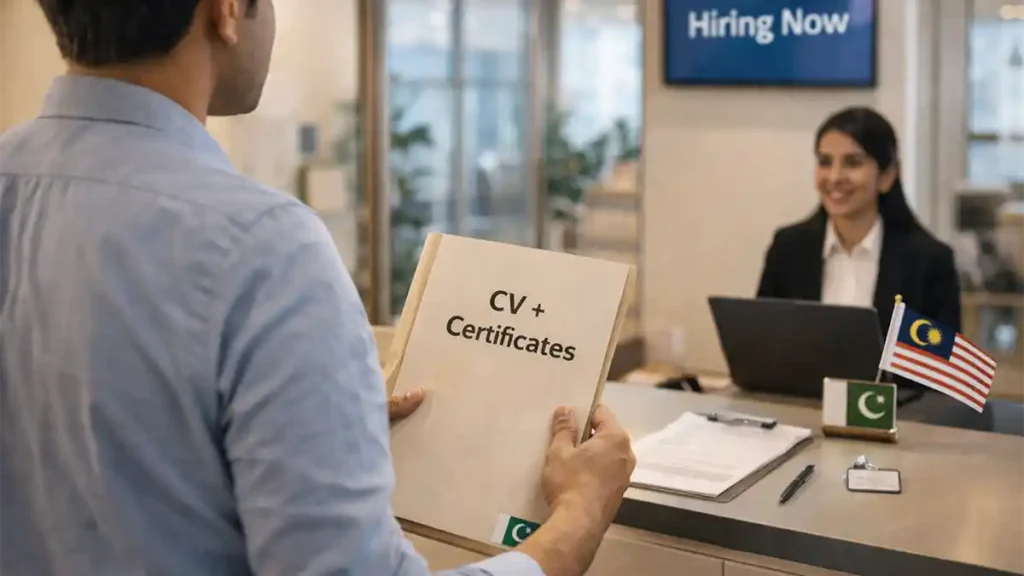
Step 8: Document readiness (don’t lose a job because of paperwork)
Prepare a digital folder before you apply seriously.
Core documents:
- Passport scan (clear, valid)
- CV (PDF)
- Degree/certificates (and English translations if needed)
- Experience letters
- Passport sized photo
- Portfolio links or proof file (if relevant)
Pro tip: Keep filenames clean (e.g., Muhammad_Ali_CV_2026.pdf) and make one combined PDF for certificates.
CV upgrades that make Malaysian employers say “yes”
A strong CV doesn’t just list tasks. It communicates value.
Upgrade 1: Add measurable outcomes
Even in non technical roles, numbers help:
- Monthly volume handled
- Time saved
- Error reduction
- Customer satisfaction improvements
- Production efficiency improvements
Upgrade 2: Show tools, not only job titles
Tools make you credible:
- Excel, Power BI, SQL basics
- Jira, TestRail, Selenium basics
- ERP systems exposure
- CAD or technical tools (where relevant)
Upgrade 3: Add a proof link
A portfolio doesn’t need to be fancy. It can be:
- A Google Drive proof folder (organized)
- A one page PDF project summary
- GitHub for tech roles
- LinkedIn featured projects
Skills that open higher paying roles in 2026
If you want a better job offer, treat skills like an investment.
High return skills (short timeline)
- Advanced Excel + reporting
- Customer support with CRM basics
- QA fundamentals with structured testing
- Intro SQL + dashboard thinking
Medium timeline skills
- Cloud fundamentals (AWS/Azure basics)
- DevOps basics (CI/CD concepts, monitoring)
- Cybersecurity fundamentals (log analysis, SOC basics)
- ERP workflows exposure (finance/ops roles)
Employers respond to proof. A certificate helps, but a small project that demonstrates your ability often helps more.
Real world pathways (how smart applicants build results)
Example 1: IT support → cloud operations
A candidate strengthens their profile by documenting a basic cloud project, learning monitoring basics, and applying to roles that match their level. They get interviews because they show capability, not because they beg for a chance.
Example 2: Accounting → shared services
A candidate upgrades Excel reporting, builds a few sample dashboards, and tailors the CV around closing support and reporting outcomes. They apply directly to companies with shared service centers and avoid agent heavy routes.
Example 3: Skilled technician → stable industrial role
A candidate organizes evidence of work, collects verifiable letters, and targets factories and maintenance contractors that value consistency. They accept a realistic start and build upward through performance.
These paths work because they are disciplined and verifiable.
Common mistakes Pakistanis make (and how to avoid them)
Mistake 1: Paying money before verifying the employer
If the first serious step is send payment, treat it as unsafe. A legitimate hiring flow is document first and contract first.
Mistake 2: Using one CV for every job
A generic CV looks like spam. Customize the headline, summary, and top skills for the role you’re applying to.
Mistake 3: Chasing titles instead of matching eligibility
If your experience doesn’t support a senior title, apply at the right level and grow. Malaysia rewards performance, but hiring starts with credibility.
Mistake 4: Ignoring contract clarity
Never accept a role where salary, overtime, or location are unclear. Ambiguity is where exploitation starts.
A practical 14 day action plan (repeat weekly)
Days 1–2: Finalize target roles, cities, and proof assets
Days 3–5: Rewrite CV + create proof folder + draft cover letter template
Days 6–7: Apply to 15 roles (company sites + LinkedIn)
Days 8–10: Apply to 25 more roles (including MYFutureJobs discovery)
Days 11–12: Follow up with 10 polite messages (proof link included)
Days 13–14: Interview prep + negotiation checklist + document readiness
Consistency wins. Most serious candidates get results in cycles, not in one day.
Quick FAQ
Can Pakistanis get jobs in Malaysia in 2026?
Yes. The best results come from applicants who target the right sectors and apply through verified employers and platforms.
Which Malaysian cities offer the most opportunities?
Kuala Lumpur and the surrounding Selangor region often have the most corporate and services hiring, while Penang and Johor can be strong for industrial and manufacturing linked roles.
What is the Employment Pass and who needs it?
It’s a common route for professional expatriate roles under a formal contract. The employer typically sponsors and manages the process.
What is a Professional Visit Pass used for?
It’s often used for short term professional assignments like services or practical training, usually limited in duration.
What’s the safest way to search for jobs?
Use official and verifiable channels MYFutureJobs, company career pages, and LinkedIn then cross check the employer before sharing documents.
Should I pay an agent to secure a visa?
Be extremely cautious. Any process that prioritizes payment over written contracts, employer verification, and documentation should be treated as high risk.
What documents should I prepare before applying seriously?
Passport scan, CV, certificates, experience letters, and proof of skills (portfolio or project summaries). Keep everything organized in one folder.
How do I avoid Malaysia recruitment scams?
Verify the employer, insist on written details, avoid pressure tactics, and never send money simply to confirm a job offer.
Conclusion: Malaysia can work in 2026 if you play it smart
Malaysia jobs for Pakistanis in 2026 are not about luck. They are about preparation, proof, and safe execution.
If you want strong results:
- Choose a realistic job lane (professional, technical, or sector based)
- Build proof that matches the role
- Apply through reliable channels, not rumors
- Verify every employer and keep your paperwork ready
- Negotiate clearly so your contract supports legal employment
Follow this approach and you’ll move from searching to progressing with fewer risks and better long term outcomes.