Last Minute Study Tips: What to Do the Night Before (Without the Panic Spiral)

Last minute study tips can absolutely make a difference if you use the night before an exam for the right kind of work. This isn’t the time to “cover everything.” It’s the time to secure easy marks, strengthen recall, reduce mistakes, and set up your brain to perform tomorrow.
If you’re feeling pressure right now, you’re normal. The night before creates a specific stress cocktail: urgency, uncertainty, and a running mental list of everything you could have done earlier. But tonight still has value. The key is switching from “more content” to “better performance.”
This WordPress-ready guide gives you a modern, realistic routine for the evening before: what to focus on, what to avoid, and how to combine active recall, high-yield revision, and sleep so you walk into the exam clear-headed instead of drained.
The Night Before: What It’s Actually For
Let’s get honest: the night before an exam is not a magic portal where you absorb a whole textbook. It’s a performance-prep window. The goal is to improve what you can realistically improve in a few hours:
- strengthen recall on high-yield material
- fix your most common errors
- practice answering in the exam format
- reduce anxiety by creating a plan
- protect sleep so your brain can retrieve what you know
In learning science, the strongest study gains come from repeated practice over time. But even with limited time, you can borrow the same principles especially retrieval practice (testing yourself) and targeted correction. That combination beats “reading and hoping” almost every time.
The Biggest Trap: Studying That Feels Busy but Doesn’t Stick
When you’re stressed, your brain prefers comforting tasks. They feel productive, but they often don’t translate into marks:
- rereading notes from start to finish
- highlighting paragraphs you already understand
- rewriting summaries neatly
- watching long videos without testing yourself
These activities build familiarity, not usable memory. Familiarity is “I recognize this.” Exams require “I can produce this under pressure.”
Tonight, choose methods that force your brain to retrieve information. Retrieval strengthens memory and reveals what still needs attention.
Step 1: Do a 10-Minute Exam Audit (Before You Study Anything)
This is your first win: clarity. Grab paper (or a notes app) and answer these quickly:
- What’s the exam format?
MCQs, short answers, essays, problem solving, definitions, case studies? - What carries the most marks?
Chapters, units, sections, or question types with heavier weight. - What usually shows up?
Past papers, teacher hints, repeated themes, standard problem types. - Where do you lose marks?
Careless mistakes, weak explanations, confusing formulas, missing steps. - How much time do you really have tonight?
Plan for reality, not fantasy.
This audit transforms your night into a strategy instead of a stress reaction. It also sets your priorities for an effective night before exam routine.
Step 2: Identify High Yield Topics (Because Time Is Not Equal)
High-yield doesn’t mean “easy.” It means “most likely to earn marks.”
Choose material that is:
- frequently tested in past papers
- foundational (other topics depend on it)
- emphasized by your teacher or syllabus
- worth heavy marks (long questions, core units)
- responsible for your common mistakes
A fast rule that works
If you can only improve a few areas tonight, improve the areas that either:
- appear often, or
- unlock multiple other questions.
Example: In math, mastering a common problem pattern can solve several questions. In history, nailing a repeated theme can power multiple short answers and essays.
Step 3: Use the Active Recall Sprint (Fast, Focused, Exam-Realistic)
The active recall study method is simple: try to answer first, check second, then fix what you missed. It’s uncomfortable in the best way, because it exposes gaps quickly.
Active Recall Sprint (45 minutes)
- 15 minutes: attempt questions from memory (no notes)
- 10 minutes: check answers, mark weak points
- 15 minutes: review only the weak points
- 5 minutes: retest the same weak points
Repeat this cycle based on your time. Two cycles are often enough to see improvement; three or four can be a serious boost.
What counts as “questions”?
- past papers (best option)
- chapter end questions
- teacher worksheets
- flashcards
- self-made questions based on headings (“Explain…”, “Compare…”, “Solve…”, “Define…”)
This is the backbone of most effective cramming strategies that don’t collapse under exam stress.
Step 4: The Blank Page Method (Perfect for the Night Before)
If you want a quick, honest measure of what you know, this works brilliantly.
How to do it
- Write a topic title at the top of a blank page.
- From memory, write everything you can: key points, steps, diagrams, formulas, examples.
- Check your notes and circle what’s missing or wrong.
- Fill only the gaps don’t rewrite the whole topic.
This method is fast because it focuses only on what you can’t currently recall. It also prevents you from wasting time “studying what you already know.”
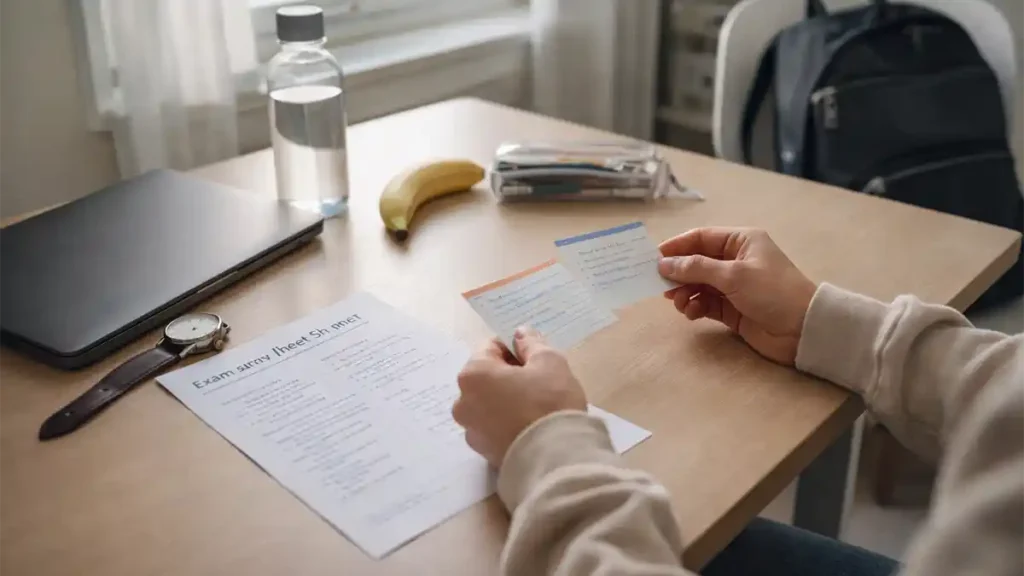
Step 5: Build a One-Page Exam Sheet (Your Personal “Mark Saver”)
Make one page that contains only high-value items. Keep it compact and readable.
Include:
- key definitions in exam-friendly language
- formulas and what each symbol means
- common mistakes you must avoid
- step-by-step outlines for common question types
- mini-examples (two is enough for many subjects)
This becomes your exam revision checklist and makes tomorrow morning easy: you’ll review one page, not a whole folder.
Step 6: Memorize Faster with Techniques That Actually Hold
If you need the best way to memorize fast, avoid long sessions of repeating the same line. Use tools that compress information and improve retrieval.
(1) Chunking
Group information into small sets (3–5 items).
Instead of memorizing 12 points, memorize 3 groups of 4.
(2) “Explain it in 60 seconds”
Speak out loud as if teaching someone.
If you get stuck, you just found what to review.
(3) Two-example rule
For each major concept, prepare:
- one simple example
- one slightly harder example
Examples help you handle new angles in the exam.
(4) Keyword triggers
For essays and long answers, use trigger words:
- “Causes” → list + brief explanation
- “Effects” → short-term and long-term
- “Compare” → similarities + differences
- “Evaluate” → pros, cons, and a judgment
Trigger words keep your writing structured even when you feel nervous.
Step 7: Stop Procrastination with a 5-Minute “Friction Reset”
When you’re overwhelmed, procrastination is often a protection response. Your brain avoids discomfort. Tonight, reduce friction so starting becomes easier.
Do this quickly
- Put your phone on charge away from your desk.
- Close extra tabs and keep only what you need.
- Set a timer for 25 minutes.
- Choose a tiny first task: “Do 10 MCQs” or “Solve 5 problems,” not “Study everything.”
This helps with stop procrastination studying because it makes the first step small and clear.
What to Avoid Tonight (These Quietly Destroy Performance)
Some habits feel “hardcore,” but they often backfire:
(1) Starting brand-new chapters late at night
This creates confusion and steals time from strengthening what you already understand.
(2) Rereading entire notes from top to bottom
It consumes time while producing low recall. You may feel prepared and still freeze tomorrow.
(3) Over-caffeinating in the evening
A short burst of energy isn’t worth a night of broken sleep and foggy focus.
(4) Studying until your brain becomes numb
If you’re rereading the same sentence repeatedly, your efficiency is gone. A short break will outperform stubborn pushing.
(5) Comparing your progress to others
Other people’s study timelines do not change your next hour. Protect your attention.
A Practical Night Schedule You Can Follow (Choose Your Time Window)
You don’t need a perfect plan just a usable one.
If you have 3–4 hours
- 10 min: exam audit + choose high-yield list
- 90 min: practice questions + corrections (active recall sprint x2)
- 10 min: break (water, stretch, short walk)
- 60 min: blank page method on 2–3 big topics
- 20 min: one-page exam sheet + pack materials
- 10 min: calm wind-down (no heavy studying)
If you have 60–90 minutes
- attempt the most likely questions
- correct your mistakes
- write a mini one-page sheet
- go to sleep
If you’re short on time, practicing the exam format is the most direct route to marks.
Subject-Specific Moves That Save Time
Math / Physics / Chemistry
Focus on patterns, not chapters.
- list formulas + when to use them
- practice mixed questions (not one type only)
- write a “common mistakes” section (sign errors, units, rounding, missing steps)
Biology / Social Studies / History
Focus on recall + structure.
- definitions and key terms
- cause/effect chains
- timelines or processes
- short paragraph practice using triggers (“Explain,” “Discuss,” “Compare”)
English / Literature
Focus on quality over quantity.
- theme banks with evidence
- strong thesis statements
- paragraph structure (point, evidence, explanation, link)
- quote selection: fewer quotes, better explanation
Computer Science
Focus on execution and clarity.
- practice core algorithms or code templates
- write syntax reminders
- do 2–3 full questions end-to-end (start to final output)
Anxiety Management: Calm Is a Study Skill
Stress isn’t always the enemy. A little pressure can improve focus. The problem is when stress becomes noise.
Quick tools that work in real life
- Box breathing (2 minutes): inhale 4, hold 4, exhale 4, hold 4
- Brain dump (3 minutes): write worries, tasks, and reminders
- Micro-movement (5 minutes): stretch, short walk, water
These are small steps, but they make your thinking cleaner and clean thinking earns marks.
Sleep: The Most Underrated Study Boost Tonight
If you’re serious about sleep before exam performance, treat sleep as part of your plan, not the reward after studying.
Why it matters:
- sleep supports memory consolidation
- sleep improves attention and speed
- sleep reduces emotional reactivity (less panic, more control)
A realistic target
Aim for 7–8 hours if possible. If you can’t, protect at least 6. Even one extra hour can improve your ability to recall and stay sharp.
A simple wind-down routine (20–30 minutes)
- stop heavy studying
- review your one-page sheet lightly
- set your clothes and exam materials
- keep the phone out of bed
- dark, cool room if possible
When your morning is calm, your exam performance often follows.
Morning-Of: What to Do (So Tonight Pays Off)
Tonight should prepare tomorrow.
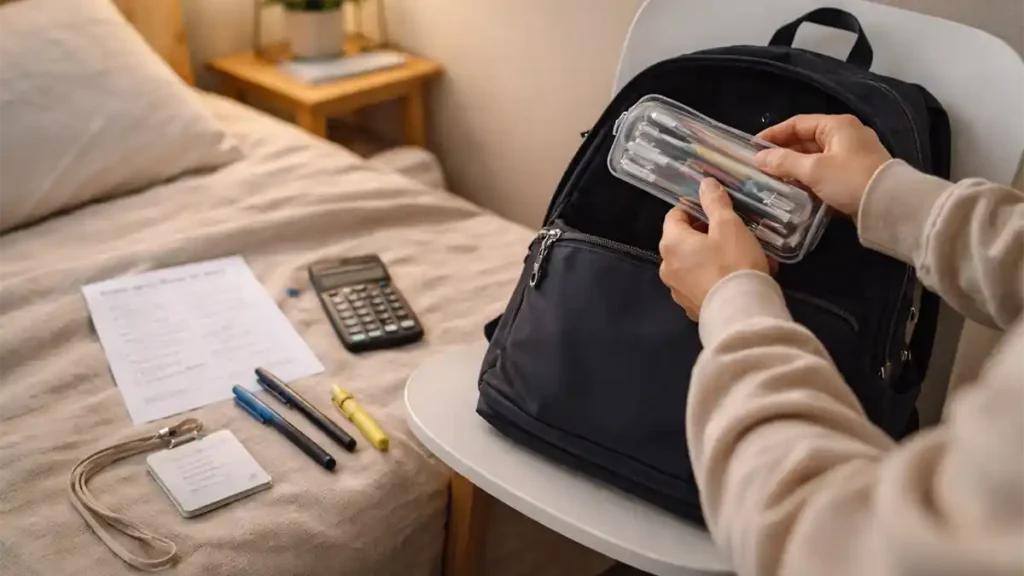
Pack and prep before sleeping
- ID, pens, calculator, charger (if needed)
- water and a light snack
- route/time plan
- one-page sheet ready for quick review
Morning review (15–25 minutes)
- scan your one-page sheet
- do a short recall warm-up (5–10 questions)
- avoid new topics
Your goal in the morning is activation, not expansion.
A 5-Minute Confidence Checklist (Before You Stop)
Before bed, confirm these:
- I practiced exam-style questions.
- I corrected mistakes and understand why they happened.
- I reviewed the highest-yield material.
- I created a one-page sheet for quick review.
- My exam materials are ready.
- I’m protecting sleep.
That’s a strong night, even if you started late.
Quick FAQ
1. Should I study all night if I’m behind?
No. All-nighters often reduce recall and focus. Do targeted practice, then sleep to protect performance.
2. What’s the fastest way to study the night before?
Practice questions first, then review only what you missed. It’s efficient and matches the exam.
3. Is rereading notes a waste?
Not always, but it’s low-return tonight unless you pair it with recall. Test yourself to make it stick.
4. How do I stop procrastinating when I feel stressed?
Shrink the task: start with 10 minutes or 10 questions. Remove phone distractions and use a timer.
5. What if I forget things right after studying?
Switch to retrieval: explain it without notes, check gaps, and retest. That strengthens memory quickly.
6. What should I review right before sleep?
Your one-page exam sheet: formulas, definitions, steps, and common mistakes. Keep it light.
7. How much sleep should I get before the exam?
Aim for 7–8 hours, but protect at least 6 if you can. Sleep supports memory and focus.
8. What should I do on exam morning?
Short recall warm-up, a calm breakfast, and arrive early. Avoid new topics and last-minute panic scrolling.
Conclusion: Make Tonight Count the Smart Way
The night before an exam isn’t about becoming perfect. It’s about becoming prepared. If you follow last-minute study tips that prioritize high-yield content, active recall, and correction, you can improve your score without burning out. Add a simple one-page sheet and a real sleep plan, and you’ll walk into the exam with better recall, steadier focus, and fewer careless mistakes.
You don’t need a heroic all-nighter. You need a strategy you can execute.