How to Study Smart: A Simple Plan for Better Grades
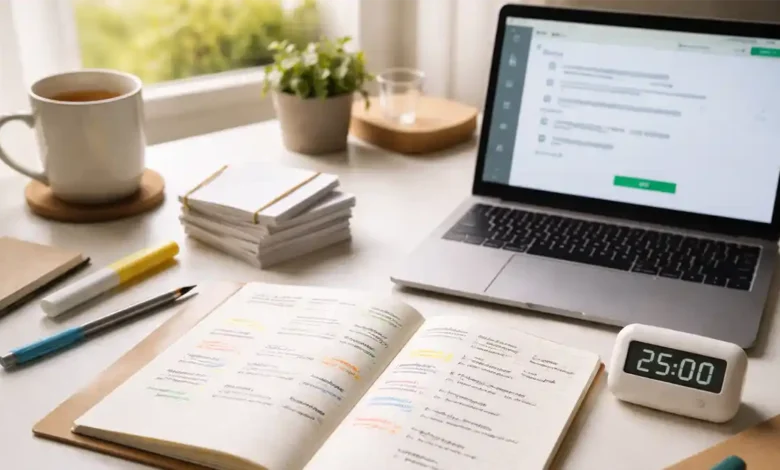
Study smart is not a talent it’s a system. The students who consistently earn better grades usually aren’t “magically motivated.” They follow repeatable routines that make learning stick: short focused sessions, frequent self-testing, and a realistic schedule that prevents last-minute panic.
If your current approach looks like rereading, highlighting, and hoping it all stays in your head, you’re not alone. Those habits feel productive because they’re comfortable. The problem is that comfort can be misleading: recognizing information on the page is not the same as recalling it under exam pressure.
This guide gives you a clear, simple plan you can start immediately. It’s modern, practical, and designed for real life busy weeks, distractions, and multiple subjects. You’ll learn how to build a study schedule that works, what to do inside each study session, and how to prepare for exams without burnout.
Why Studying Hard Doesn’t Always Lead to Better Grades
Many students work hard and still feel stuck. That usually happens because effort is going into low-return methods. Common examples:
- Rereading notes or chapters builds familiarity, not reliable recall.
- Highlighting can look organized but often stays passive.
- Cramming may help short-term memory for a day, then fades fast.
“Studying smart” means choosing methods that match how your brain learns. Memory strengthens when you repeatedly pull information out (not just look at it), and when you revisit material across time rather than in one long session.
Here’s the simple truth:
Better grades come from repeated recall over time, supported by focused sessions and a realistic weekly plan.
Everything else in this article is just turning that idea into a routine you can follow.
The Study Smart Method in 3 Parts
Think of your study plan as three moving pieces:
- A weekly schedule you can actually maintain
- Study techniques that produce real learning (not just “time spent”)
- Exam preparation that reduces stress and improves performance
Let’s build them in order.
Step 1: Set a Target That Tells You What to Do
“Do better in school” is not a study goal. It doesn’t tell you what to practice.
Use a target that is specific and measurable, like:
- “Raise my next quiz score from 70% to 80%.”
- “Finish the next unit and be able to answer 30 self-made questions without notes.”
- “Complete two timed practice sets for this chapter and reduce careless errors.”
Match your studying to how you’re graded
Different assessments reward different skills:
- Math/physics/chemistry: practice problems + error review
- Biology/history/business: explanations, comparisons, diagrams, retrieval questions
- Languages: spaced vocabulary + speaking/writing practice
- Essays: outlines + timed writing + feedback
Once you know what the test demands, your study sessions become much clearer.
Step 2: Build a Weekly Schedule That Survives Real Life
Most schedules fail because they are too strict. A smart schedule has structure and flexibility.
Use the 3-layer weekly system
(1) Anchor sessions (core learning)
- 3–5 times per week for each difficult subject
- 45–75 minutes per session
- Same time window when possible
(2) Mini-sessions (fast review)
- 10–20 minutes
- flashcards, quick recall, short quizzes, reviewing an error log
- perfect for breaks, commutes, or “low-energy” moments
(3) One flex session (the buffer)
- 30–60 minutes once a week
- used for catch-up, weak areas, or surprise assignments
That flex session is the secret. Without it, one missed day turns into a schedule collapse.
A practical example schedule (one challenging subject)
- Mon: 60 min (learn + recall questions)
- Tue: 15 min (flashcards / quick quiz)
- Wed: 60 min (practice problems + error log)
- Thu: 15 min (spaced review)
- Fri: 60 min (mixed practice + corrections)
- Weekend: 45 min flex (weak topics)
This naturally creates spaced repetition because you revisit material across multiple days.
Step 3: Use the 2 Core Techniques That Raise Grades Faster
If you do only two things consistently, do these:
1. Active recall (retrieval practice)
Active recall means pulling information out of your memory before you look at the answer.
Good active recall methods:
- answering questions without notes
- explaining a concept out loud
- writing a “brain dump” on a blank page
- doing practice problems from memory
- using flashcards correctly (more on that soon)
Why it works:
Retrieval forces your brain to strengthen the pathways needed on exam day. It also exposes gaps quickly, so you stop wasting time reviewing what you already know.
A 10-minute active recall starter
- Take one page of notes.
- Turn headings into questions.
- Close the notes and answer.
- Check answers and fix what was wrong.
- Repeat once.
Short, intense, effective.
2. Spaced repetition (spacing)
Spacing means revisiting material after time passes. Instead of doing everything in one night, you review in short rounds across the week.
A simple spacing pattern:
- Day 1: learn it
- Day 2: quick recall
- Day 4: practice questions
- Day 7: mixed review
This is how you build memory that lasts beyond tomorrow morning.

Step 4: Add “Multiplier” Techniques (High Impact, Low Effort)
Once active recall and spacing are in place, these upgrades make your studying even stronger.
Interleaved practice (mixing topics)
Instead of doing 20 identical problems in a row, mix types. This forces you to choose the right method exactly what exams require.
Try:
- 3 questions from Topic A
- 3 from Topic B
- 3 from Topic C
- repeat
It may feel harder. That’s normal. Difficulty during practice often creates stronger learning later.
Self-explanation (the “why” habit)
After solving a problem or learning a concept, ask:
- Why does this work?
- What would change if the question changed?
- What mistake is most common here?
This turns studying into understanding, not memorization.
Dual coding (words + visuals)
Turn ideas into:
- diagrams, timelines, flowcharts
- labeled sketches
- simple concept maps
If a topic includes processes, steps, or relationships, visuals can reduce confusion fast.
Step 5: Fix Note-Taking So Notes Become a Study Tool
Notes should help you learn. They should not be a transcript of class.
The “Question Notes” upgrade
After class, convert your notes into questions. For example:
- “Define opportunity cost.”
- “Explain the difference between mitosis and meiosis.”
- “Why does this formula apply here?”
- “List the steps in this process.”
Then your next study session is simple: answer the questions without looking.
The 24-hour rule (small habit, huge payoff)
Within 24 hours of learning something:
- review the notes briefly (5 minutes)
- create 8–12 recall questions
- test yourself once
This prevents the “I understood it in class, but forgot it later” problem.
Step 6: How to Read a Textbook Without Wasting Time
Textbook reading becomes powerful when it turns into questions and recall.
Use the “Preview → Question → Recall” method
1. Preview (3–5 minutes)
- skim headings, subheadings, summaries, key terms
2. Question (2–3 minutes)
- turn headings into questions before reading
3. Read for answers (15–25 minutes)
- read with purpose: you’re hunting answers, not scanning words
4. Recall (5–10 minutes)
- close the book and answer your questions from memory
- check and correct
This feels more active because it is. You stop reading like a spectator and start reading like a learner.
Step 7: Run Study Sessions Like a System (Not a Mood)
Motivation is unreliable. Structure is reliable.
The 60-minute “Study Smart” session template
0–5 minutes: Setup
- phone away
- clear your desk
- pick one goal (one chapter section, one problem set, one flashcard deck)
5–35 minutes: Active work
- recall questions, practice problems, teach-back, short quizzes
35–50 minutes: Correction + notes
- correct mistakes
- write a short “why I was wrong” explanation
50–60 minutes: Spaced review + next step
- review yesterday’s key questions quickly
- write the first task for your next session
This is how you avoid drifting into random studying.
Step 8: Make Focus Easier (So You Don’t Need Willpower)
Focus isn’t about being “disciplined all the time.” It’s mostly environment and habits.
Quick changes that help immediately
- Put your phone in another room or bag.
- Keep only one tab or one app open.
- Use a timer to reduce “starting resistance.”
- Start with the easiest task for 2 minutes to build momentum.
A simple focus routine
- 30–45 minutes focused work
- 5–10 minutes break
- repeat 2–3 rounds
During breaks, stand up, stretch, drink water avoid scrolling that steals attention.

Step 9: The Error Log That Fixes Grades Faster Than More Studying
High scorers don’t just practice they study their mistakes.
Create an error log with four lines per mistake:
- Topic / question type
- What I did
- Why it was wrong (the misunderstanding)
- Correct rule + one example
Then review your error log twice a week.
This targets weak points directly and prevents repeating the same errors on exams.
Step 10: Exam Preparation Without Panic
2–3 weeks before the exam
Shift gradually from learning new material to testing and mixing:
- practice questions several times per week
- mixed-topic review (interleaving)
- timed mini-sets to build speed and confidence
- error log review as a routine, not an emergency
7 days before the exam
Use a simple ratio:
- 70% recall and practice
- 30% review and summaries
At this stage, you don’t need prettier notes. You need stronger retrieval.
The night before the exam
Do:
- light recall (key questions, flashcards, error log)
- pack materials and plan timing
- stop early enough to sleep
Sleep is not optional for performance. If you’re exhausted, your recall and focus drop, and mistakes increase.
A Simple 7-Day Starter Plan (Repeat Weekly)
If you want a clean start, follow this:
Day 1: set goals + build your weekly schedule
Day 2: turn notes into 20 recall questions
Day 3: practice problems + start an error log
Day 4: spaced review + mixed-topic set
Day 5: mini practice test + corrections
Day 6: fix weak areas + teach-back session
Day 7: flex buffer + plan next week
Repeat weekly, adjusting based on what your results show.
How to Study Smart for Different Subjects (Quick Guides)
Math, physics, chemistry
- prioritize practice problems
- mix problem types
- write “why” notes after mistakes
- re-do missed problems after 2–3 days (spacing)
Biology, history, business, social sciences
- convert notes to questions
- use diagrams, timelines, and comparisons
- practice explaining concepts without notes
- do short quizzes regularly
Writing-heavy courses (essays, reports)
- build an outline from memory
- practice writing introductions and thesis statements
- do timed writing once a week
- seek feedback and rewrite one section (high value)
Language learning
- spaced vocabulary
- short daily speaking or writing practice
- practice listening with quick summaries
- track common errors and review weekly
Common Mistakes That Keep Students Stuck
- Studying by time instead of by outcomes (recall, accuracy, speed)
- Passive review as the main method
- No buffer in the schedule
- Avoiding mistakes instead of analyzing them
- Studying while exhausted and distracted
Fixing even two of these usually improves results quickly.
Quick FAQ
1. How many hours should I study per day?
Enough to complete focused recall and practice. For most students, 60–120 minutes per tough subject (spread across the week) is a strong start.
2. Is active recall better than rereading?
Yes for durable learning. Rereading can help you understand initially, but recall practice is what makes knowledge usable under exam pressure.
3. What’s the fastest way to improve exam scores?
Practice exam-style questions and review mistakes with an error log. That combination raises accuracy and reduces repeated errors.
4. Should I use flashcards for every subject?
Use flashcards for definitions, formulas, processes, and “if/then” rules. Pair them with practice problems for skill-based subjects.
5. How do I stop procrastinating?
Lower the starting barrier: set a 10-minute timer and begin with one easy question. Starting creates momentum.
6. What if I can’t focus?
Remove distractions, use a short timer, and do one small task. Focus often returns after you begin.
7. How early should I start studying for finals?
Ideally 2–3 weeks out with spaced review and practice tests. If you have less time, switch immediately to recall-heavy sessions.
8. Are notes on a laptop okay?
Yes, if you summarize in your own words and convert notes into questions. The key is processing, not typing speed.
Conclusion: Better Grades Come From a Simple System
Studying smart is not complicated. It’s consistent.
When you:
- build a realistic weekly plan,
- use active recall instead of passive review,
- space your studying across days,
- and learn from mistakes with an error log,
…your grades improve because your learning becomes stronger and more reliable.
Start small. Keep it consistent. Measure progress by what you can recall and apply not by how long you sat at a desk. That’s how you study smart, and that’s how better grades follow.






4 Comments