Note Taking Methods: Best Styles for Any Subject

Note taking methods are the bridge between, I heard it and I can explain it. When notes are done well, they do more than store information. They shape how you understand a topic, how you connect ideas, and how quickly you can recall the right detail under pressure.
Most people do not struggle because they are lazy or bad students. They struggle because their notes are built for capturing, not for learning. Pages fill up, but the brain does not.
This guide fixes that. You will learn the most effective note-taking styles, exactly when each one works best, and how to upgrade any method into a powerful study system. Whether you are taking notes for math, biology, history, law, business, languages, or computer science, you will leave with a clear strategy and templates you can copy today.
What Great Notes Actually Do
Across subjects, strong notes usually achieve five things:
- Reduce noise: they filter out extra words and keep what matters.
- Create structure: they show what is important and what supports it.
- Make meaning: they include a quick “why” or example, not only definitions.
- Support recall: they contain questions, cues, or prompts you can test yourself with.
- Save time later: they shorten revision and make the next step obvious.
A simple test: if you opened your notes two weeks later, would they still make sense without re-watching the lecture or re-reading the chapter? If the answer is “not really,” the method needs a better structure.
The Learning Science Behind Better Notes (In Plain English)
Your brain has limited working memory. When a teacher speaks quickly or a textbook is dense, your mind can only hold a few items at once. Good notes help by turning a stream of information into chunks, patterns, and triggers.
There are two key ways notes help learning:
- External storage: notes keep information available so you do not rely on memory alone.
- Encoding and processing: the act of selecting, paraphrasing, and organizing helps your brain understand and remember.
The second part is where results come from. Notes that simply copy words often miss the “thinking step.” Notes that force you to process information (even lightly) tend to stick better.
That is also why many students find handwriting helpful: it is harder to copy fast, so you naturally summarize more. Meanwhile, typing can be excellent when used wisely, but it is easy to fall into word-for-word transcription. The best approach is not “paper vs. laptop.” It is “processing vs. copying.”
The 3-Step System That Makes Any Method Work
You do not need perfect notes in the moment. You need a reliable process.
Step 1: Capture (during class or reading)
Goal: collect key ideas without getting lost. Keep it quick and structured.
Step 2: Clarify (within 24 hours)
Goal: fix gaps, add headings, and rewrite confusing lines while the lesson is still fresh.
Step 3: Consolidate (weekly or before exams)
Goal: turn notes into recall prompts, mini summaries, and practice questions.
Even 10 minutes of clarification can change everything. It turns “messy storage” into usable study material.
Choosing the Right Style: A Quick Decision Guide
Instead of guessing, match the method to the content type:
- If the material is structured (main idea -> details): use the outline note-taking method.
- If the material is heavy on definitions and explanations: use Cornell note-taking.
- If the material is about relationships and big-picture links: use mind mapping notes.
- If the material involves comparing categories: use charting method notes.
- If the lecture is too fast and you need speed: use sentence method notes, then upgrade later.
- If the material includes formulas, rules, and examples: use the boxing method.
- If the topic is a process, system, or sequence: use flow notes.
Now let us break down each method properly, with examples you can copy.
Method 1: Cornell Note-Taking (The Best All-Around System)
Best for: lectures, textbook chapters, exam prep, most theory subjects
Why it works: it builds organization and recall into the page
How Cornell is set up
Divide the page into:
- Main notes (right): concepts, explanations, examples
- Cue column (left): questions or prompts for testing yourself
- Summary (bottom): a short explanation in your own words
Mini example (Psychology: Classical Conditioning)
Main notes:
- Learning by association (Pavlov)
- UCS (food) -> UCR (salivation)
- Neutral stimulus paired with UCS repeatedly
- Neutral becomes CS, triggers CR
Cue questions:
- What is the difference between UCS and CS?
- How does a neutral stimulus change roles?
- Give a real-world example.
Summary:
Classical conditioning happens when repeated pairing turns a neutral signal into a trigger for a learned response.
How to study with Cornell
Cover the main notes and answer the cue questions out loud. Then check what you missed. This is where active recall notes begin naturally, without extra work.
Where Cornell struggles
Cornell is not ideal for topics that are mostly diagrams or long problem sets. You can still use it, but you will often pair it with another method like boxing or flow notes.
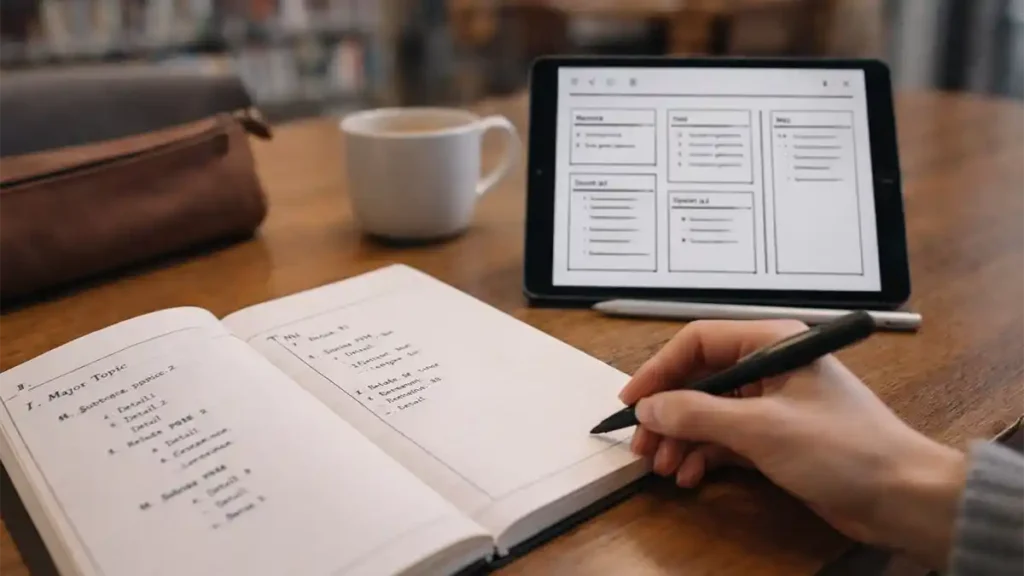
Method 2: Outline Note-Taking Method (Fast, Clean, Writing-Friendly)
Best for: history, literature, law, business, sociology, long lectures
Why it works: it mirrors how information is organized
Outline structure
- I. Main topic
- A. Key point
- Supporting detail
- Example
- B. Next key point
- A. Key point
Example (History: Causes of a Conflict)
- I. Long-term causes
- A. Economic pressure
- B. Political alliances
- C. Social tensions
- II. Trigger event
- III. Escalation and response
- IV. Outcomes and consequences
How to make outlining better
Add micro-labels in brackets:
- [Definition]
- [Example]
- [Cause]
- [Effect]These tiny labels help when revising because you instantly see the role of each line.
Best upgrade
After class, turn each main heading into a question:
- “What caused X?”
- “How did Y change over time?”
This turns an outline into a test tool.
Method 3: Mind Mapping Notes (Best for Connections and Big Picture)
Best for: biology systems, marketing, strategy, creative topics, language themes
Why it works: it shows relationships instead of only lists
How to build a mind map
- Put the main topic in the center.
- Create big branches for major categories.
- Add smaller branches for details and examples.
- Draw links where ideas influence each other.
Example (Biology: Immune System)
Center: Immune System
Branches:
- Innate defense (barriers, inflammation)
- Adaptive defense (T cells, B cells)
- Antibodies
- Vaccines and memory cells
- Common disorders
Add links:
- Vaccines -> memory cells -> faster secondary response
- Inflammation -> signals immune activity -> swelling and heat
When mind maps shine
Mind maps are excellent after a lecture when you want to “see the chapter” on one page. They also help before writing essays or presentations because the structure is visible.
Common mistake
Trying to mind map in a fast lecture can get messy. If the speaker moves quickly, capture first (sentence or Cornell), then create the mind map as a second pass.
Method 4: Charting Method Notes (Perfect for Comparisons)
Best for: economics, biology classification, law cases, business models, grammar rules
Why it works: it organizes information into categories instantly
Chart example (Economics: Market Structures)
| Type | Firms | Product | Pricing power | Example |
|---|---|---|---|---|
| Perfect competition | Many | Similar | Low | basic crops |
| Monopolistic competition | Many | Differentiated | Medium | cafes |
| Oligopoly | Few | Varies | High | telecom |
| Monopoly | One | Unique | Very high | utilities |
How to use charting during class
Set up the columns before the lecture begins. Then you only fill cells as information appears. This keeps you focused and prevents long paragraphs.
Best upgrade
Add a final row: “Exam-style comparison question.” Write one question that forces you to compare two columns. That single line can drive your revision later.
Method 5: Sentence Method Notes (For Speed When Everything Moves Fast)
Best for: guest lectures, unfamiliar topics, fast teachers
Why it works: it captures ideas without slowing you down
How it looks
Write each idea on a new line as a short, clear statement:
- Photosynthesis occurs mainly in chloroplasts.
- Light reactions produce ATP and NADPH.
- The Calvin cycle uses CO2 to build sugars.
The key rule
Do not treat sentence notes as the final product. They are your raw capture layer.
Upgrade in 10 minutes
After class:
- group related sentences under headings
- underline definitions and examples
- add 3 to 5 cue questions
This turns fast notes into structured notes.
Method 6: Boxing Method (Modern and Excellent for Technical Subjects)
Best for: math, physics, chemistry, programming, medical facts
Why it works: it separates concepts into clean, reviewable blocks
Boxing template
Concept name
- Definition
- Steps or rules
- Example
- Common mistakes
- Quick self-test
Example (Math: Quadratic Formula)
Quadratic formula
- Use when equation is ax^2 + bx + c = 0
- Formula: x = (-b +/- sqrt(b^2 – 4ac)) / (2a)
- Example with numbers
- Common mistake: sign errors and wrong substitution
- Self-test: solve one fresh problem without looking
Boxing keeps your notes readable and study-ready. It is especially strong when combined with worked examples.
Method 7: Flow Notes (Best for Processes, Systems, and Cause-Effect)
Best for: science processes, algorithms, business workflows, political systems
Why it works: it shows sequence and logic clearly
Example (Project workflow)
Goal -> requirements -> plan -> tasks -> execution -> review -> improvement
Make flow notes smarter
Add decision points:
- “If X happens, do Y.”
- “If result is negative, repeat step 2.”
This approach is powerful for coding logic, lab procedures, and troubleshooting systems.
Best Method by Subject: Practical Playbooks
If you want a simple answer for each subject type, use these combinations.
Math and Physics
- Boxing for formulas and examples
- Flow notes for problem steps
- Short summary lines for patterns and traps
Chemistry
- Flow notes for reaction steps
- Charting for properties and comparisons
- Cornell cues for theory and definitions
Biology
- Mind maps for systems and relationships
- Cornell for definitions and mechanisms
- Charts for classification (cells, organs, diseases)
History and Politics
- Outline notes for timeline and structure
- Cornell cues for revision
- Charts for comparing eras, leaders, or policies
Literature and Humanities
- Outline for themes and arguments
- Cornell for quotes, interpretations, and context
- A one-page chapter summary before essays
Business and Economics
- Charting for models and comparisons
- Mind maps for strategy and frameworks
- Cornell cues for exam practice
Languages
- Cornell for grammar rules and examples
- Boxing for vocabulary sets (word, meaning, example sentence)
- Reviews using spaced repetition study for long-term retention
Computer Science
- Flow notes for algorithms and program logic
- Boxing for concepts (data structures, syntax rules, patterns)
- Cornell prompts for explaining ideas in your own words
Paper vs Digital: How to Choose Without Overthinking
The best format is the one that fits your habits and reduces friction.
Paper advantages
- fewer distractions
- easier sketching and spatial memory
- often encourages summarizing instead of copying
Digital advantages
- search and quick organization
- easy templates and reuse
- fast linking between topics
If you use digital note-taking apps, focus on features that improve learning:
- quick headings and templates
- linking related pages
- tag systems for topics
- easy export or printing for revision
A strong hybrid approach:
- capture during class in the format that keeps you focused
- consolidate weekly into clean summaries (digital or paper)
Upgrade Any Notes Into a Study Engine (Active Recall + Spaced Repetition)
This is the part many students skip, and it is the difference between “notes exist” and “notes work.”
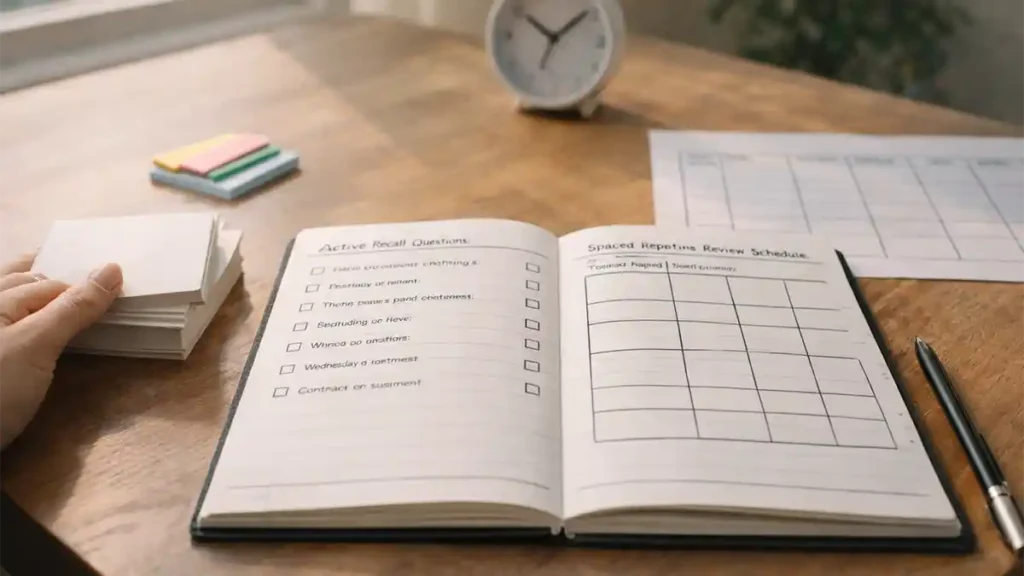
Active recall notes: the rule
If your notes do not ask you questions, you will likely reread them passively. Passive rereading feels productive, but it often produces weak recall under exam pressure.
Add prompts such as:
- “Explain this in two sentences.”
- “What causes this?”
- “What is the difference between A and B?”
- “Solve one new example.”
Spaced repetition study: a realistic schedule
- Day 1: take notes
- Day 2: answer your cue questions
- Day 7: test again and fix weak points
- Day 14: review summaries and do practice problems
- Before exams: full recall sessions
This is simple, flexible, and easy to maintain.
A fast conversion method (5 minutes per topic)
Take one section of notes and create:
- 3 recall questions
- 1 “teach it” mini explanation
- 1 example problem or real-world application
That is enough to make revision effective.
Clean Notes That Stay Useful: Modern Formatting Rules
You do not need fancy design. You need consistent signals.
Use:
- short headings
- white space between ideas
- simple labels: Definition, Example, Steps, Mistake
- a short summary at the end of each page
- a short list called “Exam triggers” (the 3 to 5 items most likely to appear)
This keeps notes readable on a phone, a laptop, or a printed page.
Common Mistakes and Quick Fixes
Mistake 1: Copying too much
Fix: write keywords plus a short explanation and one example.
Mistake 2: Notes that only make sense the same day
Fix: add a one-line summary and define new terms immediately.
Mistake 3: No revision plan
Fix: schedule a 10-minute clarification window within 24 hours.
Mistake 4: No testing
Fix: add questions in the margin or cue column and answer them without looking.
Mistake 5: Mixed topics on one page
Fix: one page per topic or clear section breaks with headings.
Quick FAQ
1. What is the best all-purpose note-taking method?
Cornell note-taking is the most versatile because it organizes content and builds recall prompts into the page.
2. Which method works best for fast lectures?
Use sentence method notes to capture ideas quickly, then convert them into Cornell or outline notes after class.
3. Are mind maps good for exams?
Yes, especially for understanding connections. Add recall questions to make mind maps exam-ready.
4. What should I use for math and science problems?
Boxing for formulas and examples, plus flow notes for step-by-step procedures.
5. How do I stop forgetting what I write?
Turn notes into questions and practice retrieving answers. That is the core of active recall.
6. How often should I review notes?
Use spaced repetition: a short review the next day, then again a week later, then again after two weeks.
7. Are digital notes better than paper notes?
Both can work. Digital note-taking apps help with search and organization; paper can improve focus and summarizing.
8. How long should a good set of notes be?
Long enough to explain the topic clearly, short enough to review quickly. Aim for key ideas plus examples, not transcripts.
Conclusion
The best notes are not the longest notes. They are the notes that help you think, remember, and perform.
Use this simple strategy:
- Choose a structure that matches the subject (Cornell, outline, mind map, chart, boxing, or flow).
- Clarify your notes within 24 hours so they stay understandable.
- Add questions and practice so your notes become active recall notes.
- Review using spaced repetition study so memory builds over time.
With the right method, any subject becomes more manageable, revision becomes shorter, and confidence rises because you are studying smarter, not just longer.