Education News Today: Key Updates Students Should Know

Education News Today is moving fast–AI in classrooms, tighter study-abroad rules, shifting loan policies, and new skills demands. Here’s what matters and what to do next.
Education News Today isn’t just “news” anymore it’s a survival guide for students. Rules change mid-year, new tools appear mid-semester, and what employers want can shift between your first lecture and your final exam. If you’ve ever felt like you’re studying on a moving train, you’re not imagining it.
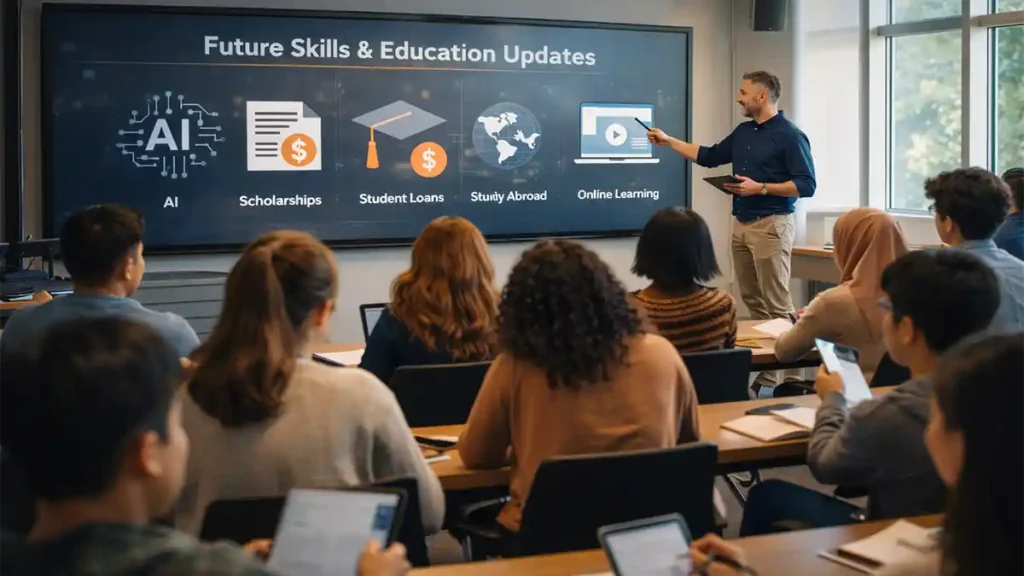
Right now (late 2025 heading into 2026), the biggest shifts are happening in five areas:
- AI is entering classrooms as a subject and a study tool
- Education costs and funding rules are tightening and changing
- Study-abroad policies are evolving (sometimes fast)
- Credentials are expanding beyond traditional degrees
- Skills and proof of skills, matter more than ever
This article breaks down the most important education developments students should know, explains why they matter, and gives you a simple action plan you can apply today.
The big picture: access is improving… but the gap is still huge
Before we zoom into “today’s updates,” it helps to understand the reality underneath them: education is expanding globally, but it’s not expanding evenly.
UNESCO’s Global Education Monitoring (GEM) data estimates that 272 million children and youth were out of school in 2023 and the number has barely improved since the SDG4 education goal was adopted in 2015. The same dataset highlights how sharply inequality shows up: about 36% of learners are out of school in the poorest countries, compared with around 3% in the richest.
Funding is a major reason. UNESCO also points to chronic underinvestment: 4 in 10 countries spend below key education financing benchmarks, and the per-learner gap is staggering about $55 per learner in low-income countries versus $8,543 in high-income countries (2022 figures cited in UNESCO/World Bank Education Finance Watch coverage).
Why should students care about these “big global stats”?
Because they shape what governments prioritize next: skills that match jobs, cheaper training routes, scalable digital learning, and “proof” of outcomes. That’s why you’re seeing growth in AI curricula, micro-credentials, tighter loan rules, and more scrutiny around international student flows.
Update #1: AI is becoming a standard part of education (and not just as a tool)
A few years ago, AI in education meant “a chatbot helps you study.” Now, many systems are moving toward AI literacy as core knowledge, similar to basic computing.
AI literacy is shifting from “nice to have” to “expected”
UNESCO has consistently emphasized that AI in education is not only about using tools, but also about understanding risks, ethics, inclusion, data privacy, and how AI can mislead and it provides guidance for policymakers on balancing opportunities and risks (updated in 2025).
Real-world example: national AI curricula are rolling out
Saudi Arabia is a strong example of this “AI becomes mainstream” direction. Reporting based on state news agency information describes plans to introduce AI learning units across stages of general education starting in the 2025/2026 academic year, using age-appropriate, interactive methods and integrating outcomes into evaluation systems.
In India, education coverage has highlighted curriculum moves such as developing dedicated AI learning resources for senior secondary students and broader policy discussions about integrating AI in teaching and learning.
What students should do (practical and non-robotic)
Instead of “learn AI,” think: learn how to work in an AI world without getting trapped by it.
Build your personal AI literacy toolkit:
- Know what AI is good at (summaries, practice questions, explanations in multiple styles) and what it’s weak at (facts without sources, current events, citations, math mistakes, hallucinations).
- Use AI for process, not for submission. Draft outlines, generate quiz questions, explain concepts then write your own work.
- Treat AI output like a confident classmate, not a textbook. Verify anything factual with reliable sources.
- Learn the “ethics basics”: plagiarism rules, disclosure expectations, and data privacy (don’t paste personal IDs, private documents, or exam content into random tools).
If your school is unclear on rules: ask for written guidance. AI policies are evolving, and ambiguity can put students at risk.
Update #2: Degrees still matter, but outcomes and affordability are under pressure
If there’s one theme that connects education news across countries, it’s this: students want value, and governments want outcomes.
OECD’s Education at a Glance 2025 puts tertiary education under the microscope attainment, completion rates, labor outcomes, and equity. One headline that should grab students: inequality isn’t subtle. Across the OECD, only about 26% of young adults whose parents did not complete upper secondary education hold a tertiary qualification, compared with around 70% of young adults with at least one tertiary-educated parent.
Completion also matters more than ever. OECD data highlights that on average only 43% of entrants to bachelor’s programs graduate within the expected duration; completion improves over time, but the “on-time” gap is real.
What this means in student life
- Schools and governments are increasingly focused on completion, employability, and measurable skills.
- Students will see more:
- career-aligned tracks
- industry partnerships
- internships baked into degrees
- pressure to choose “employable” majors
- alternatives like certificates and short programs
This doesn’t mean you should pick a major only for money. It means you should add skill proof alongside your degree.

Update #3: Student money news is changing fast (aid, loans, repayment rules)
This is where “Education News Today” impacts students immediately because one policy update can change what you pay next term.
A) United States: FAFSA timelines and aid rules
For U.S.-bound students (or students advising relatives abroad), FAFSA remains a key gateway to federal aid. The U.S. Department of Education’s Federal Student Aid (FSA) updates included timelines for the 2025–26 FAFSA release approach and processing.
Deadlines depend on federal, state, and school rules, and the official FAFSA deadline guidance is published by Federal Student Aid.
What to do:
- Create your FSA ID early.
- File as soon as your window opens (earlier filing often improves state/school aid chances).
- Keep a folder for tax documents and confirmations.
- Verify deadlines at your target institution(s), not just general timelines.
B) Pell Grants: changes are being discussed for 2026
Education finance reporting has highlighted proposed changes to the U.S. Pell Grant program starting July 1, 2026, including adjustments to eligibility and expansion toward some short-term workforce programs. Policies like this can materially change who qualifies and how much students receive.
Student takeaway: if you’re planning U.S. study in 2026, treat funding as a “living plan.” Re-check eligibility rules close to enrollment.
C) Student loan repayment policies: watch official updates closely
Loan repayment rules can shift quickly. Late-2025 reporting described changes to certain income-based repayment eligibility mechanics and the resumption of stronger collections actions for defaulted borrowers beginning in early 2026.
(If this affects you, always confirm details on official government portals before acting.)
Practical checklist if you have loans:
- Know your repayment plan type (and whether switching is allowed).
- Set up autopay if you can.
- If you’re behind: contact the servicer early don’t wait for penalties.
- Keep copies of every payment and notice.
D) United Kingdom: repayment thresholds updated (Plan 2 and Plan 3)
In the UK, the government confirmed updated repayment thresholds for Plan 2 and Plan 3 loans, including £29,385 (Plan 2 threshold for April 2026) and £21,000 for Plan 3 from April 2026.
Broader reporting has discussed the political and cost-of-living implications of threshold freezes in later years.
Student takeaway: know your plan type and thresholds repayments can start at lower incomes than students expect, and interest thresholds matter too.
Update #4: Study abroad rules are tightening in some countries (but opportunities still exist)
Studying abroad remains one of the best “life upgrade” moves for many students but it is increasingly shaped by policy caps, housing pressures, and labor market planning.
Example: Canada’s international student cap and allocations
Canada’s immigration authorities published details on allocations under an international student cap, including that 309,670 study permit application spaces would be available for certain cohorts in 2026, along with targets for total permits and exemptions for specific groups (including master’s/doctoral students at public DLIs starting January 1, 2026).
What students should do if considering Canada:
- Apply earlier than you think you need to.
- Track provincial rules (because allocation and attestation requirements can vary).
- Keep backup destinations ready.
- Confirm that your institution is a recognized DLI and understand attestation letter requirements if they apply to your program.
Big idea: “study abroad” is now a strategy, not just a dream
Students who succeed abroad often treat it like a project:
- Plan A: your preferred country/program
- Plan B: similar quality, faster processing
- Plan C: a hybrid route (local first year + transfer; or online + final year on campus)
And always: verify visa policy on official government sites (not random TikTok clips).
Update #5: Scholarships are expanding but competition and scams are too
Scholarships aren’t only about merit anymore. Many systems are increasing:
- need-based aid
- targeted scholarships (STEM, teaching, healthcare, climate, AI)
- mobility scholarships
- research fellowships
Example: Pakistan students tracking official scholarship announcements
For Pakistani students, the Higher Education Commission (HEC) maintains official announcement pages for scholarships and opportunities. That “official source habit” matters, because it reduces scam risk and keeps you updated without relying on forwarded messages.
Scholarship strategy that actually works:
- Create a “Scholarship Master CV” (everything you’ve done).
- Create a “Clean CV” (one page, role-focused).
- Build a portfolio folder (transcripts, ID, recommendation templates, certificates).
- Apply in batches: 5–10 scholarships per month beats waiting for “the perfect one.”
Red flag checklist (avoid scams):
- asks for payment to “confirm” a scholarship
- requires WhatsApp-only communication
- no official domain email
- pressure tactics (“last chance in 2 hours”)
- vague eligibility + unclear institution details
Update #6: Online learning is maturing and employers want proof, not promises
“Online learning trends” are no longer about whether online education is real. The question now is: can you prove what you can do?
This is why micro-credentials, short programs, and blended learning keep growing. It also explains why governments and institutions focus on “skills pipelines,” especially in tech, healthcare, and industry-aligned fields.
OECD’s Education Policy Outlook 2025 emphasizes lifelong learning as a strategic priority as digitalization and demographic shifts change how people learn across life stages.
What students should do (simple, effective)
Whether you’re in school, college, or university, build a Proof Stack:
- 1 project you can show (website, report, research poster, app, design, case study)
- 1 certification that adds credibility (relevant, not random)
- 1 public profile (LinkedIn or portfolio page)
- 1 recommendation from a teacher/employer/mentor
A degree + proof stack = a stronger story in interviews.
Update #7: Education is being redesigned around “skills + safety + wellbeing”
While finance and AI dominate headlines, many education systems are also dealing with:
- academic pressure and mental health
- classroom safety and bullying
- online harms and misinformation
- equity for disadvantaged learners
UNESCO’s reporting around access and financing repeatedly highlights how inequality limits opportunity, and why policy choices matter for inclusion.
Student takeaway: your wellbeing is not separate from success. Treat sleep, planning, and support systems like “academic tools,” not optional extras.
“Education News Today” action plan: what students should do this week
Here’s a clean checklist you can literally follow:
1) Create your Personal Education Dashboard (30 minutes)
Make one doc or note with:
- your program deadlines
- exam dates
- scholarship deadlines
- loan/fee due dates
- visa steps (if studying abroad)
- links to official portals
2) Build a reliable news diet (15 minutes)
Follow official sources first, then reputable reporting:
- your education ministry / department
- your university announcements page
- major education agencies
- reputable global orgs (UNESCO/OECD)
3) Audit your money plan (45 minutes)
List:
- tuition + fees
- housing
- transport
- books/software
- emergency buffer
Then add:
- scholarships you can apply for in the next 30 days
- part-time options (if legal and realistic)
4) Set AI rules for yourself (10 minutes)
Write your personal policy:
- “AI can help me study, but I will not submit AI-written work.”
- “I will verify facts and cite real sources.”
- “I won’t upload personal documents into unknown tools.”
5) Build one portfolio item (start today)
Pick one:
- a 2-page research summary
- a data dashboard
- a short tutorial video
- a mini case study on a topic you’re learning
Small wins compound.
What to watch next (2026 signals students should track)
If you want to stay ahead, keep an eye on:
- AI curriculum expansion and assessment changes
- scholarship eligibility updates and deadlines
- student visa caps, attestation requirements, and processing priorities
- repayment thresholds and loan policy updates (country-specific)
- debates on affordability and completion outcomes
Conclusion: education news is a tool use it like one
Education News Today can feel noisy, stressful, even overwhelming. But if you treat it like a tool not a stream you’ll get real advantages.
The students who win in 2026 won’t necessarily be the ones with the “perfect” major or the “best” university name. They’ll be the ones who:
- adapt quickly without panicking,
- verify information before acting,
- build skills with proof,
- protect their finances,
- and use new tools (like AI) responsibly.






7 Comments