Founding Day vs Saudi National Day: What’s the Difference, Simple Guide
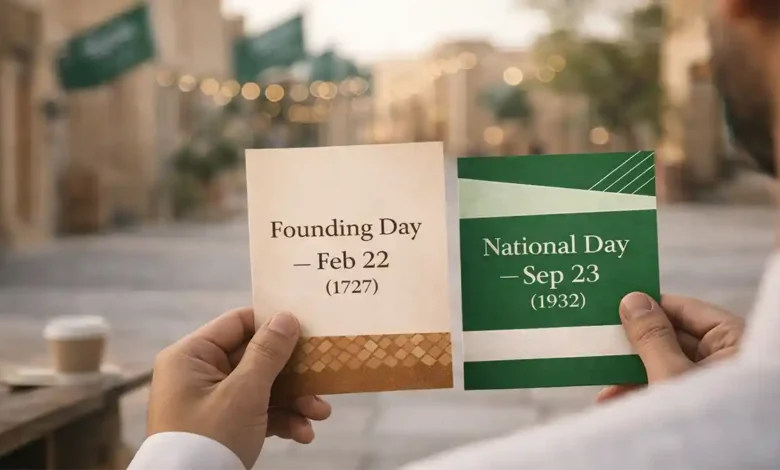
Founding Day vs Saudi National Day can sound like one topic with two labels especially if you’re new to Saudi history or you’re used to countries having a single big national day. In Saudi Arabia, these two occasions serve different purposes. They honor two separate milestones that shape Saudi identity: where the Saudi state began and how the modern Kingdom took its final unified form.
This is why you’ll see two key dates every year:
- February 22 (Founding Day)
- September 23 (Saudi National Day)
Both matter. Both are official occasions. Yet they highlight distinct moments in time, different leaders, and different historical themes.
This guide breaks everything down in plain, accessible English without oversimplifying the story. You’ll learn:
- What each holiday actually commemorates
- The easiest way to remember the difference
- Why Saudi Arabia values both roots and unity
- How celebrations often feel different in tone
- How to describe each day correctly in writing, school projects, or social posts
The Simple Answer in One Minute
Here’s the clearest way to understand it:
Founding Day (February 22) = Origins
Founding Day commemorates the beginning of the Saudi state in 1727, associated with Imam Muhammad bin Saud and early state building centered in Diriyah. It’s about the starting point of Saudi political identity its early foundation.
Saudi National Day (September 23) = Unification and modern nationhood
Saudi National Day commemorates 1932, when King Abdulaziz declared the unification of the country under the name Kingdom of Saudi Arabia. It’s about the formation of the modern Kingdom as one nation under one name.
Memory trick:
- Founding Day = the first chapter
- National Day = the modern Kingdom’s turning point
Why People Mix Them Up
The confusion usually comes from a reasonable assumption: many countries have one major holiday that covers independence, unification, or state formation. Saudi Arabia’s approach is more layered, because the Kingdom officially recognizes:
- Deep historical beginnings (the earliest Saudi state)
- Modern national consolidation (the unified Kingdom declared in 1932)
That’s not redundancy. It’s a way of honoring a longer timeline one that connects heritage with the modern state.
What Is Saudi Founding Day?
The core meaning (in plain English)
Founding Day marks the historical start of Saudi statehood, linked to the founding period of the First Saudi State in 1727. It emphasizes origins, governance, and the early formation of political authority in central Arabia, with Diriyah as a major historical reference point.
Why 1727 matters
If you only look at the modern Kingdom’s date (1932), you miss something important: Saudi identity isn’t presented as new. Founding Day underlines that Saudi statehood has a deeper history that stretches back centuries.
A quick number makes this easier to feel:
From 1727 to 1932 is 205 years.
That gap alone tells you Founding Day is not a second version of National Day. It points to a separate era.
What Founding Day highlights
Founding Day typically centers on themes like:
- historical continuity
- early leadership and governance
- cultural heritage and national roots
- the idea that Saudi identity has depth and long memory
You’ll often notice a heritage forward tone in public messaging, cultural programming, and visuals more historic than modern celebration.
What Is Saudi National Day?
The core meaning (in plain English)
Saudi National Day commemorates the proclamation of the unified modern Kingdom under the name Kingdom of Saudi Arabia in 1932, associated with King Abdulaziz. It celebrates the unification of regions and the formation of a single national state under one banner and name.
Why 1932 matters
National Day reflects a modern national milestone: the Kingdom’s official unification and naming. It’s a powerful nationhood moment, because it represents:
- one national identity
- one recognized state structure
- a unified political entity known today as Saudi Arabia
What National Day highlights
National Day usually focuses on themes like:
- unity and national pride
- modern national identity
- collective achievement and belonging
- national symbols and public celebration energy
The mood often feels big, outward, and nationwide.
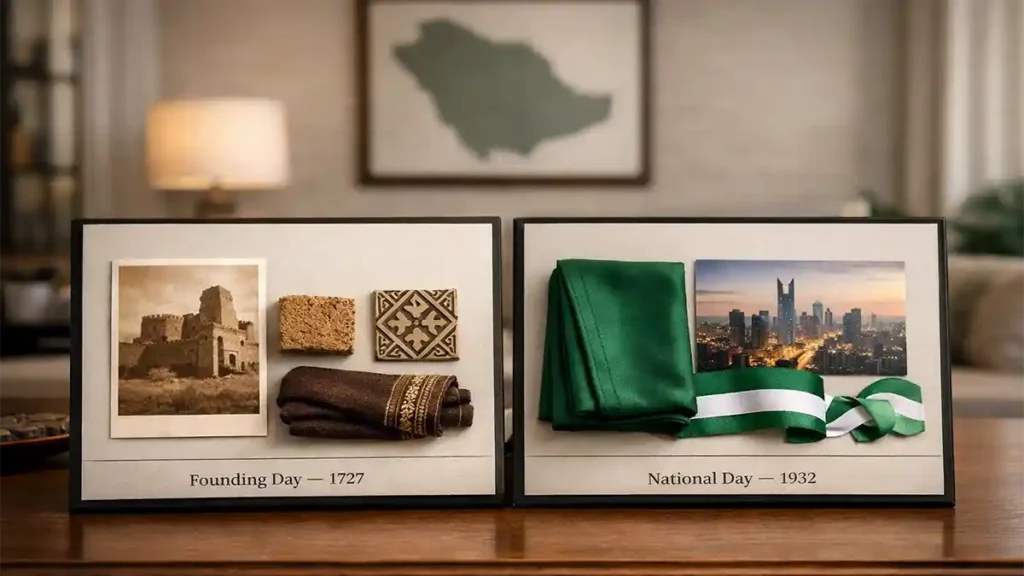
Founding Day vs Saudi National Day: The Key Differences
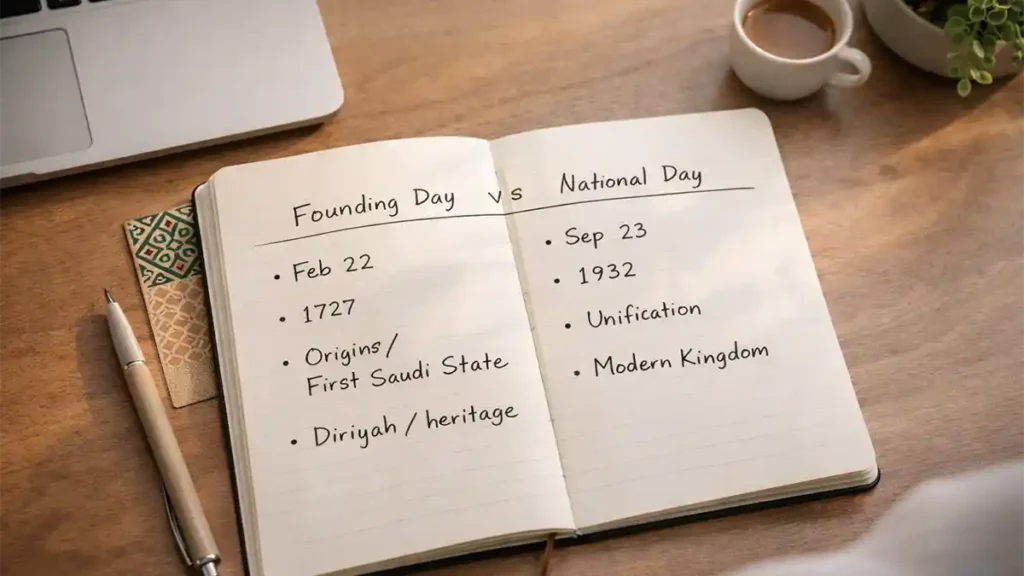
Here’s a clean comparison you can screenshot and keep:
1. Date
- Founding Day: February 22
- Saudi National Day: September 23
2. Historical year being commemorated
- Founding Day: 1727
- Saudi National Day: 1932
3. What the day celebrates
- Founding Day: the beginning of Saudi statehood (origins and early foundation)
- National Day: the unification and naming of the modern Kingdom
4. Historical figures most associated
- Founding Day: Imam Muhammad bin Saud
- National Day: King Abdulaziz
5. The big idea
- Founding Day: roots, heritage, early state building
- National Day: unity, modern nationhood, national identity
If you can explain those five points clearly, you understand the difference better than most casual conversations ever cover.
The Timeline That Connects Both Days
A simple timeline prevents confusion:
- 1727 – early formation of Saudi statehood is commemorated on Founding Day
- 1932 – the modern Kingdom is declared unified under the name Kingdom of Saudi Arabia, commemorated on National Day
So, the two holidays work together. One points to the foundation of state identity; the other points to the completed unification of the modern nation state.


How Celebrations Often Feel Different
Celebrations can vary from year to year, but many people notice a difference in tone.
Founding Day: a heritage mood
Founding Day often leans toward:
- cultural heritage storytelling
- traditional clothing styles and historic visuals
- festivals that showcase crafts, music, and traditional identity
- a roots first atmosphere
It’s the kind of holiday where you’ll see more emphasis on history, memory, and national depth.
National Day: a nationwide celebration mood
Saudi National Day often leans toward:
- large public events
- city decorations and broad national participation
- celebrations tied to unity and national pride
- a modern, public facing energy
It’s commonly experienced as a countrywide celebration where national symbolism is front and center.
A simple way to describe the difference:
- Founding Day feels like heritage and identity being honored.
- National Day feels like unity and nationhood being celebrated.
How to Use the Right Words (So Your Writing Sounds Accurate)
If you’re writing an article, a school assignment, a brand post, or even a caption, the wrong phrasing can make your content feel sloppy. Here’s how to stay precise.
Best language for Founding Day
Use terms like:
- origins
- foundation of statehood
- early Saudi state
- heritage
- Diriyah (when relevant)
- historic identity
Avoid presenting it as independence day. That framing doesn’t match what the holiday is about.
Best language for Saudi National Day
Use terms like:
- unification
- proclamation
- national unity
- formation of the modern Kingdom
- modern nationhood
- Kingdom declared under one name
Avoid describing National Day as the beginning of Saudi history. It is a major modern milestone, not the earliest historical starting point.
Why Saudi Arabia Celebrates Both (And Why It Makes Sense)
Some people ask, Why not just celebrate National Day and call it a day? The answer is simple: these holidays communicate two different messages about identity.
Message 1: We have deep roots
Founding Day sends a strong signal: Saudi identity isn’t a recent invention. It highlights historical continuity and early governance an origin story that extends beyond modern state borders.
This matters because national identity is not only about today’s institutions. It’s also about shared memory, cultural pride, and historical depth.
Message 2: We are one modern nation
National Day sends a different signal: the modern Kingdom became unified under one name in 1932, and that unity remains a core national theme.
Both messages can be true at the same time because they describe different layers of the same national story.
A Practical Case Study: How Schools, Brands, and Communities Usually Approach Each Day
You don’t need insider access to notice a clear pattern in how institutions treat these occasions.
Founding Day content tends to focus on:
- heritage visuals
- historical education
- traditional motifs
- storytelling about origins and early leadership
- museums, cultural districts, and historical references
National Day content tends to focus on:
- unity language and national pride
- modern national symbols
- public celebrations and large events
- messages about collective progress and belonging
- a shared national mood across cities and communities
Why this matters for content creators:
When you match the day’s theme, your writing feels natural. When you blur them, your audience can sense the mismatch even if they don’t correct you directly.
Travel and Lifestyle Angle: What Visitors Often Experience
If you’re an expat, tourist, or someone planning a trip, both holidays can be memorable, but they can feel different.
If you’re in Saudi Arabia around Founding Day
You may see:
- heritage festivals and cultural programs
- a focus on traditional artistry and identity
- historical storytelling through exhibits and performances
If you enjoy culture, museums, and traditional arts, Founding Day can be an excellent time to explore heritage centered experiences.
If you’re in Saudi Arabia around National Day
You may see:
- more public crowds in central celebration areas
- citywide decoration
- bigger public shows and national pride displays
If you like large scale celebrations and a national festival atmosphere, National Day often delivers that energy.
Common Misunderstandings (Cleared Up Simply)
Misunderstanding 1: They celebrate the same event.
They don’t. Founding Day is tied to 1727 and origins of statehood; National Day is tied to 1932 and the modern Kingdom’s unification and naming.
Misunderstanding 2: Founding Day replaces National Day.
Both are observed for different reasons. Founding Day adds historical depth; National Day anchors modern nationhood.
Misunderstanding 3: National Day is about one single battle.
National Day is best understood as a state milestone: unification and proclamation of the Kingdom under one name, rather than a single isolated event.
Misunderstanding 4: Founding Day is only about one place.
Diriyah is a key symbol in the Founding Day narrative, but the occasion speaks to broader national identity and origins of statehood, not tourism alone.
How to Explain It to Anyone (A Ready to Use Script)
If someone asks you the difference and you want a clean answer, say:
Founding Day (Feb 22) honors the origins of Saudi statehood tied to 1727 and early leadership in Diriyah. Saudi National Day (Sep 23) honors the unification and naming of the modern Kingdom in 1932 under King Abdulaziz. One is about roots; the other is about unity.
That explanation is accurate, simple, and clear.
Deeper Meaning: What These Holidays Say About National Identity
National holidays are not only dates on a calendar. They shape how a nation talks about itself.
Founding Day: identity through history
Founding Day emphasizes continuity. It tells a story of origins, governance, and long standing national identity. It strengthens the idea that Saudi society has deep foundations that deserve recognition.
National Day: identity through unity
National Day emphasizes the modern Kingdom as one unified nation under one name. It strengthens the shared feeling of national belonging and collective identity.
Put together, they express a balanced identity:
- History and heritage
- Unity and modern nationhood
That pairing is part of what makes Saudi national occasions distinct.
Content Creator Notes (For Bloggers and Editors)
If you’re writing for WordPress (especially for SEO), you can create strong, fresh angles without repeating the same ideas.
High CTR angle ideas for Founding Day
- Founding Day explained: why 1727 matters today
- Diriyah and Saudi origins: a simple history guide
- Founding Day symbols and heritage themes: what they mean
High CTR angle ideas for National Day
- Saudi National Day explained: the meaning of 1932
- Why September 23 matters: unification and modern nationhood
- National Day celebrations: how unity is expressed today
Editorial tip:
Use examples (family celebrations, community events, cultural motifs) to keep the article human and relatable. It reads better than listing dates repeatedly.
Quick FAQ
Are Founding Day and Saudi National Day the same holiday?
No. Founding Day focuses on origins tied to 1727, while National Day focuses on the modern Kingdom’s unification and naming in 1932.
What date is Saudi Founding Day?
Founding Day is observed on February 22.
What date is Saudi National Day?
Saudi National Day is observed on September 23.
What does Founding Day commemorate?
It commemorates the early foundation of Saudi statehood and national roots, associated with the First Saudi State era and early leadership.
What does Saudi National Day commemorate?
It commemorates the proclamation of the unified modern Kingdom under the name Kingdom of Saudi Arabia in 1932.
Which day is more focused on heritage and tradition?
Founding Day generally leans more toward heritage themes, historic identity, and cultural storytelling.
Which day is more focused on national unity and modern nationhood?
National Day typically leans more toward unity, national pride, and a modern nationwide celebration mood.
What’s the easiest way to remember the difference?
Founding Day = roots (1727). National Day = unity (1932).
Conclusion
Founding Day vs Saudi National Day is not a which one is bigger question. It’s about understanding two different milestones that define Saudi identity across time.
- Founding Day (February 22) highlights the origins of Saudi statehood tied to 1727, emphasizing heritage and early foundations.
- Saudi National Day (September 23) highlights the unification and naming of the modern Kingdom in 1932, emphasizing unity and national identity today.
When you remember the difference in one line, everything becomes easy:
Founding Day celebrates the beginning of the Saudi state’s story. National Day celebrates the moment the modern Kingdom became one.