Study Tips That Work: Learn Faster Without Stress

Study tips that work aren’t about studying longer they’re about studying smarter, with less pressure and more progress. If you’ve ever stared at a page for an hour and remembered almost nothing, you’re not lazy or bad at studying. You’re simply using methods that feel productive (like rereading and highlighting) but don’t create strong memory.
Here’s the good news: the fastest learners usually aren’t geniuses. They use a few brain friendly strategies like active recall and spaced repetition and they protect their energy with simple routines. In this guide, you’ll get a complete, real life system you can use even if you’re busy, tired, or stressed.
Study tips that work start with one truth: your brain learns by retrieving
Most people treat studying like pouring information into the mind. But learning works more like building a path in a forest.
- Rereading is like walking around the forest holding a map.
- Retrieval (active recall) is actually walking the path again and again until it becomes easy.
Every time you pull information out of your memory (even imperfectly), you strengthen it. That’s why practice questions, flashcards, and teaching something out loud beat passive reading almost every time.
Study tips that work when you’re short on time
If you remember only one thing from this article, remember this:
Test yourself more than you review.
Even 10 minutes of self quizzing can beat 30 minutes of rereading.
Now let’s build a full system around that.
Why studying feels stressful (and how to fix it)
Stress often comes from three hidden problems:
1. You’re studying a lot, but not retaining
You put in time, but results don’t match effort. That creates panic and self doubt.
Fix: Switch from passive review to active recall and plan spaced repetition so you stop forgetting everything before exams.
2. Your plan is vague
Study biology tonight isn’t a plan it’s a wish. Vague plans cause procrastination because your brain doesn’t know where to start.
Fix: Plan in tasks, not time. Example:
✓ Do 20 practice questions on cell respiration and review mistakes.
3. You’re carrying mental clutter
Open tabs, phone notifications, messy desk, anxiety about deadlines your brain burns energy before you even begin.
Fix: Use a short starting ritual and a distraction boundary (you’ll learn both below).
The 3 step learning formula (simple, powerful, proven)
If you want learning that sticks, build your study around these three steps:
Step 1: Understand (first pass)
Goal: I get what this means.
This is where you read, watch, and take short notes briefly.
Step 2: Retrieve (real learning)
Goal: I can recall it without looking.
This is the core: self quizzes, flashcards, blurting, teaching, practice problems.
Step 3: Repeat over time (spaced repetition)
Goal: I still remember it next week, next month, and on exam day.
Short review sessions spaced across days beat one huge cram session.
Think of it like the gym:
- Understanding = learning the exercise
- Retrieval = doing the reps
- Spacing = training across weeks so strength stays
Active recall: the fastest way to learn (without extra hours)
Active recall means forcing your brain to produce the answer, not just recognize it.
Easy active recall methods you can start today
Choose one based on your subject:
1. Blurting (perfect for theory heavy topics)
- Read a small section (5–10 minutes).
- Close the book.
- Write everything you remember on a blank page.
- Open the book and correct in a different color.
This shows exactly what you know and what you think you know.
2. Question first reading (great for textbooks)
Before reading a chapter, ask:
- What will the exam likely ask from this?
- What are the key definitions, processes, and comparisons?
Then read with the goal of answering those questions.
3. Teach back (the explain it simply technique)
Explain a concept as if you’re teaching a younger student. If you get stuck, you’ve found your weak spot. That’s a win because now you know what to fix.
4. Practice problems (best for math, physics, accounting, coding)
Don’t watch 10 examples and do 1 question. Flip it:
- Watch 1 example
- Do 3–5 questions
- Check mistakes immediately
A quick mindset shift that removes stress
When you self test and struggle, you might feel like you’re failing. But that struggle is often the moment learning is happening.
Struggle during practice reduces stress during the real exam.
Spaced repetition: remember more with less effort
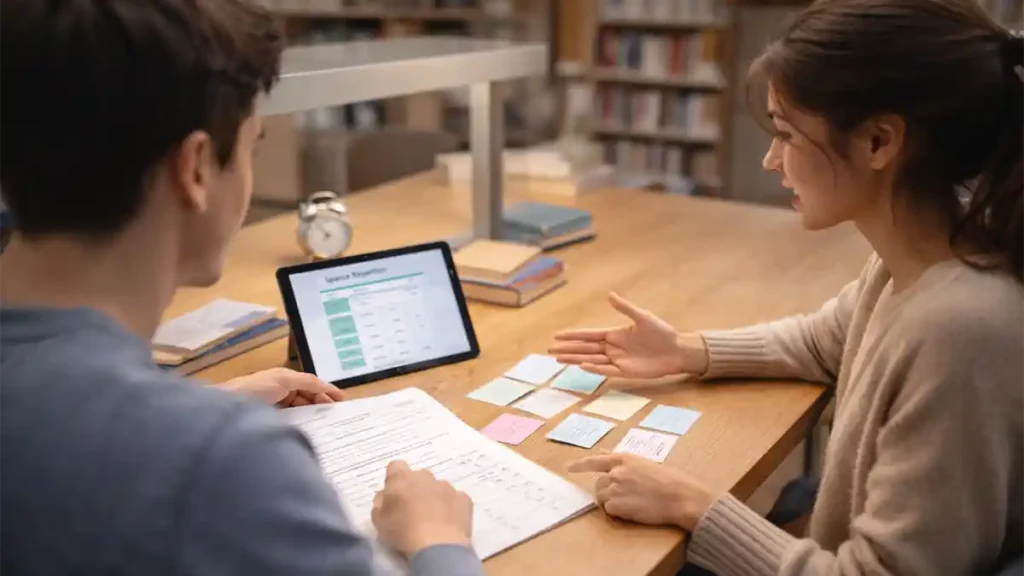
Spaced repetition is reviewing information at increasing intervals right before you’re about to forget it.
Why it works
Your brain is efficient. If you review something too soon, your brain says, We already know this. If you review too late, you’ve forgotten it completely.
Spacing hits the sweet spot: a little forgetting + a quick refresh = stronger memory.
A simple spaced repetition schedule (no apps required)
Use this for any topic you want to remember long term:
- Day 1: Learn + self test
- Day 3: Quick review + self test
- Day 7: Practice questions + fix weak spots
- Day 14: Mixed review
- Day 30: Final reinforcement
Even if you’re busy, keep reviews short (10–20 minutes). Consistency beats intensity.
Tools that make it easier (optional)
Apps like flashcard systems can automate spacing, but you can also do it with:
- A notebook review calendar
- A folder of flashcards
- A checklist in Notes/Notion/Google Keep
The tool doesn’t matter as much as the habit.
The Pomodoro technique (done the right way)
The Pomodoro technique is popular for a reason: it reduces overwhelm and makes starting easier.
Classic format:
- 25 minutes focus
- 5 minutes break
- After 4 rounds: 15–30 minute break
The upgrade: task based Pomodoro
Instead of study for 25 minutes, set a target:
- Finish 15 flashcards + write 5 difficult ones again
- Do 10 questions + review errors
- Summarize one lecture into 6 bullet points
This prevents the biggest Pomodoro trap: working for time without making progress.
Breaks that actually recharge you
Best break choices:
- Stand up + stretch
- Drink water
- Walk for 3–5 minutes
- Quick breathing reset
Avoid breaks that hijack attention (scrolling short videos), because they make it harder to restart.
Note taking methods that don’t waste time
Good notes are not pretty notes. Good notes are useful for recall.
The best rule for notes
Write notes that help you answer exam questions, not notes that look like a printed textbook.
3 note taking methods that work in real life
1. Cornell Notes (clean, structured)
- Right side: main notes
- Left side: questions and keywords
- Bottom: 3–5 line summary
Cornell notes are powerful because they naturally create active recall (the question column becomes your quiz).
2. The capture + compress method (fastest for busy students)
- Capture: Take simple notes during class (don’t overthink).
- Compress: Within 24 hours, rewrite into:
- 5–10 key bullets
- 3 likely exam questions
- 1 short explanation in your own words
That second step is where learning locks in.
3. Mind maps (best for big picture connections)
Mind maps help when topics connect across chapters like history timelines, biology systems, or business frameworks. Use them to see relationships, not to replace practice questions.
Time management for students: plan like a strategist, not a robot
Most students don’t fail because they lack time. They fail because time leaks through:
- unclear priorities
- weak routines
- fake studying
- last minute panic
The Weekly Map (15 minutes that saves hours)
Once a week, do this:
- List your deadlines (tests, assignments, presentations).
- Estimate effort honestly (small/medium/heavy).
- Block 3–5 study sessions for your hardest subject first.
- Keep 1 buffer session for surprises.
The Daily Top 3
Each day, choose three outcomes:
- One must do (highest impact)
- One should do
- One quick win
Example:
- Must: 30 mixed practice questions (biology)
- Should: Review flashcards (chemistry, 20 minutes)
- Quick win: Outline essay intro + headings (20 minutes)
You finish the day feeling in control not guilty.
How to read faster and remember more (without cramming)
If you’re reading and nothing sticks, it’s usually because you’re reading passively.
Use the Preview → Questions → Read → Recall loop
- Preview headings, charts, summaries
- Turn headings into questions
- Read to answer those questions
- Recall answers without looking
- Check and correct
This turns reading into an active mission instead of a slow blur.
A practical trick: shrink the chunk
Don’t read 10 pages and then test yourself. Read 1–2 pages, then recall. Smaller chunks = faster feedback = less forgetting.

Make studying feel easier by designing your environment
Your willpower is not endless. Your environment should do some of the work.
The study zone checklist (simple but powerful)
- One clear workspace
- Only the materials you need for this session
- Phone out of sight (or in another room if possible)
- A visible timer
- Water nearby
The distraction boundary
Before you start, write down:
- If I want to check my phone, I will do it at the next break.
- If I get a random thought, I will write it on a parking list.
This sounds small, but it protects focus.
Test anxiety reduction: calm your mind without losing performance
A little stress is normal. But anxiety becomes a problem when it steals recall and confidence.
The truth about anxiety and memory
When you’re anxious, your brain spends energy on threat signals (What if I fail?) instead of retrieval (What’s the answer?). The goal isn’t to eliminate nerves it’s to train your brain to perform with them.
Tools that work (fast and realistic)
1. Simulate exam pressure early
Once a week, do a mini mock test:
- timed
- no notes
- exam style questions
Familiarity reduces fear. Your brain stops treating the exam like a wild unknown.
2. Use a 60 second reset before studying (and before exams)
Try this breathing pattern:
- Inhale 4 seconds
- Hold 2 seconds
- Exhale 6 seconds
Repeat 4 times.
Longer exhales tell your nervous system: We’re safe.
3. Replace panic thoughts with a script
When your mind says: I’m going to forget everything, respond with:
- I trained recall. I know how to retrieve.
- I don’t need perfect just clear.
- One question at a time.
It’s not motivational fluff it’s mental direction.
The healthiest study hack is sleep (seriously)
If your sleep is broken, your studying will feel twice as hard.
Why sleep matters for learning
Sleep supports:
- memory consolidation (moving learning into long term storage)
- attention and reaction time
- emotional control (less panic, more patience)
If you want to learn faster without stress, protect your sleep like it’s part of your syllabus.
A student friendly sleep routine
- Keep a consistent wake time most days
- Stop heavy studying 30–60 minutes before bed
- Use a quick tomorrow plan so your brain stops worrying at night
- If you can’t sleep, do calm review (light flashcards) earlier not in bed
Nutrition and movement: small habits, big focus
You don’t need a perfect diet. You need stable energy.
Simple rules that help studying immediately
- Drink water (dehydration hurts focus)
- Eat a balanced meal before long sessions (protein + carbs + healthy fats)
- Don’t replace meals with caffeine
- Take short walks to reset attention
Even 10 minutes of movement can improve alertness and mood two things every student needs.
Common study myths that secretly waste your time
Let’s clear these quickly:
Myth 1: Highlighting means I’m learning
Highlighting can help mark important parts, but it rarely creates memory by itself.
Better: Highlight lightly, then turn highlights into questions.
Myth 2: Cramming works for me
Cramming can boost short term performance, but it usually increases stress and weakens long term retention.
Better: Start small earlier with spacing even 15 minutes/day.
Myth 3: I must feel confident to be ready
Confidence often comes after retrieval practice, not before it.
Better: Let your practice results guide you, not feelings.
A 7 day example plan (use this for any subject)
Here’s a realistic schedule that uses study tips that work without burning you out. Adjust times based on your life.
Day 1 (60–90 min)
- Understand core topic (short reading/lecture)
- Create 15–25 recall questions or flashcards
- Do one quick self test
Day 2 (30–45 min)
- Active recall: flashcards + blurting (focus on weak areas)
Day 3 (60 min)
- Practice questions / problems
- Error review: write why I missed it notes
Day 4 (30 min)
- Spaced review (mixed)
- Teach back: explain 2 concepts out loud
Day 5 (60–90 min)
- Timed mini mock test
- Review mistakes and convert them into flashcards
Day 6 (30–45 min)
- Light recall session + quick summary sheet
Day 7 (45–60 min)
- Mixed practice
- Final weakness cleanup
This plan looks simple, but it’s powerful because it repeats retrieval over time.
The low stress study routine you can follow daily
If you want a calm, repeatable routine, use this:
1. Start Ritual (2 minutes)
- Clear desk
- Open only what you need
- Set timer
- Write one goal for this session
2. Focus Block (25–40 minutes)
- Active recall or practice problems first
- Notes second (only for mistakes)
3. Review Block (10 minutes)
- Summarize what you learned
- List what you still don’t know
- Choose the next review date (spacing)
4. Stop Cleanly (2 minutes)
- Write the first task for your next session
This reduces procrastination because you’re not starting from zero next time.
Quick Study Tips That Work checklist (save this)
When you feel stuck, return to this list:
- ✓ Use active recall (self testing > rereading)
- ✓ Schedule spaced repetition (short reviews over days)
- ✓ Study in outcomes, not hours
- ✓ Use the Pomodoro technique with tasks
- ✓ Keep notes for recall, not decoration
- ✓ Do weekly mini mock tests to reduce anxiety
- ✓ Protect sleep and energy
- ✓ Make your environment distraction proof
Frequently Asked Questions
What are the best study tips to learn faster?
The best study tips include using a study plan, short focused sessions, revision, self-testing, and clear note-making.
How can I study without stress?
You can study without stress by breaking topics into smaller parts, taking breaks, and avoiding cramming.
How long should a study session be?
A study session should usually be 25 to 50 minutes, followed by a short break.
Is daily study better than cramming?
Yes, daily study is better because it improves memory and reduces exam pressure.
Do breaks help while studying?
Yes, short breaks help improve focus and reduce mental fatigue.
What is the best way to remember what I study?
The best way is to review regularly, explain concepts simply, and test yourself often.
Can study apps help students?
Yes, study apps can help with flashcards, time management, and practice quizzes.
How can I stay consistent with studying?
You can stay consistent by following a simple routine and setting small daily study goals.
Conclusion: Learn faster without stress by studying smarter
The goal isn’t to become a study machine. The goal is to become confident because you know your learning is real.
When you use study tips that work especially active recall and spaced repetition you stop guessing if you’re ready. You can prove it to yourself through practice. That removes stress in the most practical way possible: by replacing fear with evidence.
Start small today:
Pick one topic, create 10 recall questions, test yourself, and schedule a 10 minute review in two days.
That’s how calm, fast learning begins one smart session at a time.