Shipping China to Pakistan Explained: Air vs Sea vs Courier (Costs + Timelines)
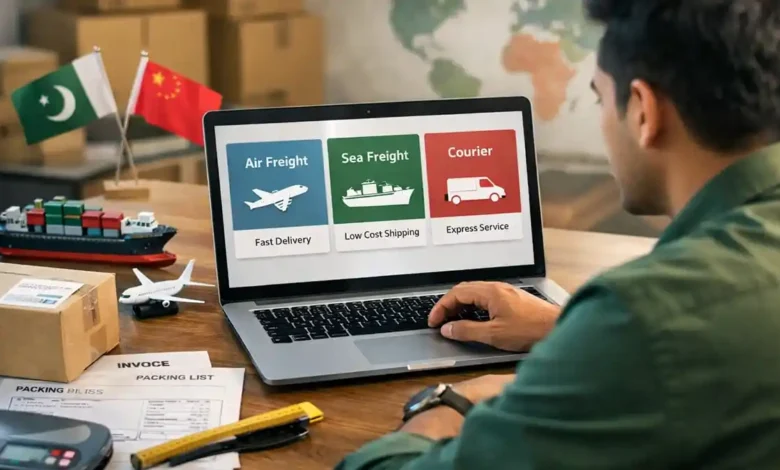
Shipping China to Pakistan is simple only on the surface. In reality, one shipment can be cheap but late, fast but overpriced, or door to door but full of surprise fees. If you are importing for a shop, an eCommerce store, a small factory, or even just ordering samples, the method you choose decides three outcomes:
- how soon your goods arrive,
- what you actually pay (not just the headline rate), and
- how smooth or painful customs clearance becomes.
This deep guide breaks down air vs sea vs courier in clear English, with real importer logic: how quotes are built, why prices change, what timelines look like in practice, and how to reduce delays without gambling. It is written for real routes like Shenzhen/Guangzhou/Yiwu/Shanghai into Karachi (and onward to Lahore/Islamabad).
One quick reality check: China is a dominant import source for Pakistan. Pakistan’s official trade analysis has cited China as the top import partner, with about 27% share of total imports in FY2023 24. That scale shapes the shipping ecosystem: more consolidators, more freight options, and intense seasonal swings.
1. The three shipping options (what you are actually buying)
A. Courier (express parcel)
Courier (DHL, FedEx, UPS and similar networks) is built for speed and convenience. In most cases, they pick up from the supplier, move the parcel through their own network, and deliver to your door with end-to end tracking. The trade off is cost per kg, especially when volumetric (dimensional) weight applies.
Best for:
- samples and prototypes
- small, urgent, high value items
- documents, spare parts, lightweight consumer items
B. Air freight (cargo)
Air freight is designed for cartons and commercial cargo that is too heavy (or too costly) for courier but still time sensitive. Typically, a freight forwarder manages the flow: pickup, export handling, airline booking, destination handling, customs clearance, and delivery.
Best for:
- restocking popular products fast
- medium weight shipments (cartons)
- businesses that need a 1 to 2 week cycle
C. Sea freight (container shipping)
Sea freight is the lowest unit cost option for heavy and bulky inventory. You either ship:
- LCL (Less than Container Load): shared container, priced per CBM (cubic meter) plus charges
- FCL (Full Container Load): a full container (20ft/40ft), priced per container plus local charges
Best for:
- bulk inventory and repeat imports
- factories, distributors, wholesalers
- any cargo where per unit profit depends on shipping cost control
2. The two measurements that control pricing: weight and volume
Most new importers focus on kg. Professionals focus on chargeable weight, which can be driven by volume.
Chargeable weight (why your 10 kg carton gets billed higher)
In air freight (and usually courier), the billed weight is the greater of:
- actual weight (scale weight), or
- volumetric weight (based on carton dimensions)
A common industry rule for air cargo is to calculate volumetric weight by dividing shipment volume in cubic centimeters by 6000.
Example:
Carton: 60 x 40 x 40 cm = 96,000 cm3
Volumetric weight: 96,000 / 6000 = 16 kg
Actual weight: 10 kg
Billed (chargeable) weight: 16 kg
This is not a scam. Airlines and express networks price space as well as mass.
Sea freight uses CBM (and density still matters)
For LCL, pricing is usually driven by CBM, then adjusted with minimums and local charges. Dense cargo often favors sea freight because volume cost becomes efficient at scale.
3. Timelines: what to expect in real life (not marketing promises)
Courier timelines (typical behavior)
Courier is usually the fastest door to door method for small shipments. Delivery times vary by service, city, and customs handling, but the network is optimized for speed and tracking.
Where courier loses time:
- customs holds (inspection, valuation queries, missing docs)
- restricted items (batteries, liquids, branded goods)
- remote delivery areas
Air freight timelines (door to door thinking)
Air freight flight time is short, but door to door includes processing on both sides.
Typical planning window:
- China pickup + export handling: 1 to 3 days
- Flight + transit: 1 to 2 days
- Destination handling + customs + delivery: 2 to 7 days
Realistic door to door ranges often land around 5 to 12 days, depending on clearance speed and capacity availability.
Sea freight timelines (two clocks)
Sea has two timelines:
- on water transit
- port handling + customs clearance + inland delivery
Published lane examples for Shanghai to Karachi show LCL estimates such as 23 days on one service and 37 days on another, depending on routing and service.
In practice, port and clearance time can add meaningful variability, so smart importers plan with buffer days.
4. Cost structure: the rate is never the full cost
If you want clean decisions, separate costs into buckets.
Bucket 1: Freight (main transport)
- courier linehaul charge
- air freight airline charge (per chargeable kg)
- sea freight ocean freight (per CBM for LCL or per container for FCL)
Bucket 2: Local charges (the usual surprise)
- origin handling and export documentation
- destination handling charges (airport or terminal fees)
- delivery to your city or warehouse
- customs clearance / broker fee
- storage fees if delayed
- demurrage and detention (sea) if containers overstay free time
- duties and taxes (HS code dependent)
A reliable quote should show a breakdown or at least clarify what is included.




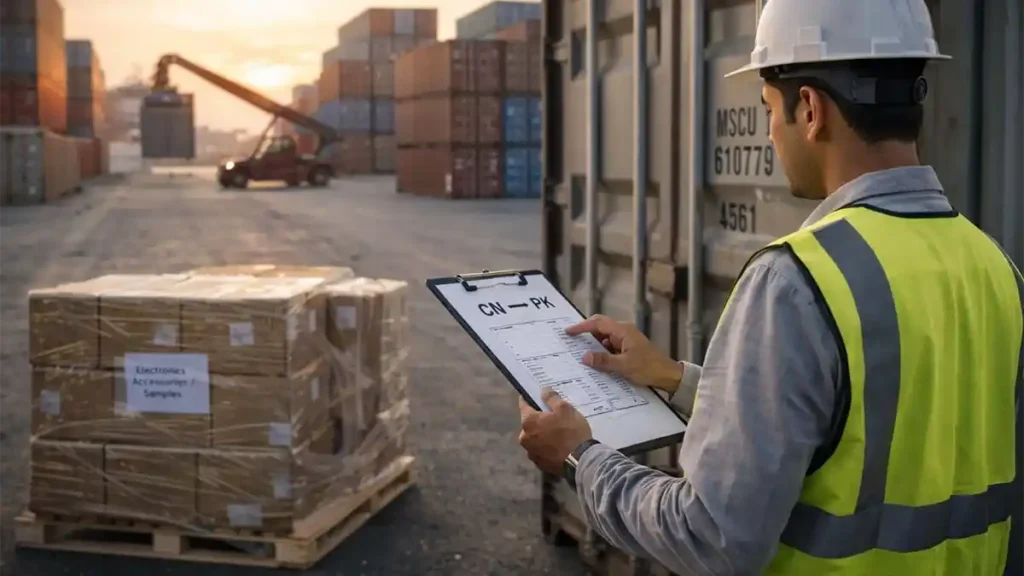
5. Courier from China to Pakistan: when it is the smartest move
Courier looks expensive per kg, but it can be the highest ROI choice when:
- you are testing suppliers or quality
- you need small quantities quickly
- you value lower coordination overhead
- you want predictable tracking and fewer handoffs
Courier pricing basics (what affects the bill)
- chargeable weight (actual vs volumetric)
- service level (economy vs priority)
- fuel surcharges
- customs/tax assessments (if applicable)
Courier is especially efficient for samples, but do not assume small parcel = no customs. Build your costs with the expectation of clearance requirements.
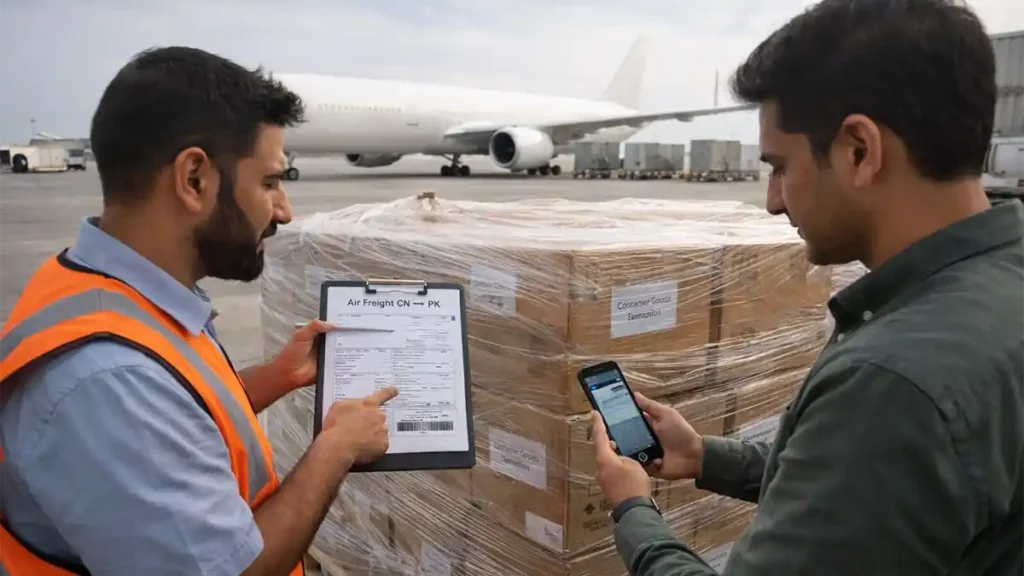
6. Air freight China to Pakistan: the speed cost balance
Air freight typically wins when you need speed but courier pricing is too painful.
Air freight’s best use cases
- 30 to 300 kg shipments (common restock sizes)
- higher margin products where stockouts are costly
- seasonal demand where timing beats the lowest unit cost
What goes into an air freight quote
A professional air quote often includes:
- pickup (optional)
- export handling and documentation
- airline charge (chargeable kg rate)
- destination handling
- customs clearance
- delivery to final address
Air freight cost example (simple, realistic)
You have:
- 8 cartons
- actual weight: 80 kg
- volumetric weight: 110 kg
Chargeable weight: 110 kg
If your all in air transport rate (airline portion) is priced per kg, you start from chargeable weight. Then you add handling and clearance elements. The exact number changes by season and capacity, but the logic stays consistent.
Air freight risk factors
Air is fast, but delays and cost spikes happen when:
- cargo is restricted (especially batteries and liquids)
- documents are incomplete
- HS code or valuation disputes arise
- booking is late during peak season
7. Sea freight China to Pakistan: the margin builder
Sea freight is not slow by default. It is planned. Importers who treat sea like a system (not a one-off purchase) usually get the best unit economics.
LCL vs FCL (how to choose)
LCL makes sense when:
- you do not have enough cargo to fill a container
- you are building a product range
- your shipment is measured in cartons and CBM, not pallets and tons
FCL makes sense when:
- you ship consistently and can fill a container
- you want fewer handling touches (often lower damage risk)
- you want more schedule control and simpler cost allocation per unit
Sea freight costs: why local charges matter more in LCL
LCL can look cheap on the ocean segment, but destination charges and handling can be meaningful, especially on small volumes. That is why small importers sometimes feel LCL is not worth it until they scale.
8. Incoterms: the hidden switch that changes who pays what
Many shipping disputes are actually Incoterms misunderstandings.
The most common terms in China to Pakistan trade
- EXW (Ex Works): you (buyer) handle almost everything from supplier’s door onward
- FOB (Free On Board): supplier covers cost to load on the vessel at the export port; you take over from there
- CIF (Cost, Insurance, Freight): supplier pays ocean freight and insurance to destination port, but you still handle customs and local delivery
- DDP (Delivered Duty Paid): seller claims to handle nearly all costs including duties (verify carefully)
Practical advice:
- If you are new, FOB often reduces export side headaches.
- If someone offers DDP, demand a written list of what is included, and who is legally responsible at customs. DDP is sometimes used loosely in the market.
9. Customs clearance in Pakistan: what usually causes delays
Most delays happen for predictable reasons:
- missing or inconsistent documents
- HS code classification disputes
- valuation questions
- restricted or regulated goods
- mismatch between invoice and packing list details
Core documents you should expect
Pakistan’s customs framework references documentation used for clearance, such as:
- bill of lading or airway bill
- commercial invoice
- packing list
- certificate of origin (when applicable)
If your forwarder is asking for these, that is normal. If your supplier is refusing to provide accurate invoice and packing list information, treat it as a red flag.
HS code discipline (the importer’s advantage)
HS codes drive duty and tax treatment. Even if you do not memorize codes, you should:
- keep a consistent HS classification strategy
- use a broker who can justify classification
- keep product descriptions accurate and specific
This reduces back and forth with customs and protects timelines.
10. A practical decision framework (choose without guessing)
Use these eight questions before you ship:
- How fast do I truly need it (days vs weeks)?
- Is the cargo bulky or dense (volume to weight ratio)?
- What is the total landed cost per unit (not freight only)?
- What is the cost of delay (stockout, missed season, penalties)?
- Is it restricted cargo (batteries, liquids, branded goods)?
- Do I need door to door convenience or can I manage clearance?
- Is this a test order or full inventory?
- Can I plan demand, or is demand unpredictable?
Simple rule of thumb (works for most importers)
- Under 5 kg and urgent: courier
- 5 to 50 kg: compare courier vs air (dimensions decide)
- 50 to 300 kg: air freight often gives the best balance
- Over 300 kg or bulky inventory: sea freight (LCL, then FCL as volume grows)
11. Mini case studies (real importer scenarios)
Case 1: New eCommerce store testing 10 products
- Shipment: 12 kg, compact cartons
- Goal: test quickly, reduce risk
- Best method: courier
Reason: speed and convenience help you learn faster than waiting for sea.
Case 2: Retailer restocking best sellers
- Shipment: 120 kg chargeable
- Goal: avoid stockouts
- Best method: air freight
Reason: courier is expensive at that weight, sea is too slow for fast restock cycles.
Case 3: Distributor importing inventory monthly
- Shipment: 6 to 10 CBM
- Goal: reduce landed cost per unit
- Best method: LCL sea at first, then upgrade to FCL
Reason: sea gives the best unit economics once volume becomes consistent.
12. How to request quotes correctly (copy/paste template)
Send this message to suppliers or freight forwarders:
Please quote door to door delivery to (City, Pakistan).
Goods: (product type), HS code if known.
Cartons: (count), dimensions (L x W x H cm per carton), actual weight (kg).
Pickup city in China: (city).
Incoterms: (EXW or FOB).
Provide courier, air freight, and sea freight options.
Include a cost breakdown (origin, freight, destination, clearance, delivery) and estimated timeline.
This prevents vague quotes and makes options comparable.
13. The most common mistakes (and how to avoid them)
- Not sharing carton dimensions (leads to inaccurate quotes)
- Choosing the wrong Incoterm (cost surprises appear later)
- Under declaring value (risk of penalties and delays)
- Ignoring HS codes until the cargo arrives (valuation disputes)
- Shipping fragile goods LCL without strong packaging (damage risk)
- Planning sea freight with zero buffer (ports and clearance vary)
- Forgetting inland delivery costs (Karachi arrival is not Lahore delivery)
14. Landed cost checklist (copy/paste)
Before you approve shipping, confirm:
- product list, quantities, and unit costs
- carton count, dimensions, and actual weight
- Incoterms written on invoice
- commercial invoice and packing list ready
- freight quote includes what you think it includes
- HS code plan (broker confirmed)
- conservative estimate of duties and taxes
- insurance decision (high value cargo should be insured)
- customs broker or clearing agent confirmed
- delivery plan to your city and unloading plan
Quick FAQ
What is the cheapest way to ship from China to Pakistan?
For heavy or bulky inventory, sea freight usually produces the lowest cost per unit. LCL lane estimates show multi week timelines, so it works best when you plan ahead.
What is the fastest method?
Courier is typically the fastest door to door for small shipments. Air freight is the next fastest for larger cartons.
Why did my parcel get charged higher than its actual kg?
Because pricing can use volumetric weight. A common air cargo rule divides volume in cm3 by 6000 and charges whichever is higher, volumetric or actual weight.
Is LCL always cheaper than air freight?
Not always. For small volumes, LCL destination charges and handling can reduce the cheap advantage. Air can be cost effective when timing is valuable.
How long does sea freight take from Shanghai to Karachi?
Published examples show LCL estimates such as 23 days on one service and 37 days on another, depending on routing and service.
What documents are commonly needed for customs clearance in Pakistan?
Commonly: airway bill or bill of lading, commercial invoice, packing list, and sometimes certificate of origin depending on the case.
Should I choose EXW, FOB, CIF, or DDP?
EXW gives you control but more responsibility. FOB often simplifies export side handling. CIF covers ocean freight but not clearance. DDP can be convenient, but only if inclusions and legal responsibility are clearly written.
How do I avoid delays and surprise charges?
Provide accurate dimensions and weights, keep invoice and packing list consistent, confirm Incoterms in writing, and work with a broker/forwarder who can manage HS code and clearance documents early.
Conclusion: pick the method that protects profit, not ego
Courier, air, and sea are not better or worse. They are tools.
- Use courier when speed, simplicity, and learning matter more than per kg cost.
- Use air freight when timing is critical but courier pricing is unjustifiable.
- Use sea freight when you are building margin and moving real volume.
When you understand chargeable weight, use the right Incoterm, prepare documents early, and compare true landed cost, shipping China to Pakistan becomes predictable, scalable, and profitable.