Saudi Arabia’s Ancient Trade Routes: From Caravans to Oil
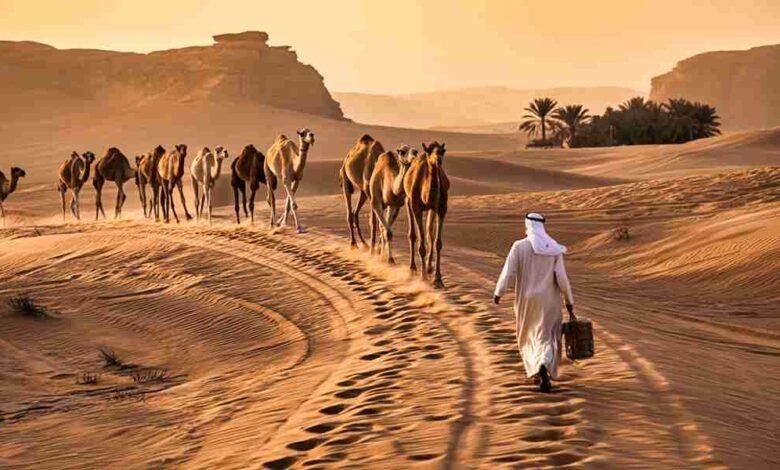
Ancient trade routes Saudi Arabia lies at the heart of a story that stretches from the dusty caravan trails of antiquity all the way to today’s global oil economy. For thousands of years, what is now Saudi Arabia wasn’t just a barren desert it was a vibrant crossroads of commerce, culture, and religion. Caravans laden with incense, spices, and silks traced long and perilous routes across the peninsula, linking South Arabia to the Mediterranean, Mesopotamia, and beyond.
Over time, as trade evolved, the map changed: sea routes opened, empires rose and fell, and eventually, black gold (oil) emerged as the dominant commodity. This article explores that journey in depth charting how ancient caravan trails laid the foundation for Saudi Arabia’s future role in global trade.
The Birth of Trade: Incense, Camels, and Caravans
Why Incense Was Golden
In the ancient world, incense especially frankincense and myrrh was not a luxury; it was indispensable. Used in religious rituals, medicine, and even daily life, these aromatic resins were prized. Saudi Arabia played a central role because some of its southern regions (and nearby Yemen and Oman) were among the few places that produced high-quality frankincense.
Archaeological and historical sources tell us that the Incense Route, as it came to be known, spanned over 2,000 kilometers, connecting the heart of the Arabian Peninsula to major centers like Petra, Gaza, and the Mediterranean.
The Route Takes Shape
Caravans often started in southern Arabia in places like Hadhramaut, Qataban, or the port of Qana and carried incense northward. One of the key “hinge” points in these routes was Najran, an oasis town deep in modern-day Saudi Arabia. From Najran, two main branches emerged:
Western branch: Through the Asir and Hijaz regions, passing Al-Ula (ancient Dadan), and heading to Petra and the Mediterranean.
Eastern branch: Cutting across the desert to places like Qaryat al‑Faw and Thaj, then onward to the Gulf and Mesopotamia.
These paths weren’t random they followed natural oases, water wells, and trading hubs, allowing caravans to resupply and pay tolls or taxes.
Key Stops Along the Ancient Arabian Routes
Al-Ula (Dadan – Hegra)
Al‑Ula, a lush oasis in the desert, was essential to the incense trade. Archaeological evidence shows it was inhabited as early as 5000 BCE. Later, it became part of the Lihyanite kingdom (7th-2nd century BCE) and was a key Nabataean stop for caravans.
Its strategic location meant caravans passing through had to pay taxes or access services there a major source of wealth. Moreover, the rock-cut tombs in Mada’in Saleh (also called Al‑Hijr), built by the Nabataeans, are a testament to the prosperity that trade brought to the region.
Tayma
Far to the north, Tayma is another ancient oasis, located in what is now Tabuk Province. Due to its location on a branch of the incense and spice trade routes, Tayma witnessed frequent visits by caravans. Archeologists have uncovered city walls, inscriptions in different scripts (Aramaic, Nabataean, etc.), and even remains of wells dating back centuries.
Qaryat al Faw and Thaj
These inland cities served the eastern branch of the trade network. Qaryat al‑Faw was once a Kindah capital, and Thaj was a bustling caravan town. These stops enabled traders to bridge the gap between southern Arabia and Mesopotamia or the Gulf. The movement of incense, spices, luxury goods, and even people created a rich tapestry of commerce in central Arabia.
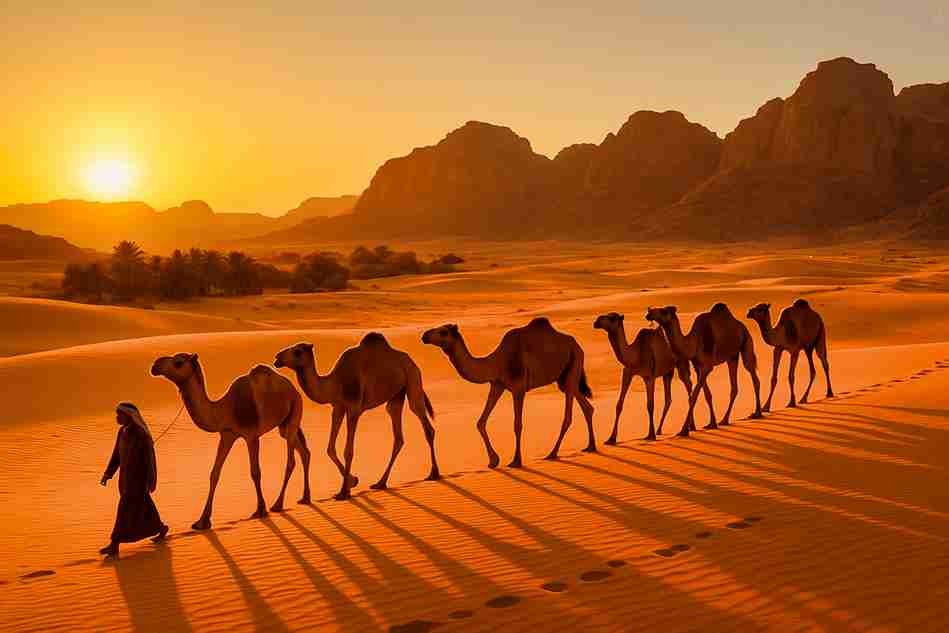
The Political and Cultural Impact of the Caravans
The Rise of Nabataeans
One of the most remarkable players along these routes was the Nabataean civilization. Originally nomadic, the Nabataeans settled and became masters of desert life developing advanced water conservation systems (cisterns, reservoirs) and establishing strongholds like Petra and Mada’in Saleh (Al-Hijr). Their control over portions of the incense routes made them fabulously wealthy.
Because of their desert expertise, they could support the caravans with safe passage, lodging, and trade infrastructure. This trade wasn’t just economic it also fostered a cultural exchange. Through these routes, ideas, languages, religious beliefs, and art moved across the Arabian Peninsula.
Engineering and Infrastructure
Running a trade route through harsh desert terrain was not simple. The ancient kingdoms built cities with fortifications, towers, marketplaces, palaces, and temples. In more than a few places, engineers and city planners designed irrigation systems to capture rare rainwater, store it in reservoirs, and bring life to arid zones.
These oases also became cultural melting pots caravanserais (inns for camel caravans), trading posts, and religious sanctuaries dotted the routes, serving as hubs of interaction and commerce.
Transition: Sea Routes and Pilgrimage Paths
Maritime Shift
Over time, the balance of trade shifted. While overland incense routes remained important for centuries, seafaring became increasingly efficient and attractive. Ports along the Red Sea and the Arabian Gulf allowed traders to bypass long desert treks.
Saudi Arabia’s coastal cities, such as Jeddah and Yanbu, re-emerged as strategic hubs in this maritime network. Moreover, the famous Silk Road, often associated with Central Asia, also found its maritime counterpart linked to the Arabian Peninsula.
Pilgrimage Routes and the Zubaydah Trail
As Islam spread, pilgrimage routes became new arteries of movement. The Zubaydah Trail (Darb Zubaydah), for example, runs through western Arabia and served pilgrims coming from Iraq and other regions. What had been a trade route gradually supported religious journeys, and water stations, grazing areas, and wells along it became more permanent and systematically organized.
These pilgrimage routes sometimes overlapped with older trade trails, showing how infrastructure built for commerce adapted to spiritual and religious needs.
The Modern Shift: Oil Replaces Incense
The Discovery of Oil
Fast forward to the early 20th century: the Kingdom of Saudi Arabia discovered vast oil reserves. What took centuries for caravans to transport in small, precious loads (resins, spices, silks), oil would now be shipped in tanker ships, pipelines, and pipelines, connecting to global markets in hours or days.
This shift was more than economic it was transformational. Just as incense once powered the ancient economies of South Arabia, oil would drive modern Saudi Arabia’s rise as a major player on the world stage.
From Caravans to Pipelines
The ancient trade corridors have a symbolic continuity: whereas incense once flowed along dusty trails with camel caravans, today oil flows through pipelines, supertankers, and advanced infrastructure. Saudi Arabia remains a hub of global trade, but its product of value has changed.
And with this change came geopolitical power. The Kingdom’s strategic geography once a bridge for merchants now serves global energy markets. Its ports, once caravan stops, are now modern shipping terminals.
The Legacy: Why These Ancient Routes Matter Today
Economic Foundation: The caravan trade built early wealth, political power, and social structures that shaped the Arabian Peninsula long before oil.
Cultural Crossroads: These trade routes enabled exchange not just of goods, but of ideas, religion, art, and architecture influencing societies from Yemen to the Mediterranean.
Engineering Ingenuity: Ancient cities along the routes innovated in water management, city planning, and settlement design in harsh conditions.
Modern Identity: Saudi Arabia’s transformation from a desert trade hub to an oil superpower mirrors its ancient role as a connector of worlds a center for trade, culture, and exchange.
Conclusion
From incense-laden camel caravans to oil-laden supertankers, ancient trade routes Saudi Arabia have woven a rich tapestry in the fabric of global history. These routes were more than mere roads they were lifelines of commerce, culture, spirituality, and innovation.
In ancient times, traders braved inhospitable terrain to move frankincense, spices, and luxury goods, building kingdoms and networks in the process. Oases and caravanserais sprang up, cities flourished, and the desert was tamed through human will. Over time, the trade adapted sea routes emerged, pilgrimage paths overlapped, and new forms of exchange took root.
Then came oil: the black gold that redefined not just Saudi Arabia but the global economic order. Yet, the genealogy remains. The Kingdom that once taxed incense caravans now supplies energy to half the world.
In understanding these ancient trade routes, we appreciate how Saudi Arabia’s past continues to shape its present and how the echoes of camel caravans still resonate in the hum of pipelines and shipping terminals.





7 Comments