Saudi Vision 2030 Explained: Projects, Jobs, and Big Changes
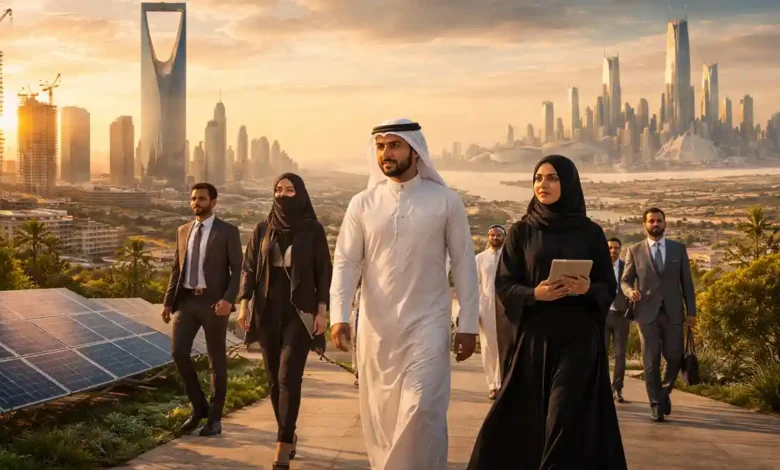
Saudi Vision 2030 is Saudi Arabia’s long-term plan to modernize the country, reduce its dependence on oil, and raise quality of life by building new industries that can drive growth for decades. Launched in April 2016, it’s built on a simple reality: the Kingdom has major strengths its strategic location, energy capacity, holy sites, a young population, and strong investment power but oil alone can’t be the foundation forever.
If you’ve seen headlines about NEOM, The Red Sea, Expo 2030, or the country’s tourism surge, those aren’t isolated announcements. They’re part of a bigger roadmap that includes massive infrastructure upgrades, new regulations, more private-sector momentum, and an everyday lifestyle that looks very different from what many people associated with Saudi Arabia just ten years ago.
In this guide, I’ll explain Vision 2030 in plain English: what it is, why it exists, which mega-projects matter most, where new jobs are coming from, and the major changes already reshaping society and business supported by real examples and credible, up to date data.
Vision 2030 in one minute (the quick picture)
Think of Vision 2030 as a national transformation program with three connected goals:
- A vibrant society (better quality of life, culture, health, livable cities).
- A thriving economy (more private-sector growth, new industries, more jobs).
- An ambitious nation (more efficient government, stronger institutions, better performance).
And it’s not just theory. Some measurable shifts are already visible:
- Saudi unemployment hit 7% by end-2024, reaching the Vision target six years early (a major milestone).
- Non-oil activities grew 4.9% year-on-year in Q1 2025 (a sign diversification isn’t just a slogan).
- Saudi women’s labor force participation reached 36.2% in Q3 2024 (up strongly over the Vision era).
- Tourism exceeded 100 million domestic + international visitors ahead of schedule, and the new target is 150 million by 2030.
Why Vision 2030 exists (and why it’s so big)
Saudi Arabia has long been an energy superpower. But oil-driven economies face a problem: they can grow fast in boom years and slow down sharply when prices drop. That volatility makes long-term planning harder especially when you’re building a modern economy with high-quality jobs.
Vision 2030’s core logic is: use today’s strengths (investment power, geography, large-scale capacity) to build tomorrow’s diverse economy, including tourism, logistics, technology, advanced manufacturing, renewable energy, entertainment, and services.
In the official Vision document, the country frames its competitive advantage around being:
- the heart of the Arab and Islamic worlds,
- an investment powerhouse, and
- a hub connecting three continents (Asia, Africa, Europe).
That “hub” idea matters more than it sounds: it explains the push into ports, airports, rail, special economic zones, logistics corridors, and tourism access because connectivity is a national economic strategy, not just infrastructure.
The 3 pillars, explained like a human
(1) A Vibrant Society: “Make life richer, healthier, and more livable”
This pillar is about quality of life: culture, heritage, sports, health, urban design, environment, and community experiences. In real terms, it shows up as:
- more events and entertainment options,
- tourism development,
- heritage restoration,
- parks and public spaces,
- improved services that support families and participation.
(2) A Thriving Economy: “Build new engines of growth and better jobs”
This is the economic heart of Vision 2030:
- create jobs through private-sector expansion,
- build skills aligned with market needs,
- unlock new sectors and investment,
- improve the business environment.
(3) An Ambitious Nation: “Make government faster, clearer, and more accountable”
This pillar focuses on government performance and enabling citizens, private sector, and nonprofits to act so the system becomes more responsive and results-driven.
How Vision 2030 turns into action (programs, targets, and delivery)
A useful way to understand Vision 2030 is to see it as a portfolio of programs + KPIs, not one single project.
- It branches into strategic objectives, and it’s delivered through multiple programs (often called “Vision Realization Programs”). Saudipedia summarizes it as 96 strategic objectives and 11 programs.
- One major early program was the National Transformation Program (NTP), launched in 2016 to accelerate reforms and improve government effectiveness.
In simple terms: Vision 2030 is the destination; the programs are the vehicles; KPIs are the dashboard.
The headline projects everyone talks about (and what they’re really for)
Vision 2030 projects aren’t just “big buildings.” Most have economic jobs logic behind them:
- create entirely new sectors (tourism, entertainment),
- attract investment and talent,
- build exportable services (events, hospitality, logistics),
- stimulate SME ecosystems around them,
- improve livability so cities can compete globally for skilled workers.
Let’s break down a few of the most important ones.
NEOM and THE LINE: a mega bet on a new kind of city
NEOM is often described as futuristic and it is but its purpose is also practical: a platform to attract new industries and global talent, while prototyping new models of urban living, sustainability, and technology.
THE LINE, one of NEOM’s flagship concepts, is described by NEOM as:
- a “cognitive city” stretching 170 km,
- 500 meters high and 200 meters wide,
- designed with no roads, cars, or emissions, running on 100% renewable energy,
- with daily essentials within a five-minute walk, and high-speed transit end-to-end in 20 minutes.
Whether all of that is achieved exactly as envisioned is something the world is watching. But even before full completion, the immediate impact is clear: NEOM fuels demand for engineering, design, construction, project management, digital systems, renewable energy, hospitality, and operations plus a supplier ecosystem.
Job signal: when a project markets itself around “prototype businesses” and “large-scale job creation,” it’s telling you it’s not just real estate it’s an economic engine.
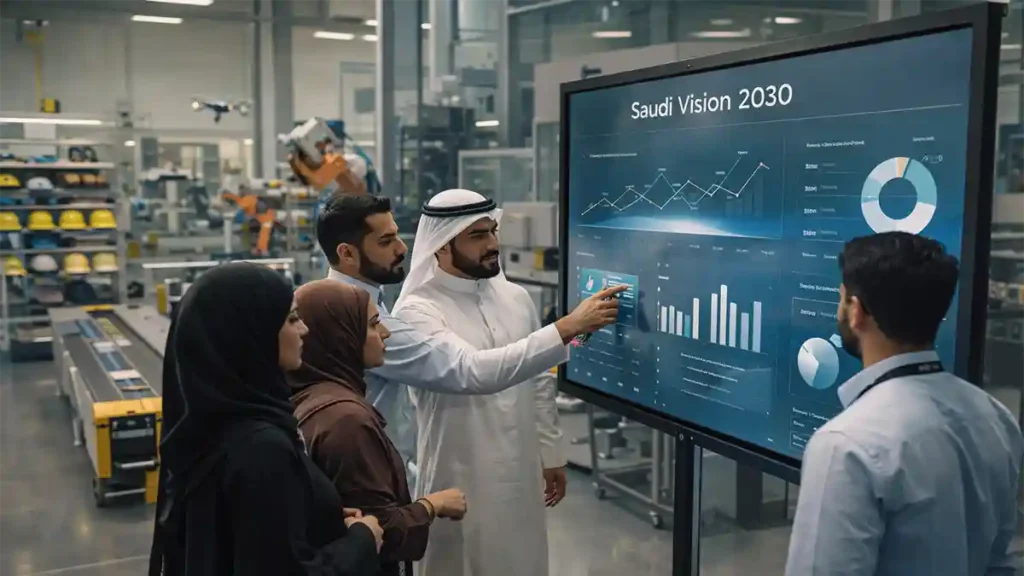
The Red Sea: tourism built around sustainability (and real openings)
Saudi Arabia’s tourism transformation is one of Vision 2030’s most visible shifts, and The Red Sea destination is a flagship example.
According to Red Sea Global:
- The destination is open with its first five resorts, part of phase one.
- Phase one includes an international airport and 16 resorts opening gradually through 2024 and 2025, offering around 3,000 keys (rooms).
- By 2030, it targets 50 hotels (8,000 rooms) plus residential properties, with development capped to host no more than 1 million visitors per year to protect the ecosystem.
- Red Sea International Airport opened for domestic flights in 2023, and began international services in April 2024 (e.g., Dubai flight), with more routes expected.
This is important because it shows Vision 2030 isn’t only “announced.” Parts are operating now creating jobs in:
- hospitality (front office, food & beverage, events),
- sustainability and environmental management,
- aviation and airport operations,
- supply chain (everything from laundry to logistics to local sourcing),
- marketing and tourism tech.
Tourism strategy: from “new to tourism” to “global destination”
Saudi tourism policy has changed fast in the Vision era. The Pilgrim Experience Program’s site notes:
- tourist visit visas were launched in September 2019 for 49 countries, later expanded, and the system continued widening.
- the Vision tourism strategy aims to raise tourism’s GDP contribution and create large-scale jobs (including priority for citizens).
Saudi Tourism Authority’s Vision 2030 page adds key momentum points:
- the Kingdom surpassed 100 million tourists earlier than planned and now targets 150 million by 2030,
- it expanded e-visa coverage (noted as 66 countries on the STA page),
- and it highlights major global events (Expo 2030, FIFA World Cup 2034, Esports World Cup).
Reuters also reports Saudi Arabia’s intention to broaden tourism beyond luxury, while keeping big targets like 150 million tourists annually by 2030 and a focus on religious tourism growth.
Why this matters: Tourism isn’t just hotels. It creates long supply chains transport, food, retail, experiences, digital services, security, training, and local SMEs.
Jobs: where Vision 2030 employment is actually coming from
People often ask, “Will Vision 2030 create jobs?” A better question is: which job categories are growing, and why?
(1) Construction and urban development (the obvious engine)
When a country builds at this scale, it creates demand for:
- civil engineers, architects, urban planners,
- safety, quality, procurement, scheduling,
- project controls (Primavera, cost management),
- skilled trades, equipment operations,
- materials, logistics, and site services.
This is not abstract. Research on the Saudi labor market links job momentum to strong non-oil growth and Vision-linked initiatives.
(2) Tourism and hospitality (the fast multiplier)
Tourism is labor-intensive, meaning it creates a lot of roles at different skill levels:
- hotel operations, culinary, guest experience,
- tour guiding, events, sports tourism,
- destination management, travel tech,
- airlines, airports, transport, and retail.
Saudi unemployment reaching 7% by end-2024 is a national milestone, and it reflects broad labor-market absorption happening alongside these expansions.
(3) Logistics and trade (the “hub connecting three continents” logic)
When a country positions itself as a connector, jobs grow in:
- ports, customs, freight forwarding,
- warehouses and fulfillment,
- cold chain and pharma logistics,
- aviation cargo and ground handling,
- supply chain analytics and automation.
(4) Tech, digital services, and “everything becoming an app”
Modernization at national scale requires:
- cybersecurity, cloud, data engineering,
- UX/UI and product roles,
- AI and analytics (tourism assistants, smart-city systems),
- fintech, e-commerce, digital identity systems.
Even tourism pages now highlight AI assistants and digitized platforms as part of the national push.
(5) Green skills: sustainability, renewable energy, environmental management
Projects like The Red Sea are explicitly built around sustainability constraints (visitor caps, ecosystem preservation, regenerative tourism). That creates specialized demand for:
- environmental impact roles,
- sustainability reporting,
- renewable integration,
- water and waste management.
A practical “jobs case study”: removing barriers to work (especially for women)
Vision 2030 isn’t only creating jobs; it’s also reducing friction that prevents people from joining or staying in the workforce.
Two examples from the Human Resources Development Fund (HRDF) show this very clearly:
Wusool (transport support)
HRDF describes Wusool as an initiative to reduce transportation costs for working women and people with disabilities in the private sector, supporting job stability implemented with licensed ride-hailing partners. HRDF notes support can cover 80% of eligible transport expenses for trips between home and work.
Qurrah (childcare support)
HRDF’s Qurrah childcare support is designed to help Saudi working women join and remain in the labor market. HRDF states it covers up to 50% of childcare booking costs, up to 1,600 SAR per child (for eligible children under 6).
These are “quiet reforms,” but they are powerful. They help explain why women’s labor participation climbed to 36.2% in Q3 2024, according to Saudi official statistics.
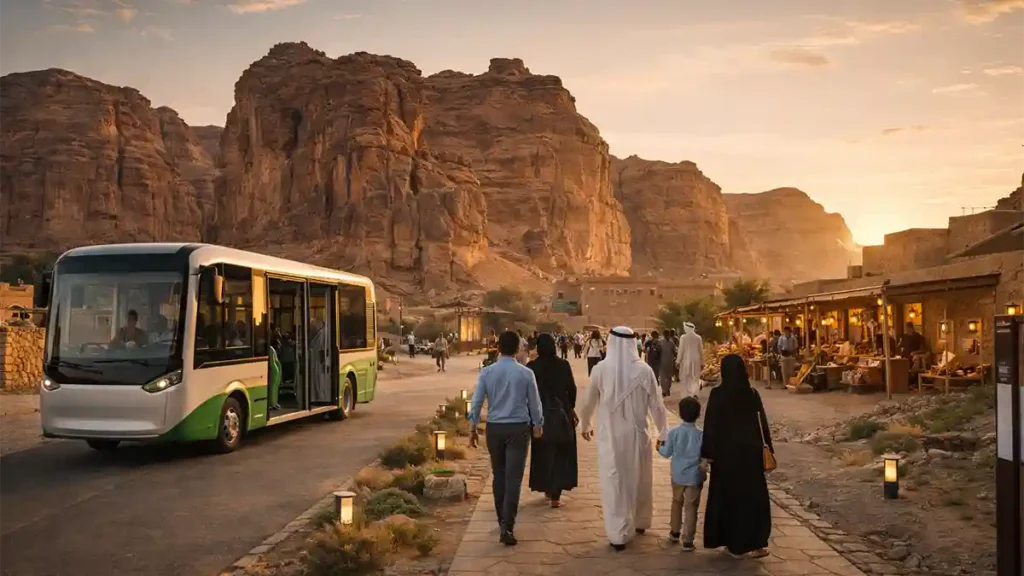
Big changes people feel in daily life
Vision 2030 is often summarized as “economy,” but for residents and visitors, the transformation shows up in day-to-day realities:
Tourism access and openness
Visa expansion and tourism platforms changed how people enter, travel, and experience the country. The 2019 launch of tourist visas and continued expansion was a key turning point for global tourism flows into Saudi Arabia.
Events, entertainment, and global hosting
Saudi Tourism Authority highlights the Kingdom’s role as a hub for major sports and esports events, and links that momentum to global milestones like Expo 2030 and FIFA 2034.
Women’s economic participation (measurable change)
Official data shows continued gains in women’s labor force participation an economic shift with major social impact.
Public transport and urban mobility
Even labor market research notes that expanding public transportation (for example, the launch of metro services in Riyadh) can influence job accessibility and commuting preferences especially for groups sensitive to travel time.
The economy: diversification in numbers (not just slogans)
A strong way to test “Vision 2030 progress” is to look at non-oil performance.
Saudi Central Bank’s Q1 2025 report (using GASTAT data) states:
- real GDP grew 3.4% YoY in Q1 2025, driven by non-oil activities up 4.9% and government activities up 3.2%.
- the report explicitly links non-oil growth to Vision 2030 programs and mega projects.
It also shows Saudi Arabia is still managing an oil-to-non-oil transition:
- In Q1 2025, the report notes budget revenues with oil still a large component (oil revenues making up 56.8% of total revenues in that quarter).
Translation: diversification is advancing, but oil still matters so the strategy is partly about building “non-oil resilience” while oil continues financing parts of the transition.
Challenges and realistic questions (what critics point to)
A serious explanation of Vision 2030 should include what makes it hard:
- Scale and timelines
Mega projects are complex everywhere. Coordinating engineering, supply chains, contractors, and regulation at this scale creates schedule risk. - Budget discipline and financing
When you’re building new cities, airports, resorts, and infrastructure, financing strategy matters especially in years where oil revenues fluctuate. Public finance indicators in official economic reports show ongoing fiscal management pressures. - Workforce readiness (skills gap)
New sectors need new skills. The challenge isn’t only job creation it’s matching people to roles with the right training, language ability, digital skills, and professional standards. - Balancing luxury ambition with mass-market tourism
Reuters reports Saudi Arabia is now also targeting broader mid-range tourism options not only high-end luxury suggesting strategy evolution based on demand realities.
The key point: Vision 2030 is not one bet. It’s many bets at once. Some will outperform, some will adjust, and some will be redesigned as conditions change.
What to watch next (2026–2030 milestones that signal progress)
If you want a simple “progress checklist,” here are practical indicators tied to the Vision direction:
- Continued expansion in tourism capacity and visitation toward the 150 million by 2030 goal.
- Red Sea Global’s phased openings through 2024/2025 and development toward its 2030 completion vision.
- Ongoing non-oil growth performance (like the 4.9% YoY non-oil growth reported in Q1 2025).
- Labor market quality: not just unemployment, but youth employment, female participation, and private-sector job stability.
- Global mega-event delivery (Expo 2030 preparations, FIFA 2034 planning).
⚡Quick FAQ
Q1: What is Saudi Vision 2030 in simple words?
A national plan to diversify the economy, improve quality of life, and modernize government by 2030.
Q2: Which projects are most linked to Vision 2030?
NEOM/THE LINE, The Red Sea, major tourism and event initiatives, and nationwide infrastructure upgrades.
Q3: Is Vision 2030 creating jobs?
Yes—especially in construction, tourism, logistics, tech, and sustainability-focused roles.
Q4: What’s the tourism goal now?
Saudi Arabia targets 150 million visitors by 2030 after surpassing 100 million earlier than planned.
Q5: What’s one major success so far?
Saudi unemployment reaching 7% by end-2024, hitting the Vision target early.
Q6: What’s the biggest challenge?
Executing mega projects at scale while keeping budgets, timelines, and workforce skills aligned.
Conclusion: what Vision 2030 really means
Saudi Vision 2030 is best understood as a national redesign: the economy, cities, tourism, job pathways, and government delivery systems are being reshaped at once.
It’s already producing measurable outcomes like 7% unemployment by end-2024 and strong non-oil growth and it’s creating new job ecosystems through tourism, construction, logistics, technology, and sustainability.
At the same time, it remains a high-execution project: timelines, financing, workforce skills, and global economic conditions will influence what gets accelerated, adjusted, or re-scoped.
But the direction is clear. For citizens, residents, investors, and travelers, Vision 2030 is not a slogan anymore it’s a lived shift you can see in new airports, new destinations, new work programs, new events, and new industries.






4 Comments