Pakistan Real Estate Trends: Where Prices Are Rising and Why
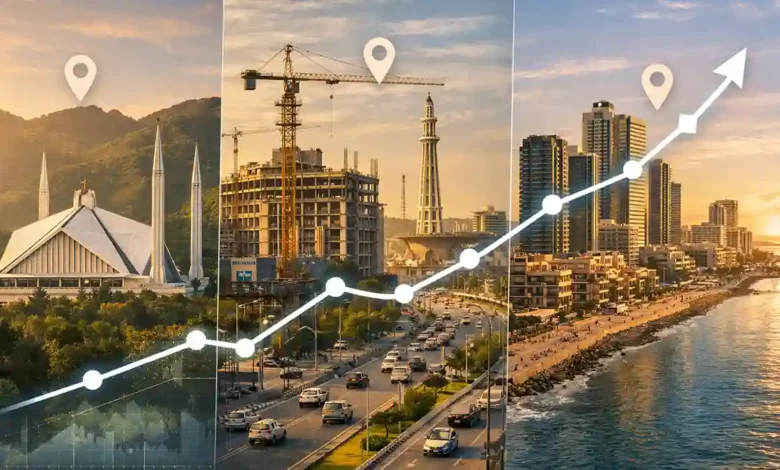
Pakistan real estate trends in 2025 are being shaped by a mix of old truths and new realities: people still love plots, gated societies still pull premium prices, and “location” is still king but the reasons behind price jumps are changing. Interest rates have come down sharply from their peak, remittances are strong, and policy pressure is pushing more transactions into the documented economy.
If you’ve been watching the market from the sidelines (or trying to decide whether to buy, sell, or hold), the most useful question isn’t “Are prices rising?” It’s:
Where are prices rising fastest, and what’s powering those pockets of growth?
Let’s break it down in plain English city by city, and factor by factor so you can understand what’s really moving the market (and what might cool it down).
The 2025 market vibe: less hype, more “selective heat”
A few years ago, Pakistan property talk often sounded like this: “Buy any file, it’ll double.” That mindset hasn’t disappeared, but the market has become more selective.
Today, price growth is clustering in places that offer one (or more) of these:
- Clearer legal status / stronger approvals (or at least stronger buyer confidence)
- Visible development progress (roads, possession, utilities, commercial activity)
- Better livability (security, maintenance, parks, schools, access)
- End-user demand (people who actually want to live there)
- Overseas buyer appeal (easy resale, recognized brand, “safe” reputation)
That’s why you’ll see strong upward movement in certain societies and corridors while other areas feel flat even within the same city.
Where prices are rising in Pakistan (and what kind of rise it is)
1) Islamabad–Rawalpindi: “premium safety” plus genuine demand
When people talk about Islamabad property prices, they’re usually talking about a specific type of buyer psychology: pay more, but sleep better.
Islamabad and the wider twin-cities region remain magnets for:
- Government and corporate employees
- Overseas Pakistanis who want a “managed” community
- Investors chasing stability (not just quick flips)
One reason prices stay firm here is land scarcity in prime sectors and the credibility premium of the capital. Another is that public-sector activity can signal confidence. For example, the Capital Development Authority (CDA) reported selling plots worth Rs 13.52 billion on the first day of an Islamabad auction (Dec 22, 2025) the kind of headline that often reinforces bullish sentiment.
Where the heat tends to concentrate:
- Recognized gated communities with strong brands and liquidity
- Areas benefiting from infrastructure, access, and “possession-ready” momentum
- Select apartment zones where rental demand is deep (especially near business hubs)
What’s different in 2025:
Buyers are less forgiving of “paper” launches. They want development proof, not just masterplans.
2) Lahore: growth is following infrastructure and livability
The Lahore housing market is massive, emotional, and very trend-driven. Lahore also has a unique pattern: once an area becomes convenient, it can transform quickly because the city’s middle and upper-middle classes actively upgrade neighborhoods.
In 2025, growth is strongest in:
- Well-connected societies (access and commute time matter more than ever)
- Areas near ring-road style connectivity and expanding commercial zones
- Neighborhoods that feel “complete” schools, markets, parks, security, maintenance
Property portal index data highlights how different pockets can behave very differently. On Zameen’s index, some popular Lahore societies show noticeable year-over-year movement for example, Beacon House Society (Lahore) houses and Park View City (Lahore) houses are listed among active movers, while other well-known names show more modest annual changes.
The key Lahore idea:
In many locations, the market is paying less for “brand only” and more for execution + access.
3) Karachi: DHA remains a price leader but the story is “micro-markets”
Karachi isn’t one market it’s several markets living inside one city. That’s why broad statements like “Karachi prices are up” can mislead.
In 2025, Karachi DHA prices remain a major benchmark. Zameen’s Karachi house index shows DHA Defence with an annual change listed around 12% (and positive movement over shorter periods as well).
But here’s the more important point: even within DHA, different sizes and segments move differently. Zameen’s DHA Defence Karachi breakdown shows varying annual changes by house size some categories rise faster than others, which usually reflects who is buying and what budgets are most active.
Outside “core DHA”, some peripheral or developing options can jump faster (because they start from a lower base). For example, Zameen’s index for DHA City Karachi residential plots shows double-digit annual changes for multiple plot sizes.
What Karachi teaches you:
The strongest rises often happen where demand meets confidence not just cheap prices.
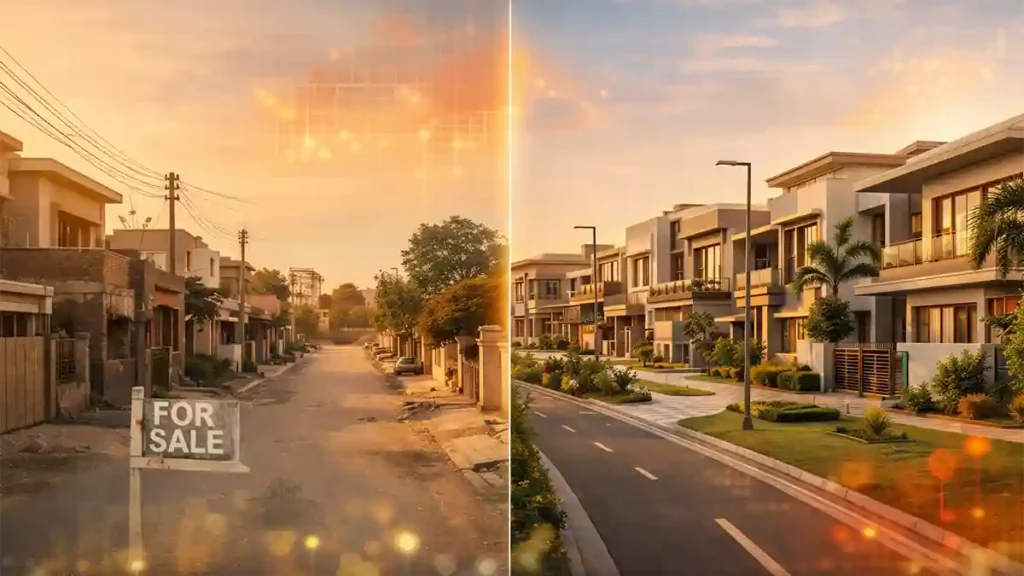
4) Secondary cities: surprising jumps, but pick carefully
One of the most under-discussed shifts in Pakistan’s property scene is how certain secondary cities are showing sharp rises often driven by:
- New housing schemes and branded communities
- Local business expansion
- Lower entry prices attracting first-time investors
- “Copy of big-city lifestyle” developments (commercial strips, gated living)
Zameen’s national index regularly highlights “top gainers,” showing how some areas can post very high percentage moves (often from smaller starting prices).
The caution:
In smaller cities, liquidity can be thinner. Prices can jump fast but resale can be slower if the buyer pool is limited. So approvals, possession status, and actual end-user demand matter even more.
Why prices are rising: the real forces behind the trend
1) Interest rates are easing so buyer confidence is returning
Real estate breathes differently when borrowing costs change.
Pakistan’s central bank has been easing from the extremely high-rate environment of the recent past. Reuters reported that on Dec 15, 2025, the State Bank of Pakistan cut the policy rate to 10.5%.
The SBP’s own Monetary Policy Report also reflects the broader shift toward a lower-rate environment compared to the peak period.
Why this matters for property:
- Monthly installment affordability improves (even if gradually)
- Developers find it easier to finance construction
- Investors rotate back into property when returns elsewhere look less attractive
This doesn’t automatically create a boom but it often creates selective price acceleration, especially in high-demand areas.
2) Remittances are a powerful fuel especially for “trusted” societies
Overseas money has always shaped Pakistan’s real estate cycle. But the scale matters.
The SBP reported FY25 remittances of $38.3 billion, up 26.6% from FY24.
And monthly updates continue to show strong inflows for example, local reporting citing SBP data put November 2025 remittances at $3.2 billion.
That’s a lot of liquidity, and a meaningful portion of it traditionally ends up in:
- Plot purchases in known societies
- House construction and upgrades
- Apartment buys for rental income
- “Safe” branded projects with overseas blocks or easier processes
This is where overseas Pakistani investment becomes a key supporting keyword in real life, not just SEO because it directly shapes demand in Islamabad, Lahore, and Karachi’s premium zones.
3) Tax and documentation pressure is changing buyer behavior
If you feel like property transactions are more “paperwork heavy” than they used to be, you’re not imagining it.
Pakistan’s fiscal framework has been pushing toward documentation and tax compliance through:
- Withholding/advance taxes on property transactions
- More emphasis on filer/ATL status
- Clearer rules and circular guidance from FBR in recent years
Major firms also summarized changes in the Finance Acts affecting property taxation and withholding structures (e.g., rates and treatment for certain categories).
What this does to the market:
- It discourages purely speculative flipping in some segments
- It pushes buyers toward projects where documentation is cleaner
- It increases the “trust premium” for reputable societies and developers
In practice: the more confident people feel about legality + paperwork, the more they’re willing to pay.

4) Housing demand is real and the shortage keeps pressure on prices
Speculation exists, yes. But there’s also a basic demand reality: Pakistan needs housing.
Pakistan’s National Housing Policy 2025 discusses the housing shortage, especially in urban areas.
When you mix a housing gap with rapid urbanization and a young population, you get long-term demand that doesn’t vanish easily.
This demand increasingly shows up in:
- Smaller, more “affordable” unit sizes
- Apartment living (especially for young families and working professionals)
- Housing societies on city edges (if connectivity improves)
5) Public signals and infrastructure corridors lift nearby markets
Infrastructure doesn’t raise prices everywhere but it can raise prices selectively.
When roads, interchanges, commercial zones, or public auctions signal activity, nearby markets often benefit. CDA’s late-2025 auction results in Islamabad are a good example of how official activity can reinforce market confidence.
In Lahore, connectivity is often the biggest price lever. In Karachi, it’s often a combination of security perceptions, amenities, and access to economic hubs.
What’s hot by property type (because not all real estate moves the same)
Plots: still popular, but the market is choosy
Plots remain a Pakistani favorite because they feel flexible: build later, sell later, upgrade later.
But in 2025, the plot market rewards:
- Possession-ready inventory
- Societies with visible progress
- Locations with real end-user demand
“Files only” can still move in hype phases, but it’s riskier when the market is selective.
Constructed houses: steady demand + lifestyle premium
Houses in mature societies often rise more slowly than speculative plot pockets, but they can offer:
- More stable value
- Faster rental potential
- Higher end-user demand (especially in family-centric communities)
That’s why premium zones in Karachi and Islamabad keep commanding strong prices.
Apartments: quiet growth, driven by affordability and rental logic
Apartment acceptance is rising especially in Islamabad and parts of Lahore and Karachi because:
- Entry prices can be lower than houses in similar locations
- Rental demand is often reliable near business districts
- Younger buyers prefer managed living
International comparisons and market trackers note how prime apartment prices in Islamabad can sit at high per-square-foot ranges in premium categories.
A practical checklist: how to buy smart in a “rising but selective” market
If you want to benefit from rising prices without getting trapped in a slow resale pocket, use this checklist:
- Verify approvals/NOCs (don’t rely on “agent says it’s fine”)
- Prefer possession-ready or clearly progressing development
- Check resale liquidity (how many real transactions vs advertisements?)
- Understand your goal: quick flip, rental yield, or long-term hold
- Factor in taxes and filer status before you calculate profit
- Track rate direction and inflation they affect sentiment and affordability
What to watch next (2026 signals that could move prices)
Pakistan’s property market can stay supported, but it won’t rise everywhere equally. The next major signals include:
- Further interest-rate moves (more cuts can boost affordability; renewed inflation can change the mood)
- Remittance strength (especially from Gulf corridors)
- Tax and documentation policy updates (these can shift buyer choices quickly)
- On-ground development progress in major societies (delivery beats marketing)
Quick FAQ
Q1: Which cities are seeing the strongest price growth right now?
Islamabad–Rawalpindi pockets, key Lahore corridors, and Karachi’s premium micro-markets (especially well-established societies).
Q2: Why are prices rising even when people say “market is slow”?
Because demand is concentrating in “safe” areas approved, possession-ready, and easy to resell while weaker locations stay flat.
Q3: Are plots or houses performing better in 2026?
Plots can jump faster in developing areas, but houses in mature societies are usually steadier and easier to rent.
Q4: What’s the #1 factor buyers should check before investing?
Legal status + approvals (NOC/authority documentation) and real on-ground development avoid pure “file hype.”
Q5: Do overseas Pakistanis still move the market?
Yes, remittances and overseas demand especially lift trusted, branded communities in major cities.
Q6: What’s a smart strategy if you’re buying for the first time?
Prioritize livability and resale: possession-ready areas, strong maintenance, real rental demand, and clean paperwork.
Conclusion: where the smart money is going
Pakistan real estate isn’t in a simple “everything up” cycle. It’s in a selective growth cycle where money concentrates in places that feel safe, livable, and easy to resell.
- Islamabad–Rawalpindi is rising where trust + scarcity + genuine demand meet.
- Lahore is rewarding connectivity, completion, and livability not just big names.
- Karachi remains driven by micro-markets, with DHA still setting the tone.
- Secondary cities can deliver explosive gains but only if the project is real, approved, and liquid.
If you approach the market like an analyst watching rates, remittances, taxes, approvals, and infrastructure you’ll stop chasing “hot tips” and start finding the pockets where price rises actually make sense.






2 Comments