7 Simple Wellness Habits You Can Start Today (10 Minutes)
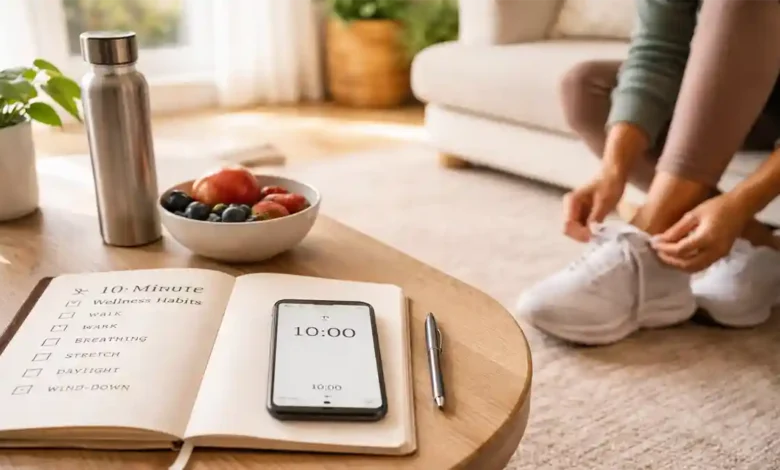
10 minute wellness habits are the most underrated way to feel better fast because they work with real life instead of fighting it. When your day is busy (or messy, or stressful, or just full), big plans often collapse. Not because you lack willpower, but because the plan requires perfect conditions.
Ten minutes does not. Ten minutes is small enough to be realistic and meaningful enough to create momentum. It’s the sweet spot where you can act even on a low energy day, and where consistency becomes possible.
This deep dive guide gives you seven simple habits that each take about 10 minutes. They are designed to improve energy, stress response, mobility, focus, and sleep without needing special equipment, expensive products, or a dramatic personality transformation.
You’ll also get:
- clear steps for each habit,
- variations for different lifestyles,
- “2 minute fallback” options for chaotic days,
- and practical strategies to make the habit stick.
You don’t need to start all seven. In fact, you shouldn’t. Pick one that solves your biggest daily problem and make it your anchor.
Why 10 Minutes Works (When Big Plans Fail)
If you have ever tried to “get healthy” by changing everything at once, you already know the pattern:
- You start strong.
- Life happens.
- You miss a day.
- You feel behind.
- You quit.
Small habits break that cycle. Here’s why:
(1) Low friction beats high motivation
Motivation is unreliable. A habit with fewer steps survives your real schedule. Ten minutes is short enough that your brain doesn’t fight it as much.
(2) Consistency builds identity
The most powerful long term change is not a perfect week; it’s the belief: I’m someone who takes care of myself. That identity forms through repetition.
(3) Small habits scale naturally
Once a habit becomes automatic, it grows. Ten minutes can turn into fifteen, then twenty without drama. But the foundation is the part most people skip: consistency.
(4) Wellness is a system, not a mood
On hard days, a 10 minute routine functions like a reset button. You’re not chasing an ideal version of life. You’re creating a system that works inside the life you already have.
The 7 Habits (Pick One and Start Today)
- The 10 minute walk (fastest whole body upgrade)
- Mindful breathing (nervous system reset)
- Mobility flow (anti stiffness, pro energy)
- Hydration ritual (simple, high impact)
- Smart snack prep (steady energy, fewer cravings)
- Daylight + screen break (focus and sleep support)
- Wind down routine (sleep hygiene that’s actually doable)
Let’s break each one down in a modern, practical way.
(1) The 10 Minute Walk Habit: Your “Movement Minimum”
If you want the highest return on ten minutes, start here.
Walking is accessible, low risk for most people, and flexible. It doesn’t require a gym. It doesn’t require perfect weather. It fits around family, work, and daily responsibilities.
Major guidelines (including those discussed by World Health Organization) emphasize that moving more is beneficial and that activity adds up over the week. A short walk is one of the simplest ways to start building a daily wellness routine that lasts.
The 10 minute walk structure (simple and effective)
- Minute 1–2: easy pace, shoulders relaxed
- Minute 3–8: brisk pace (you can talk, but you feel warmer)
- Minute 9–10: slow down, breathe deeper, unclench jaw and hands
If you’re short on time, do this “walk sandwich”
- 3 minutes brisk
- 2 minutes easy
- 3 minutes brisk
- 2 minutes easy
This keeps it interesting and makes the ten minutes feel more purposeful.
Small benefits you may notice quickly
- clearer head (especially after screen heavy work)
- less restlessness
- better mood “baseline”
- smoother digestion after meals
- less afternoon slump
Walking isn’t just “exercise.” It’s also a nervous system tool.
Real life versions (so you don’t overthink it)
- At home: hallway laps, walking during a call, marching in place
- At work: a loop in the parking area, stairs for 2 minutes, then flat walking
- In the city: walk to buy one small thing you already need
- With family: walk after dinner as a “closing ritual” for the day
2 minute fallback (for chaotic days)
Put on shoes and walk out the door. Walk for two minutes. Turn back.
This sounds tiny and that’s the point. You’re keeping the habit alive.
Make it stick (best cue)
Attach the walk to a fixed event:
- after lunch
- right after you return from work
- after the first cup of tea/coffee
- immediately after Maghrib/Isha (if evening routines work for you)
(2) Mindful Breathing: A 10 Minute Stress Reset You Can Do Anywhere
Stress isn’t just a feeling. It’s a body state. And when the body is tense, your decisions tend to be worse:
- you snack mindlessly,
- you scroll longer,
- you avoid tasks,
- you snap at people you care about,
- you stay “tired but wired.”
Mindful breathing helps because it changes your physiology: slower breath, lower tension, calmer attention.
Evidence summaries from American Psychological Association discuss mindfulness and meditation as practical tools for stress reduction and well being. You don’t need to be spiritual, perfect, or experienced. You need a simple routine you can repeat.
The 10 minute routine (beginner friendly)
Minute 1–2: settle
- Sit comfortably or stand.
- Drop shoulders.
- Breathe in through your nose, exhale slowly.
Minute 3–7: the “counted breath”




- Inhale for a count of 4
- Exhale for a count of 6
If that feels hard, shorten the count. The goal is gentle rhythm, not strain.
Minute 8–10: one question + one action
Ask yourself:
“What is the next small helpful thing I can do?”
Then choose one:
- drink water
- reply to one important message
- start a task for two minutes
- tidy one small area
- step outside for light
Mindfulness becomes powerful when it leads to a practical next step.
Common mistakes (so you don’t quit)
- Trying to “empty the mind.” Not necessary. Your mind will wander. Returning is the training.
- Doing it only when things are perfect. This works best on normal days.
2 minute fallback
Do five slow exhales. That’s it.
Five slow exhales can interrupt a stress spiral and give you space to respond instead of react.

(3) Mobility Flow: The 10 Minute Anti Stiffness Routine
If your body feels heavy, tight, or stiff especially after long sitting mobility is the fastest relief habit on this list.
Mobility isn’t about extreme flexibility. It’s about comfort and range of motion: shoulders that move smoothly, hips that don’t feel locked, a back that feels supported instead of fragile.
The 10 minute mobility flow (no equipment)
Do 45 seconds each, 15 seconds to switch:
- Neck slow turns (left/right, gentle)
- Shoulder rolls + scapular squeezes
- Cat cow (on hands/knees or standing hands on thighs)
- Hip circles (slow, controlled)
- Forward fold (knees bent, relax head/neck)
- Low lunge stretch (left)
- Low lunge stretch (right)
- Squat hold (use a chair for support if needed)
- Calf stretch (wall)
- Standing reach + 5 slow breaths
This is a “quick stretch routine” that helps you feel more awake without needing intensity.
Best times to do mobility
- after waking up (especially if mornings feel stiff)
- after work (to “close” sitting posture)
- after a long drive
- before bed (if your body needs softness to sleep)
2 minute fallback
Pick two:
- shoulder rolls + forward fold
Two minutes is enough to signal your body: “We’re not frozen in this posture forever.”
Safety note (simple and smart)
Stretch should feel like gentle intensity, not sharp pain. If something feels wrong, reduce range of motion or skip that move.
(4) Hydration Ritual: The One Bottle Habit
Hydration is often overlooked because it sounds too basic. But “basic” is where many wellness problems start:
- low energy,
- headaches,
- poor focus,
- cravings that feel random.
Guidance summaries from Mayo Clinic and public health education from Harvard T.H. Chan School of Public Health both emphasize that fluid needs vary by person, environment, and activity so the best habit is one you can actually repeat.
The 10 minute hydration ritual
Minute 1–2: create the cue
- Fill a bottle or big glass.
- Put it where you naturally reach for it (desk, kitchen counter).
Minute 3–10: sip with a mini reset
While sipping, do one of these:
- stand by a window and look far away (eye break + calm)
- write a 3 line plan for the next hour
- do light stretches
- do slow breathing
This turns “drink water” into a small wellness moment instead of a forced task.
Helpful upgrades (without turning it into a project)
- Add lemon or mint if taste helps
- Use a bottle you actually like (this matters more than people admit)
- If you sweat a lot, consider electrolytes occasionally (especially in heat), but don’t overcomplicate it
2 minute fallback
Drink half a glass of water right now.
Tiny actions reduce friction and keep the habit alive.
Note for medical situations
If you have a condition that requires fluid restriction, follow your clinician’s advice.
(5) Smart Snack Prep: 10 Minutes to Stabilize Your Energy
Many “bad wellness days” are actually unstable energy days. When hunger swings hard, your mood and focus follow.
Smart snacking is not diet culture. It’s practical fuel management.
A simple principle is: fiber + protein (and sometimes healthy fat). This combination tends to keep you full longer and reduces the crash that comes from sugary, refined snacks alone.
The 10 minute snack prep system
Prep 2–3 servings of one option:
- Greek yogurt + berries + nuts
- Apple + peanut/almond butter
- Hummus + carrots/cucumber
- Boiled eggs + cherry tomatoes
- Cottage cheese + sliced fruit
- Chickpeas + olive oil + lemon + spices
- Tuna + whole grain crackers + cucumber
You’re building a “default snack” that protects you when you’re busy.
Make it easier than ordering food
- Put snacks at eye level in the fridge
- Keep one “desk snack” option (nuts, roasted chickpeas, protein bar with decent ingredients)
- Decide your snack before you’re hungry (hunger is not a great decision-maker)
2 minute fallback
Pick one whole food:
- a banana
- a handful of nuts
- a yogurt
- a boiled egg
Two minutes of smart choice beats twenty minutes of regret.
(6) Daylight + Screen Break: 10 Minutes for Focus and Better Sleep Support
This habit is simple but powerful because it targets two modern problems:
- we spend a lot of time indoors,
- we spend a lot of time staring at screens.
Daylight exposure helps your body understand the timing of the day. Screen breaks help your eyes and attention recover.
Practical recommendations for reducing digital eye strain are widely shared by American Academy of Ophthalmology, including taking regular breaks and changing focus distance.
The 10 minute routine
Minute 1–7: get light
- Step outside if possible.
- If not, stand by a bright window.
- Look far into the distance (not at your phone).
Minute 8–10: posture + eye reset
- Roll shoulders back
- Relax jaw
- Look at something far away
- Take 5 slow breaths
Best times to do this
- mid morning (for focus)
- early afternoon (to reduce post lunch brain fog)
- late afternoon (to prevent the “scroll spiral”)
2 minute fallback
Stand up. Look far away for 20 seconds. Repeat three times.
Even this micro break helps your eyes and your mind.

(7) Wind Down Routine: 10 Minutes of Realistic Sleep Hygiene
Sleep is a multiplier. When sleep improves, many other habits become easier:
- cravings reduce,
- mood stabilizes,
- exercise feels less painful,
- stress tolerance increases.
But long, perfect night routines don’t survive real life. The answer is a short routine you can repeat even when you’re tired.
Sleep hygiene education from Harvard Medical School emphasizes consistency and wind-down cues: your brain likes patterns.
The 10 minute wind down routine
Minute 1–3: change the environment
- Dim lights
- Put your phone on charge away from your bed (even a small distance helps)
Minute 4–7: calm the body
Choose one:
- gentle stretching
- slow breathing
- quick wash/shower (signals “day is done”)
Minute 8–10: 3 line journal
Write:
- One thing that went okay today
- One thing you appreciate
- One small win you want tomorrow
This is where gratitude journaling becomes practical: not forced positivity, just mental closure.
2 minute fallback
Dim the lights and do five slow breaths.
If that’s all you do, you still trained your body to associate “calm cues” with bedtime.
How to Choose the Right Habit (So You Don’t Quit)
Here’s the most effective selection method:
Step 1: Identify your biggest daily pain
- Low energy? Start with walking or hydration
- High stress? Start with mindful breathing
- Stiff body? Start with mobility
- Cravings and crashes? Start with smart snack prep
- Poor sleep? Start with wind down
- Brain fog from screens? Start with daylight + break
Step 2: Make it specific (when, where, how)
Instead of: “I’ll do it daily,” use:
- “After lunch, I walk for 10 minutes.”
- “At 3:30 p.m., I do my daylight break.”
- “After brushing teeth, I drink water.”
Specificity removes negotiation.
Step 3: Decide your minimum
Your minimum is what you do on a bad day:
- 2 minute walk
- 5 slow breaths
- 2 stretches
- half a glass of water
- one smart snack
- 20 second eye break
- dim lights + breathe
The habit survives because the minimum is easy.
Habit Stacking: Make Wellness Automatic
A powerful trick is to “stack” a new habit onto a habit you already do.
Examples:
- After I make tea, I drink a glass of water.
- After I close my laptop, I do mobility for 10 minutes.
- After lunch, I walk.
- After I put my phone on charge, I do 3 line journaling.
This turns wellness into a sequence, not a decision you re-make daily.
What to Expect (So You Don’t Get Discouraged)
People often quit because they expect instant transformation. A better expectation:
In the first 3 days
- you feel proud you’re doing something
- you notice small improvements (a calmer moment, a lighter body, a better afternoon)
In 2 weeks
- the habit feels easier
- you miss it when you skip it
- you start stacking a second habit naturally
In 4–8 weeks
- your “baseline” improves
- you feel more in control of your day
- wellness stops feeling like a project
Progress is not loud. It’s consistent.
Common Obstacles (and Practical Fixes)
“I forget.”
Fix: set a single daily alarm with a clear label: “10 minute reset.”
“I don’t have time.”
Fix: choose a habit that fits into an existing gap (after lunch, before shower, after work). Also use the 2-minute minimum.
“I start strong, then stop.”
Fix: don’t raise the difficulty when motivation is high. Keep it the same for two weeks. Consistency first, intensity later.
“I feel guilty if I miss a day.”
Fix: use the “never miss twice” rule. Missing once is normal. Missing twice is where the habit disappears.
Quick FAQ
Which 10 minute wellness habit should I start with first?
Start with the habit that solves your biggest daily problem. If you’re unsure, choose the 10 minute walk it supports mood, energy, and overall routine building.
Can 10 minutes a day actually improve my health?
Yes. Ten minutes is enough to build consistency, and consistent activity and stress reduction habits compound over weeks.
What if I miss a day?
Don’t restart from zero. Use “never miss twice.” Do the 2 minute minimum the next day and move on.
Are micro habits for health better than big routines?
For most people, yes because they’re easier to maintain. Big routines can be great, but only after you’ve built the habit identity.
What’s the fastest habit for stress relief?
Mindful breathing. It’s immediate, portable, and helps you shift from reactive mode to calm focus.
What’s the best habit for better sleep hygiene?
A 10 minute wind down routine. Keep it consistent: dim lights, reduce phone exposure, and do a short calming cue like breathing or journaling.
How do I reduce screen fatigue quickly?
Do a screen free break with distance vision: look far away, relax posture, and breathe slowly for a couple of minutes.
How can I turn this into a daily wellness routine without overdoing it?
Pick one habit for 14 days. Once it feels automatic, add a second. Your goal is a system that fits your life, not a schedule you resent.
Strong Conclusion: Your Next 10 Minutes Matter
Wellness is not built by a perfect plan. It’s built by the small actions you repeat when life is normal and when life isn’t.
If you start one of these 10 minute wellness habits today, you’ve already done the hardest part: you’ve chosen momentum over waiting.
Pick one habit.
Make it specific.
Keep a 2 minute minimum for tough days.
Repeat it for 14 days.
Your future self doesn’t need you to be extreme. They need you to be consistent.






4 Comments