Saudi Exit Re-Entry Visa Expired (2026): Ban, Fines, Fix
Saudi exit re-entry visa expired if you’re reading this, there’s a good chance you’re either (1) outside Saudi Arabia and can’t fly back, or (2) still inside Saudi and realizing you issued a visa but didn’t travel, and now the system is angry.
Either way, this is one of those small date, big consequences problems. The solution is usually straightforward once you identify the exact scenario. The mistake most people make is applying the wrong fix to the wrong case then wasting days, paying avoidable penalties, or getting bounced between sponsor HR and Jawazat help desks.
This 2026 guide is built for real life: it explains what expired means in Saudi systems, how fines are triggered, what changed about the old ban fear, and what to do step by step depending on where you are and who your sponsor is.
1. What an Exit/Re-Entry Visa Really Is and What Expired Means
For an Iqama holder, an exit/re-entry visa is not just permission to travel. It’s a time limited authorization tied to your residency record. In practice, you’re dealing with two clocks:
Clock A: The exit/re-entry return deadline
This is the date by which you must re-enter Saudi Arabia.
Clock B: Your Iqama validity
Many online services require your Iqama to be valid for a minimum period to issue or extend visas. Absher’s own guidance for extending exit/re-entry for sponsorees outside the Kingdom states the residence permit must be valid for 90 days, and the return date must be no later than seven days before the Iqama expires.
When people say my visa expired, they could mean one of four common situations:
- You are outside Saudi and your return deadline passed.
- You are inside Saudi and your issued visa became unusable because you never traveled and didn’t cancel it.
- A dependent is outside Saudi and their visa expired while yours may still be valid.
- Your Iqama or passport validity is too short to allow an extension even if the visa itself was recently valid.
Each case has a different path and a different set of restrictions.
2. The Ban Question in 2026: What Changed and What Didn’t
For years, many expats repeated a scary rule: If your exit/re-entry expires while you’re outside, you get a three year ban.
Saudi Jawazat lifted the three year entry ban for expatriates who left on an exit and re-entry visa and did not return before it expired. Multiple sources report the directive came into force on January 16, 2024.
What that means for you today
- The old automatic three year ban is not the default assumption anymore.
- But an expired visa can still create real world blocks: you may be unable to board flights, your sponsor may close your file, and you may need a fresh visa route if extension isn’t possible.
Think of it this way: the fear narrative changed, but the need for valid authorization did not.
3. Consequences: What Actually Happens When the Visa Expires
Scenario A: You’re outside Saudi Arabia and your exit/re-entry expired
This is the emergency scenario because travel becomes the immediate bottleneck.
What typically happens:
- Airline check in systems often require proof of valid re-entry authorization for residents. If the visa is expired, you may be refused boarding.
- Your sponsor (employer or head of household) usually must take action through Absher/Muqeem service flows to extend or correct the record.
- If your Iqama validity is too short, extension may fail because Absher’s extension conditions require minimum Iqama validity and a return date buffer.
Reality check: being not banned is not the same as being allowed to board. You still need the system to show a valid re-entry permission.
Scenario B: You’re inside Saudi Arabia but the exit/re-entry expired unused
This is more common than people admit. You issued the visa, plans changed, and you forgot to cancel.
Saudi MOI lists a penalty for not reporting to cancel or renew an exit/re-entry (or final exit) before its expiry, with escalating fines:
- 1,000 SAR (first instance)
- 2,000 SAR (second instance)
- 3,000 SAR (third instance)
This is not a maybe it’s clearly stated in MOI’s published violation list.
What you usually see in real life:
- The system may block issuing a new visa until the old one is addressed.
- You may be prompted to pay a fine depending on timing and record history.
- Sponsors often discover the problem only when trying to issue a new visa for an urgent trip.
Scenario C: A dependent is outside and their visa expired
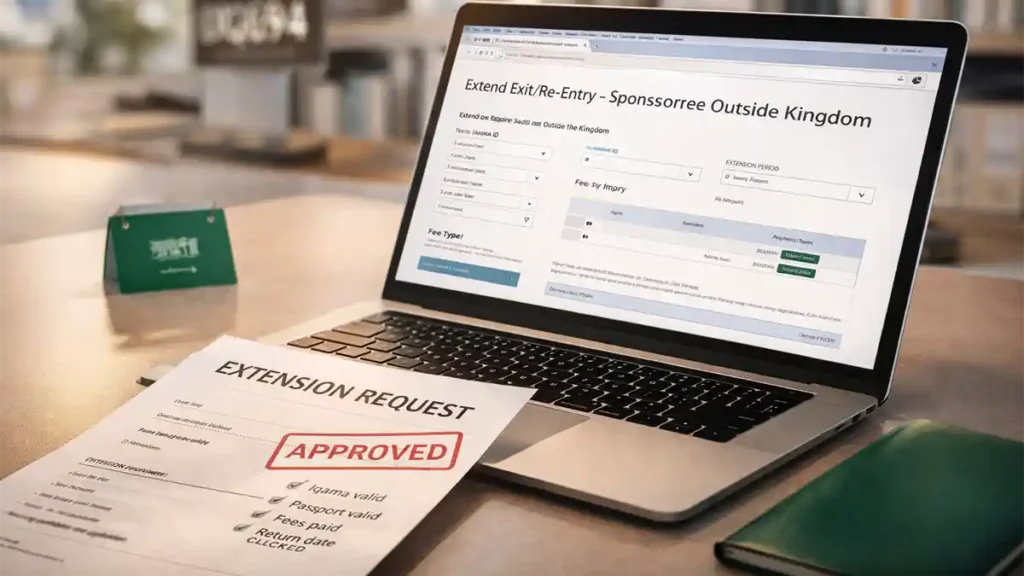
Dependents can be extended through the service Extend Exit and Re-entry for Sponsorees Outside Kingdom on Absher.
But dependents are affected by the same rule set: Iqama validity and the return date buffer still matter.
4. Fines vs Fees: Don’t Confuse These Two Costs
People lose money because they mix up fees and fines.
A. Fines (penalties for violations)
The MOI fine for not canceling/renewing before expiry is explicitly listed as 1,000 / 2,000 / 3,000 SAR based on repeat instances.
B. Fees (standard charges for visas and extensions)
Separately, visa issuance and extension have fees. Gulf News (citing Jawazat clarification) reported typical fee levels, such as:
- Single exit/re-entry: 200 SAR for up to two months, plus additional monthly charges
- Multiple exit/re-entry: 500 SAR for up to three months, plus additional monthly charges
Fee schedules can be updated; always treat the portal’s displayed payment as final. Still, this gives you a realistic range.
C. Can I cancel and get a refund?
Jawazat has repeatedly clarified that exit and re-entry visa fees are non refundable even if the visa is canceled.
That one detail changes how you should plan travel, especially if your dates are uncertain.
5. The Fix in 2026: Choose the Correct Path
Below are practical workflows that match how Absher/Muqeem systems are described and how sponsors typically resolve cases.
Fix Path 1 (Outside KSA): Extend the exit/re-entry (if eligible)
Step 1 – Verify the three gatekeeper items
Before your sponsor even clicks extend, check:
- Iqama validity: Absher’s extension guidance requires the Iqama to be valid for 90 days.
- Return date buffer: the return date must be no later than seven days before Iqama expiry.
- Your passport validity: airlines and immigration systems are unforgiving when the passport is near expiry.
If (1) or (2) fails, extension commonly fails.
Step 2 – Sponsor uses the correct service on Absher/Muqeem
For many categories, the sponsor must use the service specifically designed for sponsorees outside the Kingdom. The Saudi government services directory also lists the workflow under this service name.
Step 3 – Confirm the extension is fully processed before booking
A frequent travel mistake is assuming fees paid equals authorization updated. You want the portal record to show the revised validity/return date clearly.
Step 4 – If extension is blocked, escalate to the new visa plan
If the Iqama is expiring soon, the sponsor may have to renew Iqama first (where possible) or proceed with alternative HR/legal routes depending on employment status.
Fix Path 2 (Inside KSA): Cancel the unused/expired visa properly
If you never traveled, the first goal is clearing the record to stop blocks and fines from compounding.
Step 1 – Cancel within the allowed window
Absher’s cancellation guidance states the cancellation must be completed within 90 days from issuance or before the return date (whichever comes first).
Step 2 – Confirm the person is inside the Kingdom at time of cancellation
Absher’s cancellation rules note that the person whose visa is being canceled must be in the Kingdom.
Step 3 – Pay any fine if the system applies it
If the visa expired and wasn’t canceled/renewed in time, MOI’s violation schedule applies.
Once the fine is cleared and the old visa is closed, sponsors can issue a new exit/re-entry when needed.
Important money point: cancellation does not usually mean a refund; Jawazat has clarified fees are non refundable.
Fix Path 3 (Dependents outside): Extend through the sponsoree extension service
This is a sponsor led action. Your sponsor typically:
- logs into Absher,
- selects the service to extend exit/re-entry for sponsorees outside the Kingdom,
- selects the dependent record,
- pays the required fee, and
- confirms the updated return authorization.
The same two constraints still apply:
- Iqama validity must meet minimum requirements (90 days).
- Return date must sit within the allowed buffer before Iqama expiry.
6. Common Stuck Cases and How to Handle Them Without Guesswork
Case 1: My Iqama expires soon can I still extend?
Often, no. Absher’s rules explicitly connect extension eligibility to Iqama validity and return date buffer.
If your Iqama is too close to expiry, your sponsor may need to renew the Iqama first (when possible) before attempting extension.
Case 2: My sponsor isn’t responding
If you’re outside Saudi and your sponsor doesn’t act, your options narrow quickly because sponsor permissions typically drive resident visa actions. The practical move is to escalate within the company (HR manager, PRO/mandoub), because they handle Jawazat facing steps daily.
Case 3: I canceled, but I expected a refund
This is a painful lesson for many travelers. Jawazat has clarified that exit re-entry fees are non refundable even after cancellation.
Plan issuance timing carefully to avoid paying twice.
Case 4: I issued a visa ‘just in case’ and forgot
This is how people fall into the MOI fine schedule. If the visa expires unused without cancellation/renewal, the penalty can apply.
7. A Practical Prevention Checklist (2026)
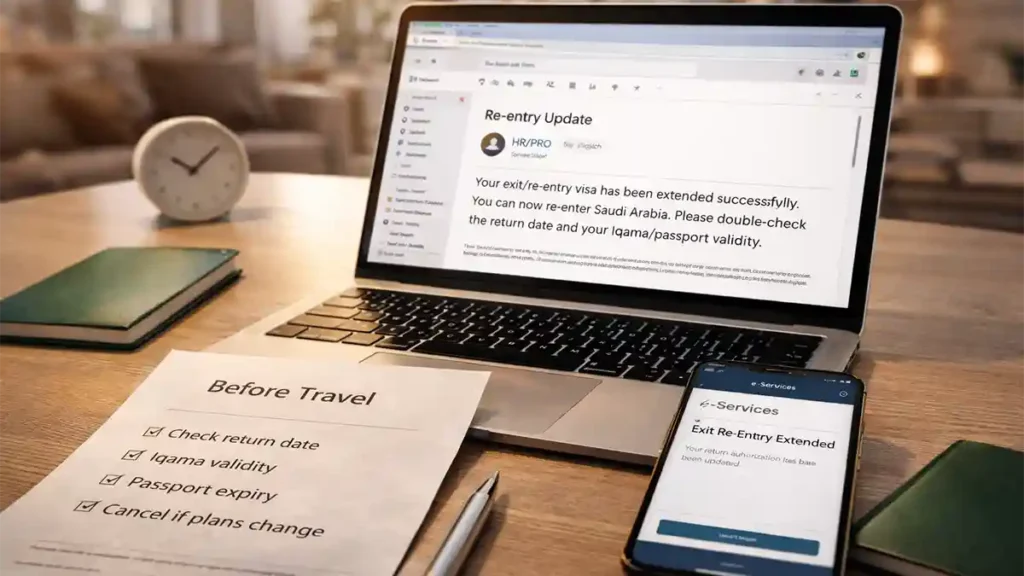
If you manage your own travel or you’re a sponsor/HR team managing many employees prevention is cheaper than fixing.
Before issuing the visa
- Confirm travel dates are real (not maybe).
- Check Iqama validity and create a buffer that satisfies Absher’s extension rules (90 days validity; return date not later than 7 days before Iqama expiry).
- Decide whether you need single or multiple exit/re-entry and understand the cost structure.
If travel plans change
- If you decide not to travel, cancel within the allowed time window (90 days from issuance or before return date, whichever comes first).
- Don’t delay because you might still go. If the date passes, you can trigger penalties.
While outside the Kingdom
- Set two reminders: one for the return date, another 10-14 days before it.
- If an emergency comes up, tell your sponsor early. Extensions are not magic; they require eligibility and processing time.
For employers (simple internal control that saves money)
Create a basic travel tracker with:
- employee/iqama number
- visa type (single/multiple)
- issuance date
- return date
- iqama expiry
- passport expiry
This reduces last minute airport incidents, and it also reduces duplicated fees (which won’t be refunded if canceled).
8. Quick Myth Busting Because Bad Advice Spreads Fast
Myth 1: Expired exit/re-entry means an automatic multi year ban
The three year entry ban for failing to return before expiry was lifted (effective January 16, 2024).
Myth 2: If I’m not banned, I can just fly back
You still need valid authorization; airlines and systems will check eligibility and documentation.
Myth 3: Canceling gives a refund
Jawazat has clarified fees are non refundable even after cancellation.
Myth 4: If I don’t travel, nothing happens
If the visa expires unused and you didn’t cancel/renew, MOI lists a clear fine schedule.
9. Realistic Examples So You Can Identify Your Situation Instantly
Example A: Worker outside KSA, visa expired yesterday
A resident in Pakistan discovers the return date passed. Airline refuses boarding because re-entry is not valid.
Fix: sponsor attempts extension using the sponsoree outside service, provided Iqama validity meets Absher requirements.
Example B: Resident inside KSA, issued visa but never traveled
A resident issued an exit/re-entry, then postponed travel. Weeks later, the visa expires.
Fix: cancel within the allowed window; if expiry already happened, pay the fine if applied, then issue a fresh visa when needed.
Example C: Dependent outside KSA, sponsor tries to extend but Iqama is near expiry
Sponsor tries the extension but fails because the Iqama doesn’t meet the required validity, or the return date would land too close to Iqama expiry.
Fix: renew Iqama first (if possible), then repeat the extension process under the same Absher conditions.
Quick FAQ
What should I do first if my Saudi exit re-entry visa expired outside the Kingdom?
Check Iqama validity and contact your sponsor immediately to attempt extension through the sponsoree outside service, if eligible.
Is the old three year ban still applied in 2026 for not returning on time?
Jawazat lifted the three year entry ban for this situation, effective January 16, 2024.
Can I get fined if I issued an exit/re-entry but never traveled?
Yes. MOI lists fines for failing to cancel/renew before expiry: 1,000 SAR first, 2,000 second, 3,000 third.
What are the key Absher conditions to extend exit/re-entry for someone outside Saudi?
Absher states Iqama must be valid for 90 days, and the return date must be no later than seven days before Iqama expiry.
How long do I have to cancel an exit/re-entry visa after issuing it?
Absher states cancellation must be completed within 90 days of issuance or before the return date whichever comes first.
If I cancel, will Jawazat refund the visa fee?
No. Jawazat has clarified exit/re-entry visa fees are non refundable even after cancellation.
What are typical exit/re-entry visa fees (single vs multiple)?
Gulf News reported typical fee levels: single 200 SAR (up to two months) and multiple 500 SAR (up to three months), with additional monthly charges.
My dependent is outside Saudi can their expired exit/re-entry be extended?
Sponsors can extend for sponsorees outside the Kingdom using the relevant Absher service, subject to the same eligibility rules.
Conclusion
When Saudi exit re-entry visa expired becomes your problem, the fastest solution is not panic it’s precision. Start by identifying where the person is (inside or outside Saudi), then check Iqama validity against Absher’s extension conditions, and finally apply the correct workflow: extend (outside cases) or cancel/clear the old record (inside unused cases).
The 2024 change that lifted the three year ban reduces fear, but it doesn’t remove the need for valid authorization and clean records.
Handle it early, and you avoid fines, duplicate fees that won’t be refunded, and last minute travel failures.






2 Comments