Pakistan’s Energy Shift Into a Crypto & AI Hub

Pakistan Crypto AI Hub: How Pakistan Is Turning Excess Power into a Crypto & AI Hub. Pakistan is entering a critical moment in its digital evolution. At a time when the world is racing toward artificial intelligence (AI), blockchain, high-performance computing, and digital currencies, Pakistan is discovering a surprising advantage: excess electricity. What was once seen as a burden on the national grid is now emerging as an unexpected opportunity one that could help transform Pakistan into a regional crypto and AI hub.
This shift is not accidental. It is the result of structural changes in the power sector, the rise of new digital technologies that require massive computing capacity, and the global trend of countries monetizing surplus power by attracting data centers, mining operations, and AI model-training facilities.
In this in-depth article, we explore why Pakistan is suddenly becoming an attractive destination for crypto mining, data centers, and AI infrastructure; what challenges still exist; and how the country can leverage this moment to build a sustainable digital economy.
1. Understanding Pakistan’s Surplus Power Problem and Opportunity
Pakistan’s power sector has long struggled with a paradox: the country often produces more electricity than it consumes, yet still faces financial losses. This happens because Pakistan’s energy system has large capacity payments where the government must pay power producers even if the electricity is not used.
According to various policy reports, Pakistan’s installed power generation capacity is over 43,000 MW, while demand rarely crosses 28,000 MW, leaving a huge unused chunk. During winters, the gap becomes even wider, with excess electricity flowing unused because the system cannot store it.
This unused power has a cost. It increases circular debt, pressures the economy, and limits investment in other sectors.
But in the digital era, excess energy isn’t useless at all. Around the world, countries with surplus power such as Kazakhstan, Iceland, and certain US states have turned this challenge into an opportunity by hosting:
Crypto mining operations
AI training data centers
High-performance computing clusters
Blockchain server farms
Cloud infrastructure zones
These industries require massive electricity, stable grid supply, and affordable rates exactly what Pakistan’s surplus power can offer.
2. Why Crypto Mining Loves Surplus Electricity
Crypto mining is essentially a global competition of computers solving mathematical puzzles to validate transactions on blockchain networks like Bitcoin. This process demands:
Continuous electricity
Stable grid access
Cool climates (to reduce cooling costs)
Low-cost land and labor
Pakistan, especially northern regions like Gilgit-Baltistan, Khyber Pakhtunkhwa, and parts of Punjab, meets these criteria naturally.
Government Experiments in KP
A few years ago, the Khyber Pakhtunkhwa government even launched pilot projects to explore state-backed crypto mining. Although regulatory challenges slowed progress, the idea revealed the economic potential of using Pakistan’s energy surplus to mine digital assets.
A Simple Formula
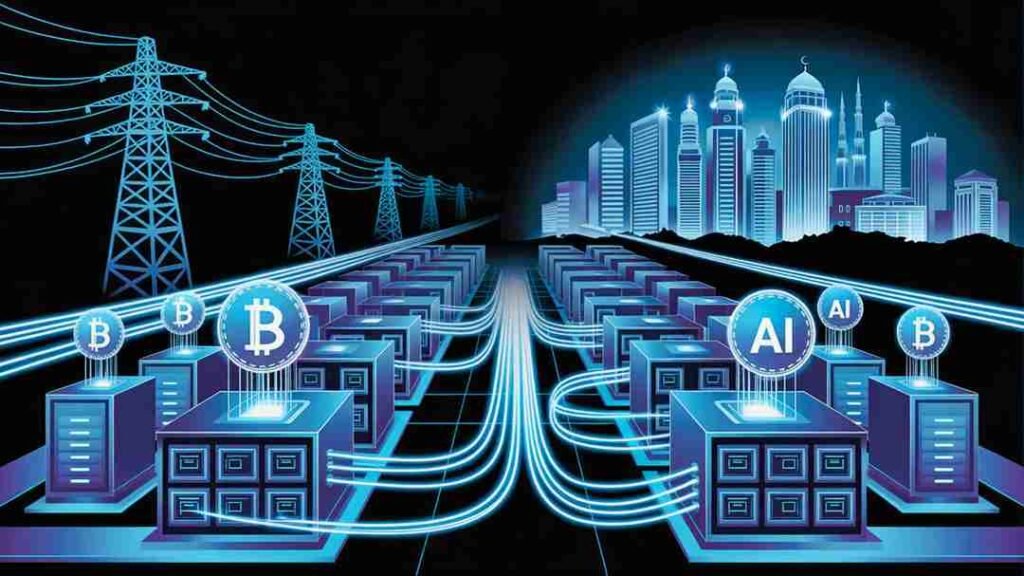
Excess Electricity → Mining Power → Digital Currency → Economic Value
Countries like El Salvador, Georgia, and Kazakhstan have turned similar strategies into multi-million-dollar revenue streams.
If Pakistan follows the model carefully, crypto mining farms could:
Generate new revenue
Reduce economic pressure from unused energy
Create skilled jobs in hardware, networking, and engineering
Attract foreign investment
3. Data Centers: The Backbone of AI & Cloud Computing
While crypto mining is energy-intensive, AI data centers demand both energy and sophisticated computing infrastructure.
AI model training like training large language models (LLMs), computer vision models, or analytics systems requires:
Thousands of GPUs
24/7 electricity
High-speed fiber networks
Advanced cooling solutions
Countries with surplus power often attract global cloud service providers because they offer lower operating costs.
Pakistan’s Growing Advantage
Pakistan’s cost of electricity during surplus hours can drop significantly. For large-scale data center operators, this creates an environment where running a GPU cluster or AI training facility becomes far cheaper than in Europe, Singapore, or the Middle East.
Companies in the UAE, Qatar, and Saudi Arabia are already exploring partnerships to build infrastructure in Pakistan because:
It is geographically close
It offers lower labor and energy costs
It has a large tech talent pool
It can support cooling due to its varied climate zones
If properly marketed, Pakistan could emerge as a regional GPU hub providing hosted AI training capacity to startups and tech companies across South Asia and the Middle East.
4. How AI Development Fits Into Pakistan’s Digital Vision
Pakistan’s AI ecosystem is still young, but fast-growing. Universities and private firms are increasingly investing in:
Machine learning
Natural language processing
Computer vision
Robotics
Data science
The government has also launched AI policies aimed at boosting skills and digital infrastructure.
But AI development requires computing power, which Pakistan lacked until now.
Excess Energy + Data Centers = AI Boom
If Pakistan channels its surplus electricity toward GPU farms, it can offer:
Low-cost AI model training services
Cloud GPU rentals
Local hosting for tech startups
National AI supercomputing resources
This would not only accelerate Pakistan’s digital transformation but also reduce dependence on foreign cloud providers like AWS, Google Cloud, or Oracle Cloud.
5. Global Examples: How Other Countries Monetized Excess Power
To understand Pakistan’s potential, it helps to look at how other nations used surplus electricity to become digital powerhouses.
Iceland: Renewable Energy → Global Data Center Hub
With nearly free geothermal power, Iceland attracted data centers from major tech firms. Today, it hosts blockchain farms, AI training centers, and cloud infrastructure.
Kazakhstan: Surplus Coal Power → Crypto Mining Capital
After China banned crypto mining in 2021, Kazakhstan’s cheap energy and open land made it a top destination for Bitcoin miners.
El Salvador: Volcano Energy → Bitcoin Mining
The country turned geothermal power from volcanoes into a Bitcoin mining facility turning natural resources into digital assets.
Pakistan can follow a similar model by leveraging:
Hydropower in KP and GB
Solar and wind in Punjab and Sindh
LNG-based surplus in winter months
6. Pakistan’s Digital Economy Is Ready to Scale
Pakistan’s tech ecosystem is evolving rapidly:
Freelancers earned over $350 million annually.
Startups attracted record investment during peak years.
Digital banking and fintech are expanding.
Government institutions are moving services online.
A strong AI and crypto infrastructure would boost all of these sectors by providing:
Faster cloud services
Local GPUs for training models
Lower costs for startups
Better digital security through blockchain
More opportunities for tech-focused entrepreneurship
7. Policy, Regulations & Challenges
Despite the opportunities, Pakistan must address several challenges to fully unlock the potential.
1. Clear Crypto Regulations
Uncertainty around crypto legalization and taxation discourages large foreign investors. Clear frameworks are needed similar to UAE or Singapore.
2. Transparent Electricity Pricing
Data center investors need predictable long-term energy rates.
3. Internet Backbone Improvements
High-performance computing requires stable, low-latency fiber networks.
4. Political Stability
Global investors want assurance that policies won’t change suddenly.
5. Digital Security
Data centers require strong cybersecurity regulations to protect both local and foreign clients.
Solving these issues would make Pakistan a strong contender in the global digital infrastructure race.
8. The Economic Impact: Billions in Potential Revenue
If Pakistan builds AI, crypto, and computing zones around surplus electricity hubs, it could generate:
Potential Gains
New foreign investment in data centers
Export of AI computing power
Revenue from blockchain hosting
New tech jobs for engineers and technicians
Reduced circular debt by monetizing unused energy
Conservative estimates from global case studies show that a single large scale crypto or AI data center can produce:
$50-$500 million in investment
Hundreds of skilled jobs
Millions in annual tax revenue
With multiple zones across Pakistan, the impact could reach billions.
9. What the Future Looks Like
If Pakistan continues on this path, we can expect:
1. Digital Energy Zones
Areas where surplus electricity is offered at special rates for blockchain and AI firms.
2. AI Training Superclusters
GPU farms built through public-private partnerships.
3. State Backed Crypto Platforms
Secure mining facilities to generate national digital reserves.
4. Regional Cloud Hosting Services
Competing with UAE, Qatar, and India.
5. Employment Growth
From electrical engineers to software developers and hardware technicians.
Pakistan is positioned to leap forward in its digital economy and using excess electricity may be the unexpected catalyst the country needs.
Conclusion
Pakistan’s surplus power is not a burden anymore it is a hidden strength. In a world driven by computing power, energy is the currency of the digital age. Countries that harness their electricity smartly become centers of innovation, cloud computing, artificial intelligence, and cryptocurrency infrastructure.
By channeling unused electricity into crypto mining, data centers, and AI superclusters, Pakistan has the chance to:
Strengthen its economy
Reduce energy sector losses
Attract global investors
Build a future ready digital ecosystem
With the right policies and investments, Pakistan can truly transform its surplus energy into a powerful engine for technological growth and become a recognized Crypto & AI Hub in the region.






2 Comments