Pakistan’s Indus River Dolphin: The Real Story of a Rare National Treasure
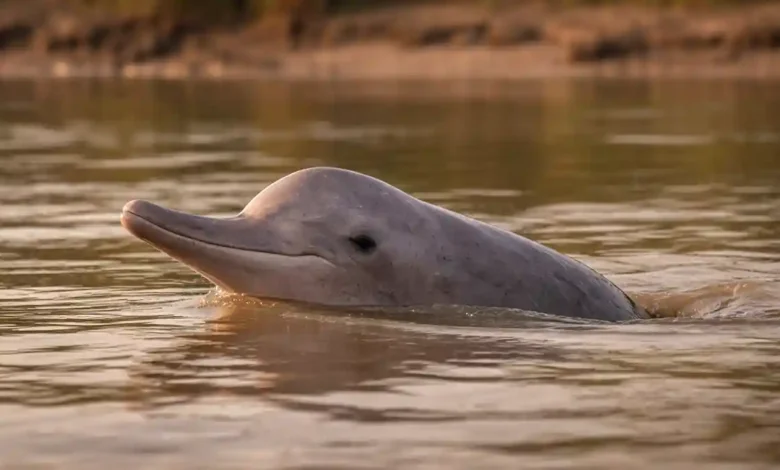
Pakistan’s Indus River Dolphin is one of the most remarkable animals in South Asia, yet it remains unknown to many people even inside the country. It does not live in the sea. It does not leap through clear blue water like the dolphins most people imagine. It survives in the muddy currents of the Indus River, moves through a difficult and heavily managed freshwater system, and depends on sound far more than sight. That alone makes it extraordinary.
But the real story of this animal is even more important than its unusual appearance or rare habitat. The Indus River dolphin is a symbol of Pakistan’s natural heritage, a living reminder of the country’s river history, and one of the clearest signs of whether the Indus ecosystem is still alive and functioning. Its story is about beauty, survival, loss, and resilience. It is about how a unique species was pushed toward the edge by human pressure and how determined conservation efforts helped pull it back.
For decades, the Indus River dolphin seemed like a creature from another age, a species fading quietly as the river changed around it. Its habitat was broken up by barrages, its movement became restricted, and its range shrank dramatically. Yet it survived. That survival is not an accident. It reflects both the animal’s extraordinary adaptations and the growing recognition that Pakistan cannot afford to lose one of its rarest and most distinctive national treasures.
This is why the Indus River dolphin deserves more than a passing mention in wildlife discussions. It deserves a full, honest, and human understanding. It is not just a rare dolphin. It is part of Pakistan’s environmental identity. Its future is deeply connected to the future of the Indus River itself.
A Dolphin That Lives in a River, Not the Ocean
When people hear the word dolphin, they usually picture a marine animal gliding through the sea. The Indus River dolphin is very different. It belongs to a small group of freshwater dolphins that evolved for life in large river systems rather than open ocean water. Instead of surf, coral, and clear horizons, it lives in murky channels, shifting currents, and sediment rich freshwater.
This makes it one of the world’s most unusual mammals. Freshwater dolphins are rare globally, and nearly all of them face serious threats. The Indus River dolphin is found mainly in Pakistan, especially in sections of the lower Indus River. That limited range makes it both precious and vulnerable. Unlike animals that can spread across continents or oceans, this dolphin’s fate is tied closely to one river system.
In Pakistan, the species is often known locally as the bhulan. That local name carries weight. It reminds us that this animal is not only important to scientists and conservationists. It is also part of the cultural and ecological memory of the communities that have lived along the Indus for generations.
Its identity as a freshwater dolphin is central to understanding why it matters. The Indus River dolphin is not simply a marine dolphin living in unusual conditions. It is a species shaped by river life. Its body, behavior, and senses reflect thousands of years of adaptation to one of South Asia’s great rivers.
Why the Indus River Dolphin Is So Unique
The Indus River dolphin is often described as nearly blind, and that is one of the most striking facts about it. In muddy river water where visibility is very low, sight is far less useful than sound. Over time, this dolphin evolved to rely mainly on echolocation. It sends out sound waves and interprets the returning echoes to understand its surroundings, locate prey, and navigate through the river.
This ability is not a small detail. It is the key to the dolphin’s survival. In a river where the water is often thick with sediment, echolocation is far more reliable than vision. The dolphin can hunt, move, and orient itself using sound in ways that seem almost unbelievable to human observers.
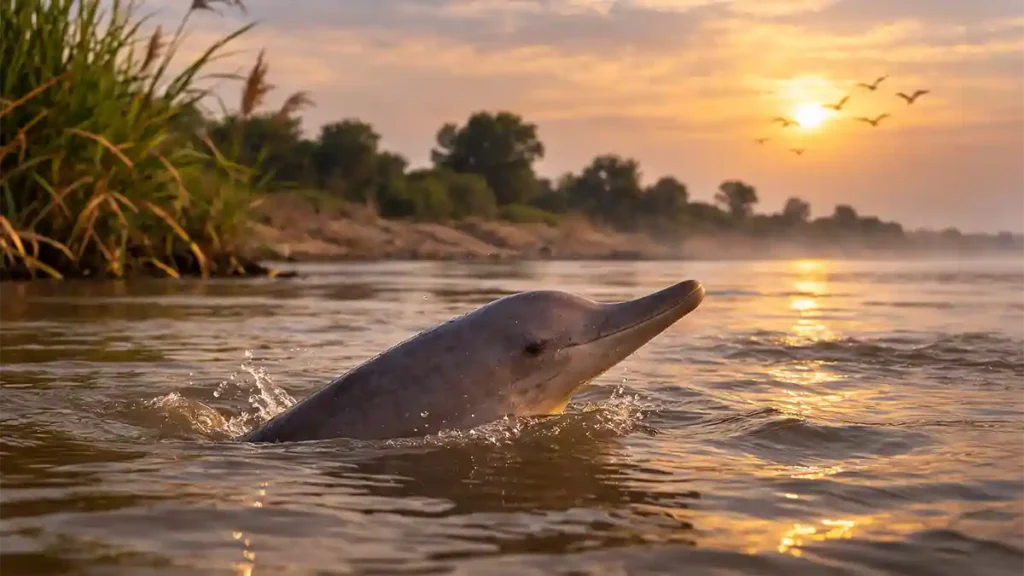
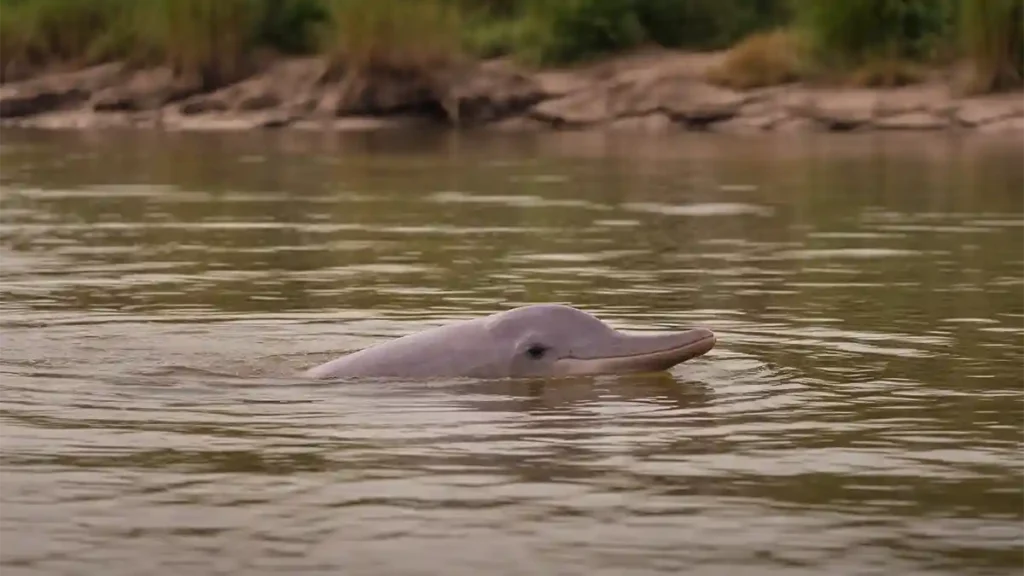
Its physical appearance also reflects its specialized lifestyle. The Indus River dolphin has a long, narrow snout that helps it catch fish in murky water. Its body is sturdy rather than sleek in the way people expect from ocean dolphins. Its dorsal fin is relatively small, and its neck is more flexible than that of many marine species. These features may not look dramatic at first glance, but together they reveal a creature built for river survival rather than ocean speed.
Another fascinating feature is its movement. Freshwater dolphins in South Asia have often been observed swimming slightly on their side, especially in shallow or complex waters. This side swimming behavior may help them move more efficiently in the river’s ever changing conditions. What looks unusual to us is actually another example of adaptation.
Everything about the Indus River dolphin tells the same story: this is not an animal surviving by accident. It is a highly specialized freshwater predator designed by evolution for a difficult environment.
The Indus River: A Harsh but Vital Home
To understand the dolphin, you have to understand the river. The Indus is not a calm, simple, or predictable waterway. It is one of the great rivers of Asia, shaped by snowmelt, seasonal flows, sediment movement, irrigation withdrawals, engineering projects, and heavy human use. It supports millions of people, feeds farms, powers infrastructure, and sustains entire communities.
For the dolphin, this river is both home and challenge. It offers prey, movement routes, and habitat, but it also changes constantly. River depth can shift. Flow can rise or fall. Channels can narrow, divide, or become isolated. The dolphin has evolved to cope with these natural difficulties, but it is much less equipped to handle the scale of human changes imposed on the river over the last century.
That is why the Indus River dolphin is often described as an indicator species. In simple terms, if the dolphin is surviving, it suggests that some essential parts of the river ecosystem are still functioning. If it declines sharply, that is a warning that the river itself is under deep ecological stress.
This makes the dolphin far more than a rare animal. It is a living signal from the Indus. Its health reflects the health of the freshwater system around it.
A Much Larger Past Range
One of the saddest parts of the dolphin’s story is how much of its former range has been lost. The Indus River dolphin once occupied a far broader stretch of the Indus river system. It moved through long sections of the main river and parts of connected waterways. Over time, however, that range collapsed.
Today, the species survives mainly in fragmented stretches of the lower Indus, with its most important population centered in Pakistan. This does not mean the dolphin was always naturally rare in tiny pockets. It means its world was reduced.
That distinction matters. When people hear that a rare animal survives only in one place, they sometimes assume that has always been the case. In reality, the Indus River dolphin was pushed into a much smaller existence by changes to the river. The loss of range is one of the clearest signs of how severe the pressure has been.
A reduced range brings several dangers. It limits movement between groups, increases isolation, and makes local populations more vulnerable. If one stretch of river becomes less suitable, dolphins in that section may have no easy way to reach safer habitat. Over time, fragmentation can become just as dangerous as a direct drop in population numbers.
How Human Engineering Changed Everything
The biggest reason for the dolphin’s decline has been the transformation of the Indus River by humans. Barrages, dams, irrigation systems, and water diversion projects changed the flow and structure of the river on a massive scale. These developments supported agriculture and human settlement, but they also altered the ecological character of the river in ways that were devastating for species like the Indus River dolphin.
Barrages are especially important in this story. They divide the river into sections and interrupt the natural flow of water and wildlife. A dolphin population that once moved through a more connected system became trapped in separated stretches. Some of these sections still supported enough water and prey for dolphins to survive. Others became too shallow, too isolated, or too degraded.
This fragmentation had lasting consequences. Dolphins could no longer move freely across the river as they once did. Some groups became cut off from others. In places where water levels dropped too low, habitat quality declined. In other places, animals wandered into irrigation canals and became stranded.
The result was not a sudden disappearance but a long, uneven decline. The river remained, but it no longer functioned in the same way. For the dolphin, that meant the loss of a connected living system and the emergence of a broken habitat.
The Threat of Canal Entrapment
One of the most immediate dangers facing the Indus River dolphin is canal entrapment. Because the Indus is linked to an enormous irrigation network, dolphins sometimes enter canals, especially during certain flow conditions. Once inside, they may become trapped when water levels change or structures prevent them from returning to the main river.
This is a serious threat because stranded dolphins can die if they are not found and rescued quickly. Unlike some wildlife threats that remain hidden, canal entrapment creates urgent emergencies. A dolphin in a canal is in the wrong place, under stress, and often in immediate danger.
Over the years, rescue efforts have become one of the most visible parts of Indus dolphin conservation. Teams work to identify trapped animals, carefully remove them, and return them to safer river stretches. These rescues require skill, coordination, and local knowledge. They are not simple operations. They demand speed, planning, and a strong understanding of the animal’s needs.
These rescue missions also reveal an important truth: conservation is not only about laws and reports. Sometimes it is physical, difficult, hands on work carried out in heat, mud, and uncertain conditions. Every successful rescue is a reminder that saving a species often depends on real people acting at the right moment.
Pollution, Fishing Pressure, and River Stress
Habitat fragmentation is the central problem, but it is not the only one. Pollution adds another layer of danger. Agricultural runoff, industrial waste, and declining water quality affect the river in ways that can harm fish populations and degrade the broader ecosystem. The dolphin may not always be the first visible victim, but it is affected by the cumulative damage.
Fishing pressure also matters. Dolphins share the river with human communities that depend on fish for food and income. In some cases, nets can injure dolphins or create risks of entanglement. More broadly, when fish stocks are stressed by overfishing or ecological damage, the dolphin’s food base also suffers.
These pressures combine in ways that make conservation more difficult. A fragmented river, reduced flows, pollution, and fishing stress do not act separately. They overlap. Together, they create a system that is harder for a specialized freshwater mammal to survive in.
That is why the dolphin’s story cannot be reduced to one single threat. It is the story of cumulative pressure. A species can survive one challenge. It becomes much harder when every part of its environment is under strain at the same time.
What the Dolphin Eats and How It Lives
The Indus River dolphin is a predator, feeding mainly on fish and other aquatic animals. In the muddy waters of the Indus, it uses echolocation to locate prey and move efficiently through its environment. Its long snout helps it catch fish in turbid conditions where sight would be of little use.
It is not usually seen in the dramatic, playful way often associated with marine dolphins. The Indus River dolphin is more secretive and practical in its behavior. It surfaces, moves, hunts, and disappears again into the river. Much of its life remains hidden beneath brown water, which is one reason it still feels mysterious to many people.
This mystery, however, should not lead us to think of it as unknowable. Its basic ecological role is clear. It depends on a functioning freshwater food web. It needs enough prey, suitable depth, and stretches of river where survival is possible. In this way, the dolphin is closely tied to the health of the river’s fish communities and aquatic habitats.
Because it sits high in the river food chain, it also reflects broader ecological balance. A river that can support dolphins is still capable of supporting a rich web of life. A river that can no longer sustain them is telling us that something deeper has gone wrong.
From Decline to a Rare Conservation Success
For a long time, the Indus River dolphin seemed destined for extinction. Its range had shrunk sharply, its habitat was fragmented, and pressures on the river continued to grow. Yet over the years, Pakistan’s conservation efforts began to make a real difference.
This is one of the most hopeful parts of the story. The dolphin’s survival is not just about luck. It is also about policy, monitoring, rescue work, and long term commitment. Protective measures helped reduce direct harm. A protected river stretch between Guddu and Sukkur became a major stronghold for the species. Conservation groups, government departments, and local communities all played roles in preventing further collapse.
Repeated surveys brought something else that matters greatly in conservation: evidence. Instead of relying only on fear or assumptions, researchers and wildlife authorities were able to track how the population was changing. Over time, the numbers suggested a meaningful recovery in the species’ main surviving range.
That does not mean the dolphin is now safe. It remains endangered, and its habitat is still under serious pressure. But the recovery matters because it proves that conservation can work, even in a crowded and heavily used landscape. In a world full of environmental bad news, that is no small achievement.
Why the Recovery Should Be Viewed Honestly
It is tempting to turn the Indus River dolphin into a simple success story. That would be understandable, but it would also be misleading. The species has shown encouraging recovery in some areas, yet it still lives in a fraction of its former range and remains dependent on a stressed river system.
A rise in numbers is positive, but numbers alone do not tell the whole story. If habitat remains fragmented, if water flows remain insecure, and if ecological pressures continue to build, the species can still face long term danger even after short term improvement.
This is why careful honesty matters. The Indus River dolphin is neither a hopeless case nor a fully rescued one. It sits in a middle space that is both promising and fragile. Pakistan has shown that recovery is possible, but lasting safety will require deeper protection of the river itself.
Conservation often fails when people assume that a partial success means the problem is solved. For the Indus River dolphin, the next stage is the hard one. It is about protecting the broader conditions that allow the species to live, not just reacting when individuals are in danger.
The Role of Local Communities
One of the most important parts of the conservation story is the role of local communities. People living near the river are often the first to spot a trapped dolphin, notice unusual movement, or report an emergency. Without local awareness and cooperation, many rescue efforts would be too slow.
This community role is crucial because large river systems cannot be protected by experts alone. Conservation is strongest when people who live with a species understand its value and take part in its protection. That does not happen automatically. It grows through awareness, trust, and a sense of shared responsibility.
The Indus River dolphin has gradually become more than a scientific concern. It has become a source of local and national pride. That shift is important. When people see a species as part of their identity and heritage, they are more likely to support the difficult work needed to protect it.
This does not mean all tensions disappear. River communities depend on water, fishing, agriculture, and development. But the dolphin’s story shows that conservation does not have to stand outside human life. It can become part of how people understand and care for the landscape around them.
Why It Is a National Treasure
The phrase national treasure can sometimes sound decorative, but in the case of the Indus River dolphin, it is fully justified.
First, the dolphin is globally rare. Pakistan holds most of the responsibility for the future of this species. That alone gives it national importance.
Second, it is ecologically valuable. It is not just a beautiful creature. It is part of a complex freshwater system and a sign of whether the Indus still supports rich aquatic life.
Third, it is historically meaningful. Its decline reflects the transformation of the river over time. In the dolphin’s story, you can read a larger national story about water, development, and environmental cost.
Fourth, it carries emotional power. This is an animal that survived against the odds. It represents endurance in a damaged landscape. It reminds people that even after severe decline, recovery is still possible when action is taken seriously.
That combination of rarity, ecological significance, historical meaning, and emotional force makes the Indus River dolphin far more than an interesting wildlife fact. It is one of Pakistan’s most important living natural symbols.
What Pakistan Must Do Next
If Pakistan wants the Indus River dolphin to remain part of its future, the next phase of conservation has to go beyond rescue operations alone. Rescue work is essential, but it treats the symptoms more than the root causes.
The deeper task is protecting the river ecosystem. That means safeguarding environmental flows in key dolphin stretches, improving water management, reducing pollution, lowering canal related risk, and strengthening habitat protection. It also means supporting research so that conservation decisions are based on real ecological understanding rather than assumption.
Fisheries management matters too. A healthy dolphin population depends on a healthy prey base. If fish stocks decline badly, the dolphin’s survival becomes harder even in protected areas.
Public awareness must continue as well. Many Pakistanis still know very little about the animal. A species that remains invisible in public understanding can easily become invisible in policy priorities. The more people know the real story of the Indus River dolphin, the harder it becomes to ignore the condition of the river it depends on.
This is not only an environmental issue. It is a question of national stewardship. Protecting the Indus River dolphin means protecting part of Pakistan’s natural inheritance.
The Deeper Meaning of the Dolphin’s Survival
There is something powerful about an animal that survives where many would expect it to vanish. The Indus River dolphin does not live in easy conditions. It survives in a river burdened by fragmentation, competition for water, pollution, and constant human pressure. Yet it remains there, moving through muddy currents, hunting with sound, and enduring in one of the most altered freshwater systems in the region.
Its survival carries a deeper message. It tells us that nature can be damaged severely, but not always beyond repair. It also tells us that recovery is never guaranteed. It depends on action, attention, and long term care.
In that sense, the dolphin is more than a species. It is a test. It asks whether development can coexist with ecological responsibility. It asks whether a country can recognize the value of a living river, not only as a source of water and power, but as a home for irreplaceable life.
For Pakistan, the answer to that question is still being written.
Quick FAQ
What is the Indus River dolphin?
The Indus River dolphin is a rare freshwater dolphin found mainly in Pakistan’s Indus River system. It is one of the world’s most unusual and threatened river mammals.
Is the Indus River dolphin really blind?
It is often described as nearly blind because it relies mostly on echolocation rather than normal vision. This helps it survive in muddy river water where visibility is very poor.
Why is it important in Pakistan?
It is one of Pakistan’s rarest native animals and a major symbol of the country’s freshwater biodiversity. It also reflects the health of the Indus River ecosystem.
Where is it mostly found?
The most important surviving population is found in the lower Indus River, especially between Guddu and Sukkur in Sindh.
Why did its population decline?
Its numbers dropped mainly because of habitat fragmentation, barrages, water diversion, canal entrapment, pollution, and wider ecological stress on the river.
What does the Indus River dolphin eat?
It mainly feeds on fish and other small aquatic animals found in the river.
Can the species still be saved?
Yes, but only with continued conservation, better river management, stronger habitat protection, and long term public and institutional commitment.
Why is it called a national treasure?
Because it is rare, unique to the region, ecologically important, and deeply connected to Pakistan’s natural heritage.
Conclusion
Pakistan’s Indus River Dolphin is one of the country’s rarest, most unusual, and most meaningful wild animals. It is a freshwater specialist, a master of sound in muddy water, and a survivor of one of the most transformed river systems in South Asia. Its story is not just about wildlife. It is about the Indus River, human impact, ecological loss, and the possibility of recovery.
The dolphin’s journey from broad historical presence to endangered remnant shows how deeply human decisions can reshape the natural world. But its survival and partial recovery also show that decline is not always final. With protection, monitoring, rescue work, and public support, even a species pushed to the edge can hold on.
That is what makes the Indus River dolphin a true national treasure. It is rare, resilient, and deeply tied to Pakistan’s natural identity. It deserves protection not only because it is endangered, but because it tells a larger truth about the river that has shaped the country for centuries.
If the Indus River dolphin continues to survive, it will mean that part of the river’s living spirit still survives with it. And if Pakistan continues to protect it, that will say something important about the kind of environmental future the country chooses to build.