Lahore Basant 2026 Is Back: Kite Festival Returns With New Safety Rules
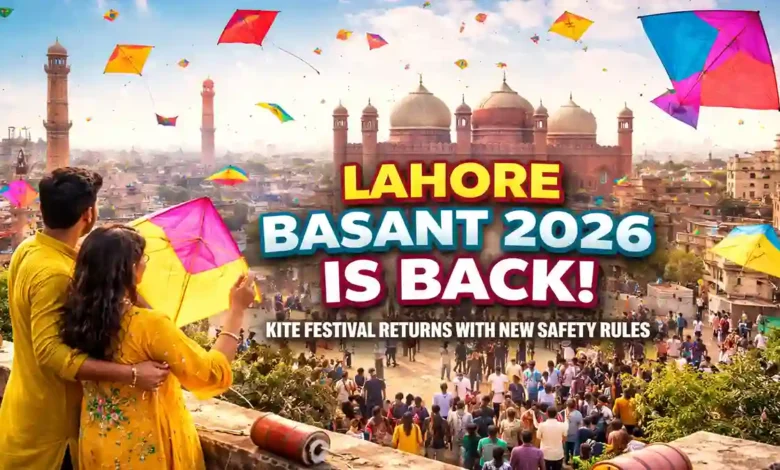
Lahore Basant 2026 is back in the city that made Basant feel larger than life. For many Lahoris, this is not just a weekend event. It is a piece of cultural memory returning to the skyline: rooftops lit up, family gatherings in yellow, the sharp music of dhol in the distance, and the famous shout of “bo kata!” when a kite line is cut.
But the comeback comes with a condition that cannot be negotiated: safety comes first.
Basant was banned for years because celebration turned into tragedy, largely due to dangerous kite strings that caused severe injuries and deaths, especially on roads. The 2026 return is built on a different idea: keep the spirit of the festival, but remove the most lethal risks through strict rules, traceability, and visible enforcement.
This deep dive explains what changed, what the new safety rules mean in everyday life, what is allowed and what is not, and how to celebrate Basant in a way that helps it stay back for good.
(1) Why Basant Matters in Lahore
Basant is a spring festival with deep roots in Punjab’s cultural landscape. In Lahore, it evolved into a citywide celebration that blended tradition, sport, fashion, food, and community. Kite flying became the center of the spectacle, but Basant always had layers:
- A seasonal marker: the emotional switch from winter to spring
- A social ritual: rooftops as gathering spaces, neighborhoods as shared audiences
- A competitive sport: kite fighting as skill, timing, and strategy
- A marketplace: kites, string, food stalls, rooftop catering, and tourism
For older Lahore, especially around the Walled City and dense inner neighborhoods, Basant was almost a form of public theatre. One kite fight could involve multiple rooftops, strangers cheering for each other, and entire lanes pausing to look upward.
That is why Basant never fully disappeared from public discussion. Even when it was restricted, people remembered what it felt like when the sky looked alive.
(2) Why Basant Was Banned: The Real Problem Was the String
It is important to say this clearly: Basant did not collapse because kite flying is dangerous by nature. The major trigger was how the competition changed.
Over time, some sellers and flyers started using reinforced, treated, or otherwise illegal kite strings designed to cut other lines more aggressively. This created a chain of harm:
- Stray strings drifted across roads, becoming nearly invisible hazards
- Motorcyclists and pedestrians suffered severe injuries
- Children and bystanders were exposed without choosing to participate
- Emergency services faced preventable spikes in trauma cases
There were other risks as well, including rooftop overcrowding, falls, and clashes in some areas. But the biggest symbol of Basant’s danger became the killer string culture.
Once fatalities and public pressure increased, authorities moved toward bans and crackdowns. The intention was simple: stop preventable deaths. The result, however, was also cultural loss and an underground market for illegal materials.
That history explains why the 2026 comeback is not a soft return. It is a controlled experiment.
(3) The 2026 Comeback Model: Celebrate, But Make It Trackable and Enforceable
Punjab’s approach in 2026 is built around one principle: if the supply chain is controlled, the worst risks shrink.
That is why the rules focus heavily on:
- Material restrictions (cotton only string, no dangerous treatments)
- Traceability (QR codes on kites and string)
- Registration (manufacturers and sellers must be known)
- Geofencing (no kite zones near sensitive locations like airport corridors)
- Crowd management (rooftop checks and limits)
- Road safety mitigation (motorcycle safety rods and enforcement)
This is Basant redesigned as a regulated festival rather than a free for all.
(4) The New Safety Rules Explained in Plain English
(A) QR Codes on Kites and String: Why They Matter
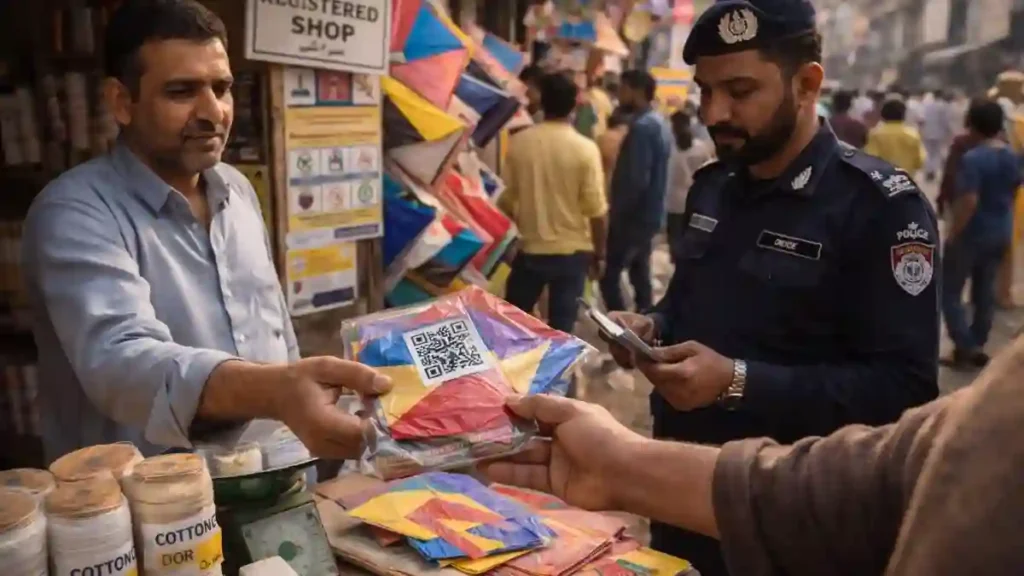
One of the most important changes is the use of QR coding for kites and string bundles. The aim is not to look modern for the sake of it. The aim is accountability.
If authorities seize illegal string or identify unsafe supply, QR coding can help trace where it entered the market. This discourages unregistered sellers from taking the risk, and it gives enforcement a stronger tool than random raids.
What it means for you: buy from authorized sellers and look for properly labeled products. If someone offers special strong dor without traceable packaging, that is a red flag, not a bargain.
(B) Cotton Only String: The Biggest Safety Shift
The core rule is simple: cotton string is allowed; dangerous string is not.
Prohibited types include any string that is metallic, glass coated, chemically treated, nylon like, or reinforced in ways that increase cutting power. The government is trying to remove the entire category of material that turned Basant lethal.
Why this works: Most of the worst road injuries were linked to cutting, strengthened, or treated strings. Cotton string reduces the likelihood of severe slicing injuries, especially if combined with other safety measures.
(C) Kite Size Limits: Reducing Power and Chaos
Regulation includes limits on kite size. Bigger kites often require stronger tension and encourage heavier string. That combination increases risk when kites fall, drift, or tangle near roads and wires.
What it means: the festival is being pushed back toward controlled, manageable kite flying rather than oversized, high tension competitions.
(D) Registered Sellers and Manufacturers: No More Anonymous Supply
A major part of the 2026 framework is registration. Reports noted thousands of producers and sellers being registered to supply the Lahore market. The idea is to shrink the informal pipeline where dangerous materials used to circulate.



What it means for buyers: choose registered vendors. If you cannot identify the seller, you cannot trust the product.
(E) Rooftop Safety Rules: Because Falls Are Also Tragedies
Rooftops are Basant’s main stage, but rooftops are not all equal. Some are structurally weak. Some have broken railings. Some become dangerously crowded.
Authorities have signaled that large rooftop gatherings may require registration, and inspections can restrict use of unsafe roofs.
What it means: if you are hosting a big group, treat your rooftop like a venue, not a casual hangout. Safety is part of hosting.
(F) Under 18 Restrictions: Responsibility Shifts to Adults
One widely reported rule in the new framework is that minors are restricted from flying kites, and guardians can be held responsible for violations.
This is controversial for obvious reasons: Basant memories often begin in childhood. But from a public safety angle, the government is prioritizing risk reduction and enforceability.
The practical takeaway: children can still enjoy Basant from a safe position as spectators, helpers, and participants in non risky activities, but kite flying is being treated as an adult controlled activity.
(G) Motorcycle Safety Rods: A Direct Response to Road Injuries
Motorcyclists historically faced some of the highest risk because strings can stretch across roads at neck or face height. The 2026 response includes widespread promotion of motorcycle safety rods, often described as antenna like frames that help deflect or lift strings away from the rider.
Some reporting described very large scale installations to reduce injuries during the Basant period.
What it means: if you are riding during Basant, treat safety rods as essential, not optional.
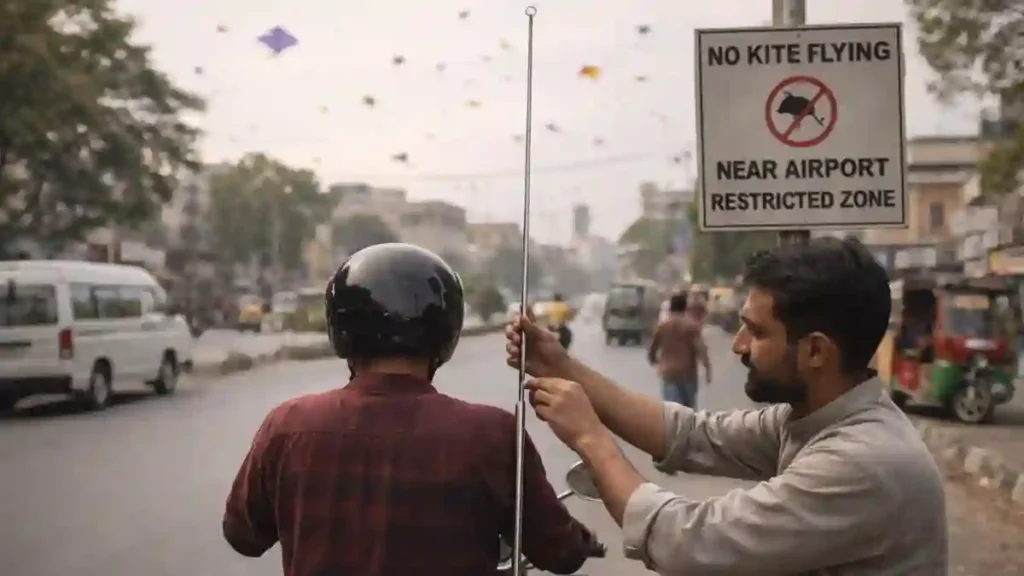
(H) Airport and Flight Corridor No Kite Zones: Non Negotiable Safety
Aviation safety is a strict priority. No kite zones near airport approach and departure corridors are designed to prevent incidents that could endanger flights.
What it means: if you live near restricted zones, do not assume Basant rules are relaxed there. They are stricter.
(I) Enforcement: Cameras, Checks, and Zero Tolerance Messaging
The 2026 plan depends on enforcement being visible and consistent. Reporting described crackdowns on illegal string and unauthorized activity, along with surveillance tools such as city camera networks and monitoring.
The logic is simple: rules that cannot be enforced become suggestions. Basant’s survival depends on compliance.
(5) What Is Allowed vs What Can Get You Penalized
Generally Allowed (When You Follow the Rules)
- Kite flying during the approved Basant window, in permitted areas
- Buying kites and string from registered sellers
- Using approved cotton only string
- Rooftop gatherings within safety guidelines
High Risk Actions (Likely to Trigger Enforcement)
- Using any prohibited string type or modified string
- Buying from unregistered sellers or informal supply routes
- Flying in restricted zones, especially near airport corridors
- Creating danger through reckless rooftop behavior or public disorder
If your Basant plan depends on shortcuts, it is likely to end with confiscation, fines, or worse. In 2026, the festival is being treated as a safety managed event, not a private hobby.
(6) Safe Basant Checklist: Practical Advice That Actually Helps
Rooftop Safety (Do This Before the First Kite Goes Up)
- Inspect the edges: weak parapets, broken railings, slippery surfaces
- Control crowd size: overcrowding increases falls and panic risk
- Create a no run zone: especially near edges and stairways
- Separate the cooking area: grills and hot oil should be away from crowds
- Keep children supervised: and away from edges at all times
- Prepare first aid: a basic kit for cuts, burns, and minor injuries
Buying Supplies Safely
- Buy from registered shops
- Look for properly labeled, traceable products
- Choose cotton only string and refuse any strong special offers
- Avoid stock that looks repackaged or suspicious
Road and Neighborhood Safety
- Riders should install safety rods and wear protective gear
- Avoid flying near roads where strings can drift into traffic
- Do not pull hard on string tangled near power lines
- Dispose of used string; do not leave it in streets or on trees
Respect Restricted Areas
No kite zones are not cultural attacks. They are safety boundaries designed to prevent disasters.
(7) The Economic Side: Why Basant Creates a Boom
Basant has always carried an economic wave, but the 2026 return is being watched closely because it revives multiple local industries at once:
- Kite and paper manufacturing
- Printing and dye supply chains
- Retail markets and street vendors
- Food, catering, and rooftop services
- Transport and ride demand
- Hospitality: hotels, guesthouses, and short stay rentals
Reports around the 2026 revival described strong sales activity, high hotel occupancy, and rooftop demand in central areas. This matters because a festival that supports livelihoods becomes harder to ban again, provided safety outcomes are acceptable.
In other words, economics can protect culture, but only if the event does not produce a new wave of tragedy.
(8) The Social Debate: Culture vs Control, and Who Gets to Enjoy Basant
Every regulated festival faces the same criticism: regulation can protect people, but it can also reshape the experience.
Common concerns include:
- Rising costs for kites and approved string
- Rooftop rentals becoming expensive, limiting access
- The festival becoming more commercial and less community driven
- Enforcement sometimes affecting low income neighborhoods more harshly
These concerns are real. A safe Basant that only the wealthy can enjoy is not a cultural revival; it is a branded event.
The most sustainable model is balanced:
- Make approved supplies widely available
- Punish dangerous materials, not harmless celebration
- Use enforcement to prevent harm, not to generate fear
- Encourage community safety norms that reduce the need for constant policing
(9) Why Lahore Is the Center of the 2026 Experiment
The decision to focus the celebration primarily on Lahore makes enforcement easier and reduces complexity. Lahore has the strongest Basant identity, and it also has high density zones where risks can spike fast.
If the 2026 model succeeds in Lahore, it creates a stronger argument for expansion in future years. If it fails, the return may be short lived.
That is why Basant 2026 is not just a festival. It is a test of whether celebration can coexist with modern safety governance.
(10) What Success Looks Like in 2026 (The Metrics That Matter)
A successful Basant comeback is not measured by how many kites you see.
It is measured by:
- fewer serious injuries and deaths
- reduced availability of illegal string
- fewer road incidents involving kite lines
- fewer rooftop falls and overcrowding emergencies
- compliance in restricted zones
- enforcement that targets danger effectively
If these outcomes improve, the conversation shifts from should Basant exist? to how can Basant become a permanent tradition again?
(11) A Realistic Basant Scenario (How Things Go Right or Wrong)
Scenario 1: The Safe Rooftop
A family hosts 12 guests. The roof edge is clear. Kids stay away from the parapet. Supplies are bought from a registered vendor. Cotton string only. Kites are flown away from roads. Used string is collected. Riders in the area use safety rods. No drama, no injuries, no enforcement action.
Outcome: Basant feels joyful and calm. This is the model that keeps Basant alive.
Scenario 2: The Risk Rooftop
A rooftop hosts 45 people without basic safety control. People run during kite fights. Someone uses stronger string bought informally. A line drifts into a road. A rider is injured. Police respond. Confiscations and arrests follow. News spreads fast.
Outcome: Basant becomes headline risk again, and the argument for bans returns immediately.
The difference is not luck. It is behavior.
Quick FAQ
Is Lahore Basant 2026 officially allowed?
Yes, it has returned under regulated conditions with defined safety rules, restricted areas, and enforcement.
What is the single most important safety rule?
Use cotton only string and avoid any prohibited, treated, metallic, or reinforced string.
What are QR coded kites and why are they used?
They help trace kites and string through the supply chain, making it harder for illegal sellers to operate.
Can children fly kites during Basant 2026?
Under the new framework, minors are restricted from kite flying, and guardians may be held responsible for violations.
Are rooftop gatherings regulated?
Large gatherings may face registration expectations and inspections, especially if a roof is structurally unsafe or overcrowded.
Why are motorcycle safety rods being promoted?
They reduce the risk of kite string injuries for riders, especially on busy roads.
Where is kite flying not allowed during Basant?
Restricted zones include sensitive areas such as airport approach and departure corridors and other notified no kite areas.
What happens if someone uses illegal string?
Penalties can include confiscation, heavy fines, and possible arrest depending on the violation and applicable law.
Conclusion: Basant Can Stay Back Only If Safety Becomes Part of the Tradition
Lahore Basant 2026 is a major cultural return, but it is also a public safety responsibility. The city can celebrate without repeating the tragedies that led to the ban, but only if the dangerous habits that grew around Basant are rejected.
The new rules are not designed to kill fun. They are designed to stop the festival from killing people.
If Lahore treats safe kite flying as a shared standard, Basant becomes more than a comeback story. It becomes a sustainable tradition again, year after year.




Yeah, tried it. Easy enough to get in. RN are pretty standard, nothing super flashy. <a href'nofollow ugc" is worth a look if you're bored, but don't expect miracles from the login process.