Import Goods from China to Pakistan Cheaply: Beginner Guide 2026
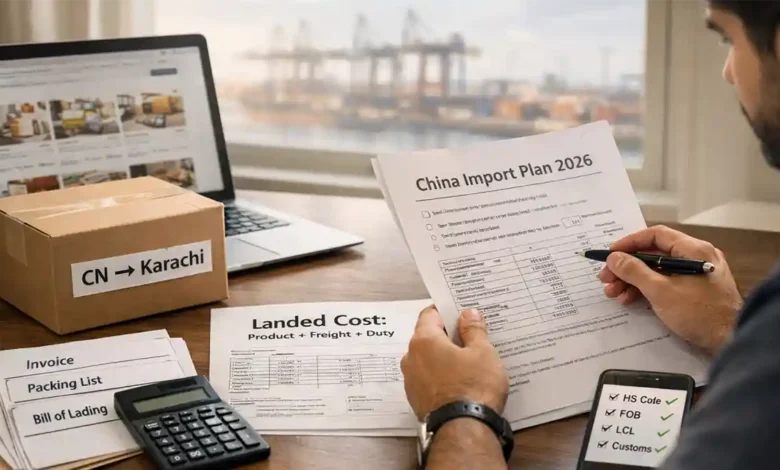
Import goods from China to Pakistan cheaply in 2026 is not about finding the lowest price on Alibaba and hoping everything works out. It’s about controlling your landed cost the real all in cost after shipping, customs, taxes, clearance, and local delivery. Beginners usually lose money for one reason: they focus on the product price and ignore the system that decides profit.
This guide is built for first time importers in Pakistan who want a clean, repeatable process. We’ll cover product selection, supplier verification, negotiation, shipping strategy (LCL vs FCL), documents, Pakistan Single Window and WeBOC basics, duty planning through HS codes, and the hidden fees that quietly destroy margins. You’ll also get checklists, examples, and a practical roadmap so you can import safely and scale with confidence.
(1) What Cheap Importing Really Means in 2026
When people say cheap importing, they often mean cheap item price. That’s the wrong target.
Cheap importing = the lowest landed cost per sellable unit.
Your landed cost is the total of:
- Product cost (including packaging)
- China side local charges (pickup, consolidation, export docs)
- International freight (sea/air/rail if available)
- Insurance (recommended for sea shipments)
- Pakistan destination charges (terminal handling, DO, port fees)
- Clearing/agent fee
- Duties and taxes (based on HS code, valuation, and policy)
- Inland delivery (port to your warehouse)
- Losses (damage, defects, delay penalties, storage/demurrage)
If you master landed cost, you can beat competitors even when their supplier price looks “lower” on paper.
(2) Beginner Rule: Start With a Low Complexity Product
In 2026, Pakistan’s import flow is more digital and structured, but products still fall into two buckets:
Low complexity products (best for first import)
These are items that:
- don’t require special approvals
- have simple quality checks
- are compact and pack efficiently
- have predictable demand
Examples (category level ideas, not guarantees): basic household organizers, simple tools, non-branded accessories, general hardware items, stationery, certain kitchen items (non-electrical), and basic auto accessories (non electrical).
High complexity products (avoid for your first shipment)
These often trigger extra scrutiny, testing, approvals, or documentation needs:
- items with batteries
- wireless or telecom related devices
- cosmetics, food items, supplements
- medical products
- branded goods with IP risk
Beginner shortcut that’s actually smart: choose one product you can explain clearly in one sentence, and you can physically inspect in minutes when it arrives.
(3) The 2026 Import Workflow (The Professional Sequence)
Most beginners do this:
- Find a product online
- Pay supplier
- Figure out shipping
- Panic at customs
Professionals do this:
- Choose product based on shipping + duty + regulation
- Identify HS code candidates early
- Vet supplier and order samples
- Lock packaging and specs
- Decide incoterm (FOB is often easiest for first timers)
- Book shipping and confirm documents before departure
- Plan clearance path and payments
- Receive, inspect, record lessons, reorder with improvements
If you follow the professional sequence, your first import becomes a controlled experiment instead of a gamble.
(4) Set Up Your Import Basics in Pakistan (Before You Spend)
You don’t need a huge company to start importing, but you do need basic structure.
Essentials to prepare
- Basic business identity (even a simple sole setup)
- Tax registration as required for your business model
- A bank account that can handle trade related transactions
- A reliable clearing agent or consultant (especially for your first shipment)
Why this matters
Importing is not only logistics; it’s also documentation and financial compliance. A good bank relationship and clean paperwork reduce delays and delays are expensive.
(5) HS Codes: The Most Important “Money Lever” Beginners Ignore
Your HS code determines:
- duty and tax rates
- whether extra approvals apply
- how customs interprets your product
- how “risky” your shipment appears
How to handle HS codes as a beginner
- Write a technical description of your product (material, function, how it works).
- Shortlist 2–3 likely HS codes (don’t guess blindly).
- Confirm with a clearing agent before finalizing the order.
- Keep product description consistent across invoice, packing list, and declaration.
Cost saving reality: one correct HS code decision can save more money than any supplier discount.
(6) Product Research: Pick Items That Ship Cheaply (CBM Is King)
For sea freight, especially LCL, cost often depends heavily on volume (CBM), not just weight.
Products that usually ship cheaply
- compact items with high unit value
- items that stack efficiently
- items with low packaging waste
Products that look profitable but ship badly
- bulky plastic items with lots of empty air in cartons
- low price items with big cartons
- fragile items requiring heavy protective packaging
Pro move: ask suppliers for carton dimensions early and calculate approximate CBM before you negotiate price.
(7) Where to Source: Alibaba vs 1688 vs Agents (Beginner Safe Strategy)
Alibaba (best for first time importers)
Pros:
- easier communication
- export friendly sellers
- better structure for invoices, packing lists, and shipping terms
Cons:
- pricing can be higher than domestic China platforms
1688 (cheaper, but operationally harder)
Pros:
- often lower prices
Cons:




- domestic focused listings
- language and payment barriers
- quality variation is wider
- usually requires a sourcing agent for smooth execution
Recommended beginner path:
Start with Alibaba for your first successful shipment. Move to 1688 once you know your clearance and shipping process.
(8) Supplier Verification: Simple Steps That Prevent Expensive Mistakes
A supplier can look professional online and still be unreliable. Use a verification routine.
Basic supplier vetting checklist
- Ask if they are a manufacturer or trading company (either can work, but clarity matters).
- Request business registration documents (at minimum, proof of legitimacy).
- Ask for a short factory or warehouse video showing the exact product.
- Confirm production lead time in writing.
- Ask for packaging details (units per carton, carton size, gross weight).
- Order samples before large payments.
Red flags
- pushing you to pay immediately “because prices will rise today”
- refusing to provide packaging dimensions
- unclear answers about defects, replacements, or warranties
- inconsistent company name across invoice and bank details
Keep your first order small enough that even a mistake doesn’t destroy your capital.
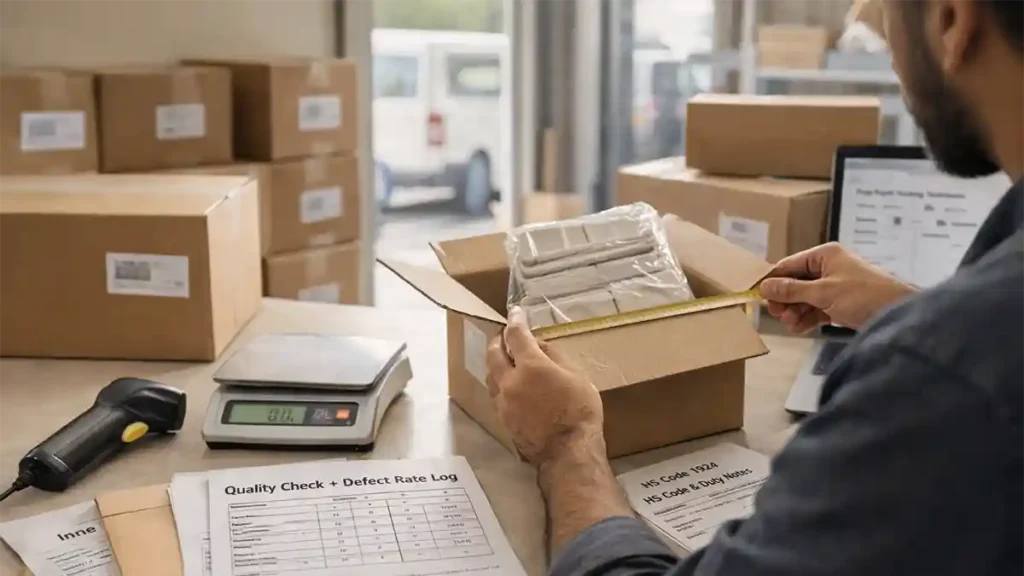
(9) Samples and Quality Control: The Cheapest Insurance You’ll Buy
For beginners, a sample is not optional for most products it’s a protective step.
What to check in samples
- build quality and finish
- functionality and durability
- color consistency (if visuals matter)
- packaging strength
- labeling details
- carton packing efficiency (this affects shipping cost)
Quick quality policy you should agree on
- acceptable defect rate
- replacement policy (e.g., supplier provides extra units for expected defect percentage)
- whether defects are refunded or replaced in the next order
A clear defect policy turns disputes into predictable business costs.
(10) Negotiation That Actually Lowers Your Total Cost
Beginners negotiate unit price only. Smart importers negotiate the cost drivers.
High impact negotiation points
- Packaging optimization: smaller cartons reduce CBM and freight.
- MOQ flexibility: reduces risk while testing the market.
- Spare units: request extra pieces to cover defects.
- Payment terms: partial deposit, remaining balance after inspection.
- Incoterms: choosing FOB vs EXW can shift cost and control.
Power question that saves real money:
“Can we reduce carton volume by improving packing or removing unnecessary inserts?”
(11) Incoterms Explained for Beginners (The Cheap vs Risk Balance)
EXW (Ex Works)
You handle everything from the supplier’s location. It can be cost effective if you have strong logistics support, but it increases complexity.
FOB (Free On Board)
Supplier delivers goods to the port and handles export steps. This is often the cleanest starting point for beginners because it reduces China side confusion.
CIF (Cost, Insurance, Freight)
Supplier arranges freight to Pakistan. It’s convenient, but can reduce transparency and sometimes includes marked up freight components.
DDP (Delivered Duty Paid)
Looks easy because it promises “everything included.” The risk is hidden assumptions about duties, valuation, and documentation. DDP can also reduce your control over compliance.
Beginner friendly recommendation:
Use FOB for your first shipment unless you have an experienced forwarder managing EXW end to end.
(12) Shipping Choices in 2026: What’s Cheapest in Practice?
Sea Freight (usually the cheapest per unit for volume)
Best for:
- bulk orders
- low urgency
- items that aren’t extremely fragile
Air Freight (fast, but cost sensitive)
Best for:
- high value per kg
- urgent replenishment
- small test shipments where speed matters more than cost
Express courier (fastest, typically most expensive per kg)
Best for:
- samples
- very small parcels
Cheap shipping is not one method. It’s matching method to product economics.
(13) LCL vs FCL: How Beginners Should Decide
LCL (Less than Container Load)
You share container space. Great for starting small and testing products. Charges are often tied to CBM and minimum billable volumes.
How to make LCL cheaper:
- reduce CBM through better packaging
- consolidate multiple suppliers into one shipment (one clearance cycle)
- avoid multiple small shipments that each trigger fixed destination fees
FCL (Full Container Load)
You pay for the whole container. Lower cost per unit when volume is high and steady.
Rule of thumb:
Start with LCL, then shift to FCL when your reorder volume becomes predictable and consistent.
(14) Freight Forwarders: The Partner That Makes or Breaks Cheap Importing
A good freight forwarder helps you reduce cost without increasing risk.
What to ask before choosing a forwarder
- Give me a quote with full inclusions (origin charges, freight, destination charges).
- Can you quote both port to port and door to door?
- Can you consolidate cargo from multiple suppliers?
- How do you handle documentation checks before departure?
- What are the likely destination fees at Karachi/Port Qasim for LCL?
Biggest beginner mistake
Choosing the “cheapest quote” without understanding what is excluded. Many “cheap” quotes become expensive when destination fees appear later.
(15) Documents You Must Control (Even If Someone Handles Clearance)
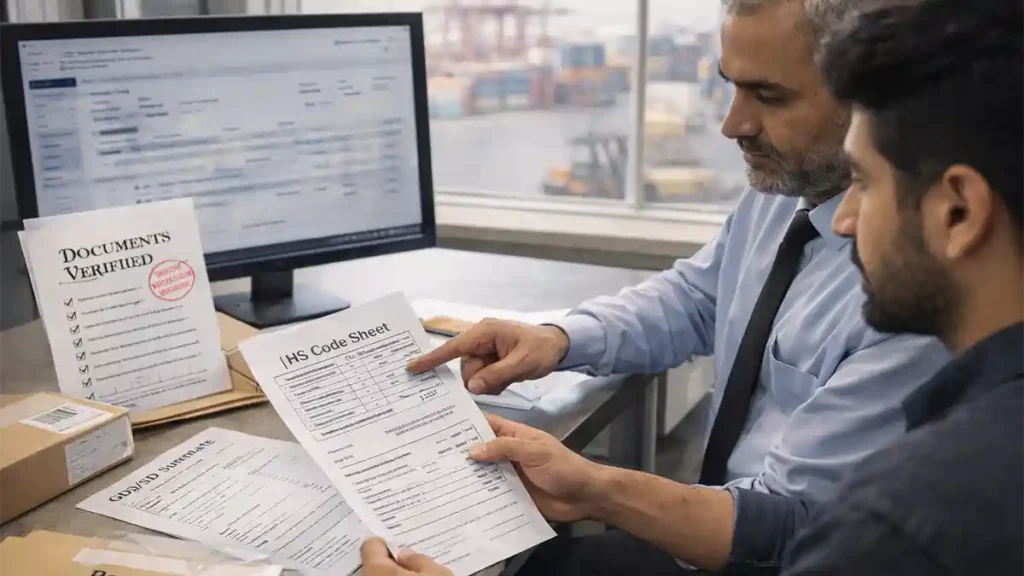
Even if an agent files everything, you must review documents for consistency.
Core documents
- Commercial invoice
- Packing list
- Bill of lading (sea) or air waybill (air)
- Insurance certificate (if applicable)
- Certificate of origin (useful for preferential tariffs where applicable)
- Any product specific certificates (if required)
Consistency rules
- Product name and description should match across all documents.
- Quantities and carton counts should match.
- Company names and addresses should match.
- Declared unit price should match the invoice.
Clean documents reduce delays. Delays create storage, demurrage, and penalties.
(16) Pakistan Customs Clearance in 2026: PSW and WeBOC (Simple View)
In Pakistan, customs processing is increasingly integrated through digital systems.
What a beginner needs to know
- Many importers and agents still refer to WeBOC workflows for declarations.
- Pakistan Single Window is designed to streamline filings, especially where regulatory agencies are involved.
- If your product triggers regulatory requirements, your filing path becomes more structured and may require PSW’s Single Declaration route.
Practical advice:
For your first shipment, don’t “wing it.” Align your product category, HS code, and filing path with your clearing agent before your goods leave China.
(17) Legal Ways to Reduce Duty (No Risky Shortcuts)
If you want sustainable importing, avoid illegal valuation tricks. Use lawful levers instead.
Legal duty saving levers
- Correct HS code classification
- Accurate product description
- Preferential tariff treatment (where applicable, such as CPFTA lines)
- Clean origin documentation
- Avoid delays that generate storage and port charges
Why under invoicing is a trap
Even if someone claims it “works,” it increases the risk of:
- reassessment
- penalties
- shipment holds
- long term compliance problems
Cheap and safe beats cheap and risky every time.
(18) Hidden Charges That Destroy Profit (Know Them Before You Ship)
Beginners often budget only for freight and duty. Real world imports include destination and time based costs.
Common hidden costs
- terminal handling charges
- documentation charges and delivery order fees
- port storage charges if clearance is delayed
- demurrage/detention if containers are not cleared on time
- extra inspections or re checks due to mismatched documents
- local transport spikes during peak periods
Cheap importing is mostly about avoiding these surprises.
(19) Landed Cost Calculator (A Simple Template You Can Use)
Before you place the order, collect:
- total units
- unit price
- cartons count
- carton dimensions (L × W × H)
- gross weight
- incoterm (FOB/EXW/CIF)
- freight quote with inclusions
- clearing agent estimate
- HS code estimate for duty/tax range
- inland delivery estimate
Then calculate:
Estimated landed cost per unit = (all in landed cost) ÷ (sellable units)
Add a buffer for learning:
- 5–10% buffer for first shipment uncertainty
- 2–3% buffer for defects (depends on product)
(20) Example Cost Breakdown (Illustrative, Not a Price Promise)
Scenario: compact home organization product
- Units: 2,000
- Shipment: LCL by sea
- Goal: test market, then reorder
Smart steps that reduce cost:
- Supplier adjusts packaging to reduce carton volume by 12%
- You consolidate two suppliers into one LCL shipment
- Documents are pre checked before departure
- HS code is confirmed early so duty surprises are minimized
Result:
Your unit profit improves because freight and delays are controlled not because you found a miracle supplier.
(21) The Beginner Roadmap: Your First Import in 4 Phases
Phase 1: Planning (Days 1–3)
- Choose a low complexity product
- Shortlist HS code candidates
- Confirm whether approvals are required
- Set target selling price and margin
Phase 2: Sourcing and samples (Days 4–14)
- Shortlist 5 suppliers
- Verify legitimacy and request packaging data
- Order samples and test them
- Finalize specifications and defect policy
Phase 3: Shipping setup (Days 15–25)
- Choose forwarder and compare quotes by inclusions
- Select incoterm (often FOB for beginners)
- Confirm document formats and product descriptions
- Book shipment with a clear cargo ready date
Phase 4: Clearance and receiving (Arrival window)
- File declaration via your agreed channel
- Pay assessed duties/taxes properly
- Receive cargo and inspect immediately
- Record issues, then improve the next order
This roadmap turns beginner luck into a repeatable business process.
(22) Mistakes That Make Imports Expensive (Even When Price Looks Low)
- Buying without confirming HS code implications
- Paying too early without sample verification
- Ignoring carton volume and packaging efficiency
- Choosing shipping based on speed when your product economics require sea
- Accepting unclear freight quotes that hide destination charges
- Document mismatches that trigger holds
- Relying on a “friend of a friend” with no written accountability
- Not inspecting goods immediately on arrival
Avoid these, and you’ll be cheaper than most first year importers.
(23) How to Scale Cheaply After Your First Successful Shipment
After your first import, your cost drops naturally if you:
- optimize packaging again
- reorder larger quantities (better freight economics)
- shift from LCL toward FCL when volume justifies
- build a shortlist of trusted suppliers
- standardize document templates
- negotiate better terms based on repeat business
The long term winners are not the people who chase the cheapest listing. They’re the people who standardize the process.
Quick FAQ
What’s the cheapest way to import from China to Pakistan as a beginner?
For most starters, sea freight via LCL is the most cost efficient when you’re importing more than a small parcel and can wait longer.
Should I choose FOB or EXW for my first shipment?
Most beginners do better with FOB because it reduces China side complexity while keeping freight choices open.
Why is carton size more important than weight for sea shipping?
Because LCL sea costs often track volume (CBM). Big cartons with empty space can make “cheap products” expensive.
What documents are essential for customs clearance?
Typically: invoice, packing list, bill of lading/air waybill, plus any required certificates depending on your product category.
How do I avoid getting scammed by suppliers?
Verify identity, request real videos, confirm packaging data, order samples, and keep payments structured with clear terms.
Can I reduce customs duty legally?
Yes, through correct HS code classification, clean documentation, and applicable preferential tariff lines where allowed.
What’s the biggest reason shipments get delayed at port?
Document mismatches, unclear product descriptions, missing requirements, or late preparation for the filing/clearance path.
How can I calculate profit before importing?
Use a landed cost template: product + freight + destination charges + clearance + duties/taxes + delivery, then divide by sellable units and add a safety buffer.
Conclusion: Cheap Importing Is a System You Build
If you want to import goods from China to Pakistan cheaply in 2026, treat your first shipment like a controlled project:
- Choose a low complexity product with shipping friendly packaging
- Verify suppliers and test samples
- Negotiate the cost drivers (packaging, terms, defect policy)
- Select the right incoterm and shipping method
- Control documents and reduce delays
- Use legal duty optimization through correct classification and policy awareness
Do this once successfully, and your next import becomes easier, faster, and cheaper because you stop paying beginner “tuition” in mistakes, delays, and hidden fees.





2 Comments