FIA EMI App Pakistan for Overseas Pakistanis: Travel Checklist + Common Scenarios (2026)
Why overseas Pakistanis should care in 2026
FIA EMI App Pakistan is part of a bigger shift: immigration processes are becoming more digital, more data driven, and less forgiving of messy documentation. If you’re an overseas Pakistani, that shift can be a blessing shorter queues, clearer flows, fewer repeated questions but only if you show up prepared.
Most airport delays don’t happen because someone is doing something wrong. They happen because information doesn’t match:
- Your passport spelling is slightly different from your NICOP spelling.
- You renewed a passport and the old one contains important travel history or residency evidence.
- Your child’s documents don’t clearly link to you.
- Your airline wants proof you can enter your onward destination (even when Pakistan entry is fine).
This guide is designed to feel like a practical travel playbook, not a brochure. You’ll get:
- A complete overseas Pakistanis travel checklist for 2026
- Clear explanations of how a FIA e-immigration app fits into real travel
- Common airport scenarios and the calm, correct way to handle each one
- Pro level tips for families, students, GCC workers, dual nationals, and frequent flyers
- A quick FAQ you can skim right before you travel
The 2026 reality: travel is smoother when your data story is clean
Think of modern immigration like this:
- You are not only a person your documents are a profile.
- Airports run on matching. Names, dates, passport numbers, identity cards, visa/residency evidence, and travel history all connect.
- When the profile is consistent, everything feels fast. When it’s inconsistent, a simple trip turns into a long conversation.
That’s where immigration pre-clearance Pakistan concepts matter. Whether it’s a formal app flow or simply organized info, the goal is the same: reduce confusion before it reaches the counter.
What is FIA EMI (e-immigration) in simple words?
FIA EMI is best understood as an e-immigration direction digital support to help immigration processing become more efficient and more secure.
For a traveler, that typically means:
- entering key travel and identity details in a structured way
- supporting faster verification (where systems allow it)
- reducing repeated manual checks
- supporting better screening against fraud, trafficking, and document misuse
You may also hear terms like Pakistan immigration clearance app or references to FIA IBMS (Integrated Border Management System). The technical names are less important than the practical idea: immigration wants cleaner, earlier, more reliable information especially at busy airports.
What it is (practically)
- A way to organize and submit travel related info (depending on rollout)
- A supporting layer for immigration processing
- A convenience tool when it’s working well, and a neutral step when it isn’t
What it is not
- Not a replacement for a passport or legal entry requirements
- Not a guaranteed fast track in every airport at every time
- Not a solution to legal issues, watchlists, or missing documents
Is the FIA EMI App Pakistan mandatory for everyone in 2026?
In 2026, the most realistic answer is: it depends on rollout, airport readiness, and how your airline handles pre-checks. You may see differences between airports and between arrival vs departure.
So the smart approach is simple:
- Treat the app as a strong travel readiness step, not your only plan.
- Prepare your documents so you can travel normally even if the app isn’t used.
- Keep proof of anything you submit (screenshots, confirmation, offline copy).
This mindset keeps you safe from the two extremes:
- panic (I can’t travel without the app!)
- denial (I don’t need anything digital!)
The overseas Pakistani document stack (clear, simple, correct)
Here’s the clean logic you should use before every trip.
Core documents (most common)
- Pakistani passport (primary international travel document)
- NICOP (strong supporting identity document for overseas Pakistanis)
- Proof of onward destination eligibility (visa, residency permit, return ticket, or entry permission depends on where you live)
Why NICOP matters for travel
For overseas Pakistanis, NICOP is often the bridge between identity systems especially when your life is spread across countries. It helps confirm identity consistency when the passport alone doesn’t answer questions.
NICOP travel Pakistan becomes especially helpful when:
- you’re traveling with family
- you have mixed nationality households
- your passport is new and your history is in old documents
- your names/spellings vary between countries
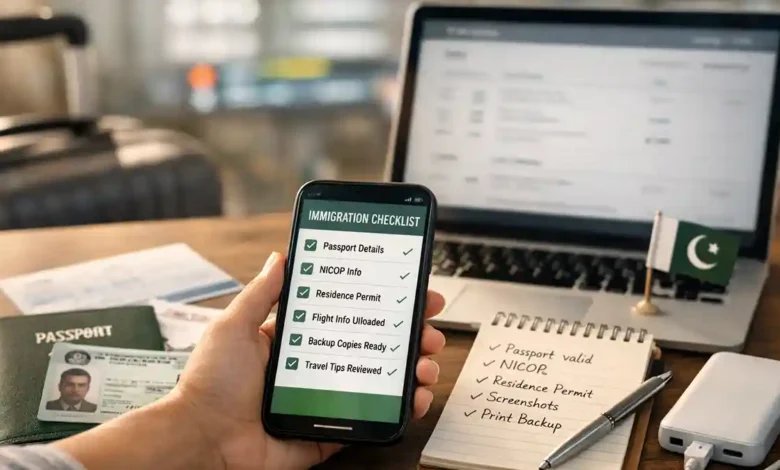
Overseas Pakistanis Travel Checklist (2026)
This checklist is built to prevent the most common failures at check in and immigration. Use it like a timeline.
(1) Two to four weeks before travel (the fix it properly phase)
Passport health check
- Validity: aim for 6+ months wherever possible (airlines often prefer buffer even if rules allow less)
- Condition: no torn pages, no water damage, no loose binding
- Details: your name and date of birth must match your other IDs as closely as possible
NICOP check
- Validity: check expiry and renewal options early
- Spelling: compare passport and NICOP letter by letter
- Personal data: father/spouse name and DOB should be consistent
Family document planning
- Children: confirm passport validity and identity linkage
- If traveling with elderly parents: keep their documents simple and separate
- If one parent is not traveling: prepare a consent letter if needed (airlines and countries vary err on the side of being prepared)
Your identity alignment audit (high impact, low effort)
Open your passport and NICOP side by side and confirm:
- First name spelling (including “Muhammad/Mohammad” variations)
- Surname spelling
- Date of birth format consistency
- Parent/spouse name spelling
If you find mismatches and you travel frequently, it’s worth fixing long term. If travel is soon, prepare supporting link documents (more on that below).
(2) Seven days before travel (the make it easy at the airport phase)
Create a digital travel folder
On your phone, create one album or one folder that includes:
- passport bio page (clear photo)
- NICOP front/back
- ticket/PNR (screenshot + PDF)
- residency permit/iqama/BRP/green card (whatever applies)
- hotel address (if visiting)
- emergency contacts (saved offline)
Print a minimal backup set
Print only what helps in chaos:
- itinerary page
- passport bio page
- NICOP copy
This isn’t old fashioned. It’s practical. Phones die, apps crash, airports have weak signals.
(3) 24–72 hours before travel (the final verification phase)
Airline readiness check
Airlines are strict about onward entry eligibility. Before you travel, ensure you can prove:
- you can enter your destination country after Pakistan (visa/residency)
- you have return/onward booking if required
If you plan to use FIA EMI App Pakistan
- fill details calmly at home, not at airport Wi-Fi
- double check spellings
- save any confirmation screen
- keep your phone charged and carry a power bank
(4) Day of travel (the smooth execution phase)
Document order that reduces stress
Keep a simple sequence you always follow:
- Passport
- NICOP
- Residency/visa proof (for onward destination)
- Supporting links (only if needed)
Do not bury documents in checked luggage.
If something becomes urgent at check in, you need it in your hand within seconds.
How FIA EMI App Pakistan fits into real travel (without hype)
Here’s the most realistic model:
- The app supports structured information and may help reduce repeated manual entry.
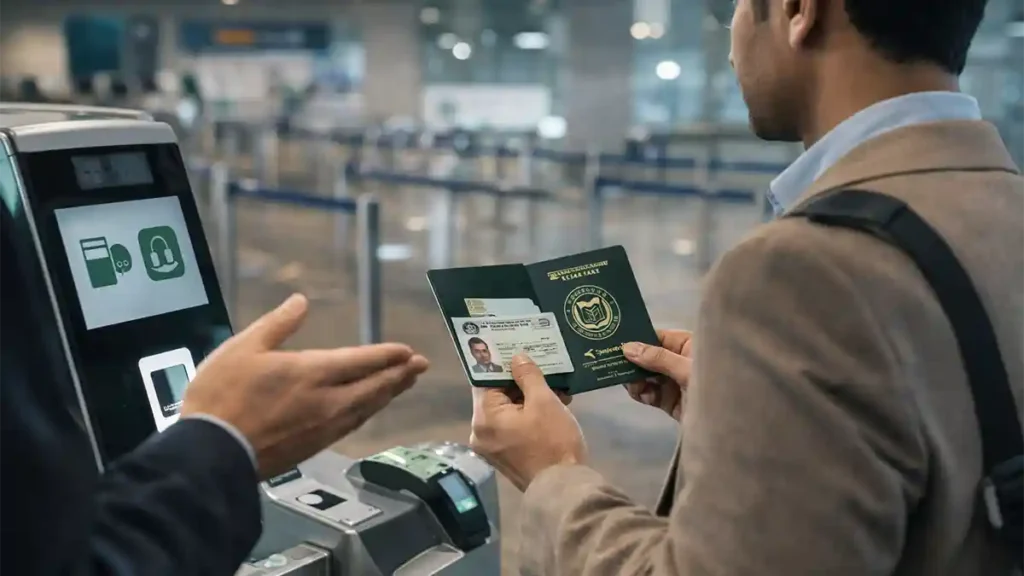
- Where e-gates and digital workflows exist, it can support faster movement.
- When airports are busy, even small reductions in confusion can matter.
But your best travel strategy remains constant:
- document consistency first
- calm, direct answers second
- digital support third
If the app is required or helpful, you’re ready. If it isn’t available, your travel still works.
The supporting links that solve 80% of airport questions
These are the documents that quietly rescue you when details don’t match perfectly.
Useful link documents
- Old passport (especially if it contains visas/residency evidence)
- Birth certificate copies for children
- Marriage certificate copy (useful for surname differences)
- NADRA application/receipt (if updates are in progress)
- A short employer letter or student enrollment letter (only if travel purpose is questioned)
The goal is not to prove too much. The goal is to connect identity dots quickly.
Common Scenarios for Overseas Pakistanis (and what to do)
This section is written for real life: crowded check in desks, tired kids, and last minute surprises.
Scenario 1: My NICOP is expired, but my Pakistani passport is valid.
What usually happens
You can still travel on a valid Pakistani passport, but an expired NICOP may create extra questions if your identity details don’t align perfectly.
What to do
- Use your passport as primary.
- Keep NICOP (even expired) as supporting ID.
- Ensure your onward destination requirements are satisfied (airline priority).
One line explanation if asked
My passport is valid. My NICOP renewal is in progress / due here is the passport and details.
Scenario 2: I’m dual national. Which passport should I use?
What triggers delays
Switching identities mid route confuses records: different names, different passport numbers, and inconsistent declared nationality.
Practical approach
- For Pakistani immigration, use the document route that matches your legal status and travel purpose.
- For your return abroad, keep your other passport/residency proof ready for airline checks.
What not to do
- Don’t alternate passports randomly at different checkpoints. Consistency prevents questions.
Scenario 3: My name spelling differs between passport and NICOP.
This is one of the most common issues for overseas Pakistanis.
What to do
- Carry at least one supporting link document (old passport, NADRA receipt, marriage certificate if surname changed).
- Answer briefly and consistently.
Clean explanation
Same person different English spelling. Date of birth and parent name match.
Scenario 4: I renewed my passport; old passport has visas and history.
What happens
Airlines and officers may ask to see the old passport to verify continuity.
What to do
- Carry both old and new passports.
- Keep the old passport accessible, not in luggage.
- If you filled an app or digital form, use your current passport number.
Scenario 5: My child was born abroad; paperwork is complicated.
Why this becomes difficult
Children in overseas Pakistani families often have mixed documentation: foreign birth certificates, different surname patterns, and parents with different passports.
What to do
- Decide the child’s travel identity before booking: Pakistani passport vs foreign passport + proper entry permission.
- Carry birth certificate copies to link parents.
- If parents have different surnames, bring a marriage certificate copy.
Avoid this mistake
Assuming family relationship is obvious. Airports don’t work on assumptions only documents.
Scenario 6: I’m traveling with a foreign spouse to Pakistan.
Typical friction points
- Entry permission confusion (visa, e-visa, eligibility rules)
- Unclear purpose of visit
- Missing proof for hotel address or host contact
What to do
- Save visa confirmation/offline proof (don’t rely on email only).
- Keep a simple itinerary: city, hotel, dates, contact number.
- Carry marriage certificate copy only as a backup, not a first step.
Scenario 7: I’m a GCC worker traveling during peak season.
What makes this harder
High volume times increase checks and slow queues. Travel fatigue increases mistakes.
What to do
- Keep an extra clear file: passport + NICOP + iqama/residency proof + ticket.
- Avoid last minute changes (seat swaps, rebookings, missing luggage tags).
- Keep your job and residency details consistent if asked.
If questioned
Short answers win. Long stories invite more questions.
Scenario 8: I’m a student traveling between Pakistan and abroad.
Common issues
- Expired student visa/permit
- Travel purpose mismatch (saying tourism when you’re studying)
- Missing enrollment evidence
What to do
- Carry a current enrollment letter (digital + printed).
- Carry valid residence/student permit proof.
- Keep your narrative consistent: I study in X, returning for semester on DATE.
Scenario 9: My phone died / app won’t open / no internet.
This is common. It should not ruin your trip.
What to do
- Use your printed backups and offline screenshots.
- Shift attention back to the basics: passport, NICOP, onward eligibility proof.
- Ask a practical question: What document do you need from me right now?
What not to do
Argue about the app. At airports, outcomes matter more than debates.
Scenario 10: I have a name change due to marriage; documents don’t match.
What causes delays
Inconsistent surname usage across countries and document types.
What to do
- Carry marriage certificate copy.
- Use the passport as the primary identity anchor.
- If traveling as a family, keep one folder that links everyone logically.
Scenario 11: I lost my NICOP or passport abroad before travel.
This is stressful, but solvable.
Emergency plan
- Report loss according to local requirements (often needed for replacement).
- Contact the nearest Pakistani mission/consulate for guidance on travel documents.
- Keep copies of any IDs you still have (even photos help start the process).
Future proofing tip
Always keep secure digital copies of core documents in a private, protected folder.
What to say at the airport (simple scripts that reduce friction)
These short responses work because they are clear and consistent.
If asked why details differ:
Same person spelling variation. My DOB and parent name are the same.
If asked about travel purpose:
I’m visiting family for two weeks. / I’m returning to my job/study.
If asked for onward eligibility:
Here is my residence permit / visa proof and my return booking.
If a staff member seems unsure:
Please tell me which document you need, and I’ll show it.
These scripts prevent the biggest mistake: over explaining.
The biggest mistakes overseas Pakistanis make (and how to avoid them)
- Filling forms at the airport
Do it at home. Airports are the worst place for careful typing. - Depending on a single device
Always keep screenshots and a small printout set. - Mixing passports casually
Dual nationals should choose a consistent, legal document path. - Ignoring name consistency
Small spellings cause big delays. Audit them early. - Bringing every document and creating confusion
Bring the right documents in the right order. Extra papers should be backup only.
Practical privacy habits (balanced, not paranoid)
Digital travel tools are useful, but smart users take basic precautions:
- Download apps only from official app stores.
- Keep your phone locked with a strong PIN.
- Avoid sharing screenshots publicly (passport numbers are sensitive).
- Give permissions only when needed (camera for scans, etc.).
- Use a private folder for document copies.
This keeps your convenience high and your risk low.
Quick profiles checklist (pick your situation)
If you’re visiting Pakistan for family/home
- Passport + NICOP
- Hotel/home address and contact
- Return booking and residency proof (for airline)
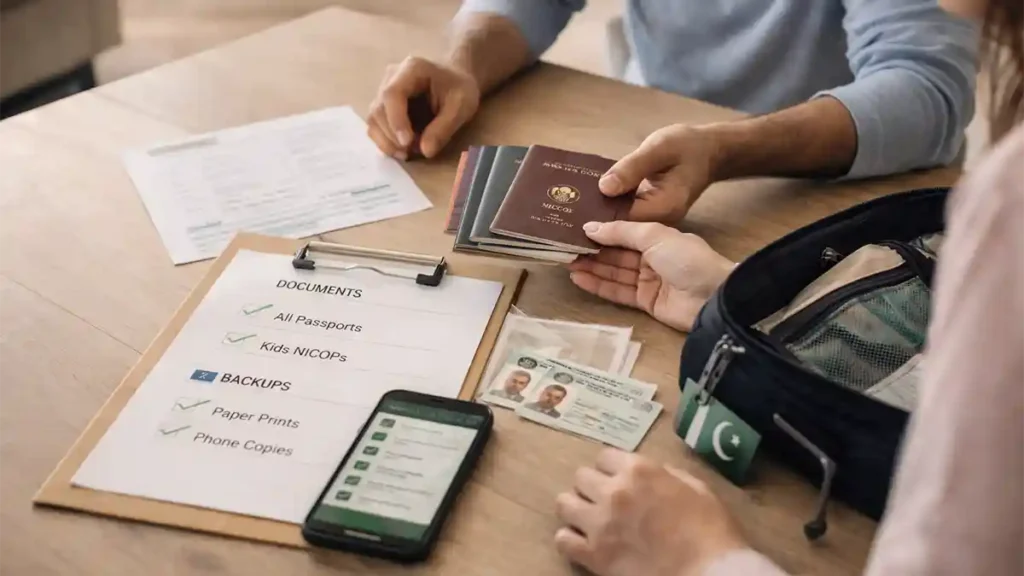
If you’re traveling with kids
- All passports
- Birth certificate copies
- Consent letter if relevant
- One clean family folder
If you’re a GCC resident
- Passport + NICOP + iqama/residency proof
- Employer info saved offline
- Return booking
If you’re a student
- Enrollment letter
- Student visa/residence permit proof
- Simple travel purpose statement
If you’re dual national
- Decide your document path in advance
- Keep both passports organized
- Stay consistent at checkpoints
Quick FAQ
Is FIA EMI App Pakistan required for overseas Pakistanis in 2026?
Requirements can vary by rollout and airport. The best approach is to be ready to use it, while still traveling smoothly with standard documents.
Can NICOP replace a passport for international travel?
No. A passport remains the primary international travel document. NICOP supports identity and can reduce confusion, especially for overseas Pakistanis.
What if my NICOP is expired but my passport is valid?
You can usually travel on a valid passport, but an expired NICOP may increase questions if your details don’t match cleanly. Carry it as supporting ID.
What’s the most common reason people get delayed?
Mismatch: name spellings, renewed passports without old passport backup, unclear documentation for children, or weak proof of onward destination eligibility.
Do I need printed documents if everything is on my phone?
It’s strongly recommended to print a minimal set. Phones die, signals fail, and screenshots sometimes don’t load when you need them most.
I’m traveling with a foreign spouse what should I carry?
Offline visa proof, hotel/address details, and a marriage certificate copy as a backup document (not necessarily for routine checks).
If the app doesn’t work at the airport, will I be stuck?
Not if you’re prepared. Treat the app as support, not a replacement. Your passport, NICOP, and onward eligibility proof are what matter most.
What should I do if names differ slightly across documents?
Carry one “link document” (old passport, marriage certificate copy, NADRA receipt), and use a short consistent explanation: same person, spelling variation.
Conclusion: Travel gets easier when you’re boringly prepared
In 2026, the winning travel strategy for overseas Pakistanis is not complicated. It’s disciplined.
- Keep your passport and NICOP details aligned as much as possible.
- Build a simple, reliable overseas Pakistanis travel checklist and follow it every time.
- Use FIA EMI App Pakistan when it’s helpful or required, but don’t let your trip depend on one app screen.
- Prepare for common scenarios kids, dual nationality, renewed passports, spelling differences before you reach the airport.
When your documents tell one clear story, immigration feels smoother, staff interactions feel simpler, and your journey starts with confidence instead of stress.





4 Comments