Pakistan Business Ideas: Low Investment Options That Actually Work

Pakistan business ideas that don’t need huge money
Pakistan business ideas are often discussed as if you either need big capital or powerful connections. In reality, most successful small businesses start the same way: a simple service, a clear customer problem, and a repeatable delivery system. After that, they scale with reinvested profits.
If you’re reading this, you likely want something practical:
- A business you can start with limited cash
- A model that fits Pakistani markets, where trust matters and budgets are tight
- Clear steps that help you avoid common traps like overbuying stock, copying saturated ideas, or underpricing your work
This guide gives you:
- Low investment options across online, home-based, and local service models
- Realistic cost ranges in PKR
- Simple launch plans (what to do in your first 7–30 days)
- Growth strategies that match Pakistan’s reality, including social commerce and digital payments
One important point: “low investment” does not mean “low effort.” It means you spend money only where it creates traction basic tools, small test inventory, and trust-building branding while your skill and customer service become the main engine.
Why low investment businesses are rising in Pakistan
Pakistan has a huge base of small businesses and informal work. Official and policy references often describe SMEs as a backbone of the economy. In one widely cited set of estimates, SMEs are described as numbering in the millions and contributing significantly to GDP, exports, and non-agriculture employment.
At the same time, three shifts are making low-capital entrepreneurship more realistic:
1. Digital payments are becoming normal
Recent payments reporting from the State Bank of Pakistan highlights billions of retail payment transactions and strong growth in digital channels. This reduces friction for small businesses because customers can pay faster and sellers can operate with less cash handling.
2. Internet access continues expanding
Pakistan’s telecom reporting has highlighted very large subscriber and broadband bases. More connectivity means more customers discover services through search, social platforms, and WhatsApp-style referrals.
3. Skills-based exports are growing
Pakistan’s official economic reporting tracks rising ICT export services and notable inflows linked to freelancers. This matters because online work can bring higher-paying clients while your living costs remain in PKR.
So whether you want a home setup or a local service model, this is a workable time to start if you choose a model you can execute consistently.
Choose a model that matches your reality
Before picking an idea, answer these questions honestly.
1. Do you want a service, a product, or a hybrid?
- Service businesses (freelancing, repairs, tutoring) can start fast with low cash risk.
- Product businesses (reselling, food, handmade goods) can scale, but inventory can trap your money.
- Hybrid models often win because you combine steady income with scalable sales (for example, meal subscriptions plus packaged add-ons).
2. How many hours can you commit weekly?
- 6–10 hours/week: side hustle models (reselling, tutoring, content services)
- 15–30 hours/week: serious microbusiness (e-commerce ops, repair services, agency work)
- 40+ hours/week: full build (shop, workshop, larger production)
3. What is your “unfair advantage”?
Not a fancy concept just what helps you win:
- a skill (editing, design, cooking)
- a location (near a market, university, office area)
- a network (schools, shop owners, community contacts)
- language + online ability (communication can unlock better clients)
What “low investment” looks like in Pakistan
To keep expectations realistic, use this simple ladder:
- Micro (PKR 5,000–30,000): phone + data + basic tools, small supplies
- Starter (PKR 30,000–150,000): better tools, small inventory, packaging, basic branding
- Serious (PKR 150,000–500,000): equipment, setup, working capital, initial marketing
Most people struggle because they jump into “serious” spending before proving demand. The smarter approach is to start micro, validate quickly, then reinvest.
The 3 rules of low-investment success
Rule 1: Sell first, then build
Don’t buy large stock based on assumptions. Aim for paid orders first. Use pre-orders, small batches, and simple trial offers.
Rule 2: Trust beats price
In Pakistani markets, buyers often choose the seller they trust. Your edge can be clean branding, quick replies, transparent pricing, and reliable delivery.
Rule 3: Cashflow is your oxygen
Profit matters, but cashflow keeps the business alive. If customers pay late and you pay upfront, growth becomes painful even with “good margins.”
22 low investment business ideas in Pakistan (with launch plans)
(A) Online and skill-based options
(1) Freelance services (writing, design, development, virtual assistant)
Investment: PKR 10,000–60,000
What to sell: one clear package (for example, “12 social posts/week” or “YouTube editing per video”).
First 14 days: build 6 samples, create a simple offer sheet, pitch daily to local and online leads.
Avoid: selling everything to everyone. Pick one niche.
(2) Short-form video editing for local brands
Investment: PKR 5,000–30,000
Offer idea: monthly reel packages with hooks, captions, and simple polish.
First 7 days: create 5 strong sample edits and show “before/after.”
Pricing tip: packages protect your income better than hourly billing.
(3) Social media management for nearby businesses
Investment: PKR 5,000–20,000
You handle: content calendar, posting, replies, and basic promotions.
Start plan: approach clinics, salons, gyms, cafes, and small stores within your area.
Win strategy: provide a 7-day content plan to show value quickly.
(4) Online tutoring (Matric/Inter/O-Levels, entry tests)
Investment: PKR 5,000–25,000
Start plan: choose one subject and one grade range, offer a free diagnostic test, convert to monthly fees.
Upgrade path: group tuition increases income without doubling hours.
(5) CV, LinkedIn, and scholarship application help
Investment: PKR 5,000–15,000
How to sell: show anonymized “before/after” examples and clear turnaround times.
Pricing: tiered packages (basic, standard, premium).
(6) Bookkeeping for microbusinesses (Excel-based)
Investment: PKR 10,000–40,000
Clients: small shops, online sellers, service providers.
Offer: monthly records, cashflow summary, and basic invoice systems.
(7) Translation and subtitling (Urdu-English, captions)
Investment: PKR 5,000–25,000
Start plan: produce sample translations and subtitle clips; pitch creators and small businesses.




(8) Micro-agency lead generation for local services
Investment: PKR 15,000–80,000
What you sell: leads and appointment booking for dentists, trainers, real estate agents, clinics.
Key: track lead quality clearly to avoid payment disputes.
(B) Home-based and local services
(9) Home tiffin or meal prep subscriptions
Investment: PKR 20,000–120,000
Start plan: offer 2 menu tiers, deliver in a tight radius, run weekly subscription discounts.
Profit lever: standardized portions and bulk ingredient buying.
(10) Home baking (custom cakes and snack boxes)
Investment: PKR 30,000–200,000
Standout strategy: create 3 signature items and own them.
Growth: corporate orders and event bundles.
(11) Tailoring and alterations
Investment: PKR 25,000–150,000
Best entry: start with alterations for quick cash flow, then move into custom stitching.
Add-on: pickup and drop service within your area.
(12) Beauty services at home (makeup, nails, henna)
Investment: PKR 10,000–80,000
Start plan: build a portfolio on real clients, post consistently, keep a clear price menu.
(13) Home and office cleaning plus organization
Investment: PKR 8,000–40,000
Packages: deep clean, weekly maintenance, move-in clean.
Trust factor: punctuality, clear checklist, and professional presentation.
(14) Maintenance coordination business (partner with technicians)
Investment: PKR 5,000–15,000
Model: you manage leads, scheduling, and customer care; technicians do the work.
Income: commission per job.
Warning: quality control is essential.
(15) Mobile accessories with installation (small kiosk model)
Investment: PKR 50,000–250,000
Why it works: frequent purchases and impulse buying.
Win strategy: neat display, quick service, basic warranty.
(16) Bike-based delivery routes for small businesses
Investment: PKR 10,000–50,000
Clients: pharmacies, bakeries, gift shops, document delivery.
Best approach: recurring daily routes, not random one-off runs.
(C) Reselling and product-based options
(17) Thrift and resale (clothing, books, gadgets)
Investment: PKR 10,000–80,000
Rule: buy only what you can sell within 14 days.
Best move: specialize instead of selling everything.
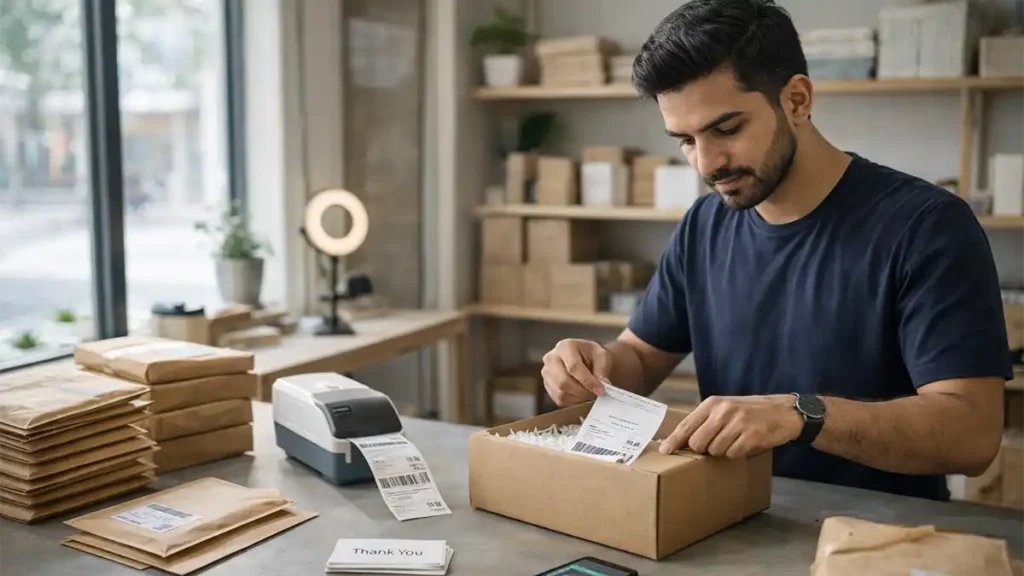
(18) Packaging supplies for online sellers (pouches, boxes, labels)
Investment: PKR 30,000–200,000
Customers: online sellers need packaging repeatedly.
Offer: bundle packs (50/100/200) with delivery.
(19) Customized gifts (mugs, frames, stickers)
Investment: PKR 25,000–150,000
Start smart: outsource printing first; focus on design and selling.
Growth: seasonal and corporate gifting.

(20) Niche e-commerce store (one category focus)
Investment: PKR 20,000–250,000
Examples: modest accessories, kitchen tools, car organizers, phone cases.
Rule: one category, one audience, one clear promise.
Tip: sell on marketplaces or social commerce first, then build your own store later.
(21) Microgreens or mushrooms (small indoor setup)
Investment: PKR 30,000–250,000
Customers: restaurants and health-focused buyers.
Start plan: secure 5 steady buyers before expanding production.
(22) Homemade personal care (soaps, oils)
Investment: PKR 15,000–120,000
Important: focus on safety, labeling, and honest claims.
Trust lever: clean packaging and clear ingredient lists.
Validate any idea in 14 days (without wasting money)
Use this framework:
- Pick one customer type (hostel students, office workers, brides, shop owners).
- Identify one clear problem they want solved.
- Create one offer with one price.
- Pre-sell: aim for 5 paid orders or 3 paying clients.
- Deliver fast and collect proof (photos, reviews, before/after).
- Improve your offer based on real feedback.
- Reinvest profits into the biggest bottleneck (tools, packaging, delivery speed).
Pricing that prevents burnout
For services
Set a minimum value for your time. Then sell packages that match that value. Monthly retainers are usually more stable than one-off gigs.
For products
Calculate real margin: selling price minus product cost, packaging, delivery, and a small buffer for returns or damage.
Marketing that works in Pakistan on a small budget
(1) WhatsApp referral loops
Use broadcast lists and ask for referrals politely. Offer a small bonus: discount, free add-on, or extra service.
(2) Local visibility (Maps and reviews)
If you serve a local area, reviews and consistent service can outperform paid ads over time.
(3) Short content that proves work
Simple videos often outperform polished ads:
- packaging and dispatch proof
- process clips
- before/after results
(4) Community selling
For many home-based businesses, consistent service and neighborhood trust create repeat buyers faster than large-scale advertising.
Basics of registration and compliance (simple overview)
You don’t always need formal registration on day one, but you should understand the routes:
- Tax registration and filing: FBR’s online systems are widely used for registration and returns.
- Company formation: SECP online services are used when you move toward formal incorporation.
- Planning support: SMEDA resources can help with basic feasibility and planning before big spending.
(This is general information, not legal or tax advice. Requirements can differ by business type and region.)
A practical first 30-day plan
Days 1–3: choose one idea, one niche, one offer, one price.
Days 4–7: create proof (samples or a small batch) and capture clean photos/videos.
Days 8–14: sell daily; aim for paid orders, not likes.
Days 15–21: standardize operations with checklists and consistent delivery.
Days 22–30: reinvest into the main bottleneck and build referrals.
Common mistakes that sink low-investment businesses
- Buying too much inventory too early
- Copying saturated ideas with no differentiation
- Underpricing until you burn out
- Not tracking income and expenses
- Weak trust signals (late replies, unclear pricing, messy packaging)
- Expanding too fast without consistent delivery
Quick FAQ
1. What is the best low investment business in Pakistan right now?
A service business with repeat demand tutoring, video editing, social media management, or meal subscriptions often starts fastest with lower risk.
2. Can I start with PKR 10,000?
Yes. Start with tutoring, freelancing, small-batch resale, or a referral-based service. Focus on paid orders first.
3. Which low-investment business has the highest profit margin?
Skill-based services often have higher margins because you sell expertise rather than inventory.
4. Is e-commerce still worth it in Pakistan?
Yes, especially if you focus on one niche, build trust, and keep operations simple.
5. What business is best for women in Pakistan with low investment?
Home-based models like baking, beauty services, tailoring, tutoring, and social media management can grow quickly through trust and referrals.
6. How do I test an idea before spending money?
Use a 14-day validation test: one niche, one offer, one price, and a target of 5 paid orders or 3 paying clients.
7. Do I need to register my business immediately?
Not always. Many people start small and formalize later when revenue becomes consistent.
8. How can I grow without taking a loan?
Reinvest profits into your biggest constraint tools, packaging, delivery speed, or a small marketing budget and focus on repeat customers.
Conclusion: low investment, high execution
Low-investment entrepreneurship in Pakistan is not about hunting a “perfect idea.” It’s about selecting a model you can deliver consistently, validating demand quickly, and building trust faster than competitors.
Start with a service if you want the lowest risk. Add products once you have repeat customers. Improve your delivery and customer experience every month, and reinvest profits where they create real growth.






One Comment