Pakistan’s EMI App: AI Airport Immigration Made Faster
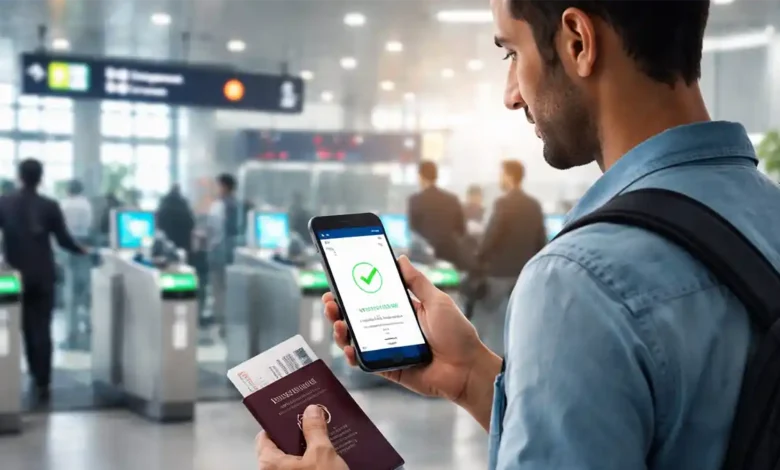
Pakistan EMI App is built around a simple promise: make airport immigration quicker for genuine travellers while strengthening checks against fraud, illegal migration networks, and forged documents. For years, passengers have complained about long queues, last-minute uncertainty, and inconsistent experiences at immigration counters. Meanwhile, authorities face real pressure to stop fake paperwork, organised “agent” scams, and routes used for unlawful travel.
These two realities collide inside the same space: the airport immigration hall. It’s where families are rushing with kids, students are nervous about their first international journey, and workers carry documents they don’t always understand while officers must make serious decisions under time pressure. That is exactly where technology can help, if it’s designed with care.
This article explains what Pakistan’s FIA EMI App is meant to achieve, how AI airport immigration Pakistan could work in practice, what e-gates might change at major airports, and why fairness and transparency will decide whether the system earns public trust. You’ll also find practical guidance for travellers, an SEO-ready package, and a quick FAQ you can publish immediately.
The real problem EMI is trying to solve
Airport immigration isn’t slow because officers want it to be slow. It’s slow because the system is forced to do too much, too late.
At the counter, an officer may need to:
- confirm identity,
- scan a passport and check records,
- validate visa and travel purpose,
- detect forged documents,
- assess risk indicators,
- and handle follow-up questions.
All of that happens while hundreds of people are waiting behind you, and while airline boarding deadlines keep ticking.
Now add the biggest stress factor for travellers: uncertainty. Many passengers don’t know what will trigger extra questions. Some rely on agents who provide half-true guidance. Others carry genuine documents but fail to explain them properly. The result is frustration, confusion, and occasional offloading an experience that can be financially painful and emotionally humiliating.
Pakistan’s shift toward a digital process is an attempt to move part of this work before a traveller reaches the counter, so the airport hall becomes a place of confirmation instead of a place of surprises.
What “EMI” actually means in Pakistan’s context
In everyday language, EMI is being used to describe an e-immigration approach an app-led system that connects passenger data with official verification channels. The “app” is not the whole project; it’s the public-facing entry point.
Think of it like this:
- The app collects and organises traveller details ahead of time.
- The backend system checks those details against official records and applies screening logic.
- The airport layer (including e-gates) uses that verified information to speed up clearance for eligible passengers.
One important term often linked with this modernization is Integrated Border Management System (IBMS), which refers to connecting border and immigration operations through a central digital framework. Even if travellers never hear the term, IBMS matters because it’s the engine that makes pre-verification and smart routing possible.
Why the EMI push is happening now
The timing of EMI is not random. Pakistan is facing multiple pressures at once:
(1) Rising scrutiny and travel restrictions
Authorities have become more cautious because forged documents and suspicious travel patterns damage Pakistan’s reputation and create international complications.
(2) Networks exploiting ordinary people
Fraudulent agents often target low-income workers, first-time travellers, and students. They sell “packages,” manipulate paperwork, and promise outcomes they can’t guarantee. When things go wrong, the passenger pays the price.
(3) Airport congestion and passenger load
Airports are built to move people. When immigration slows down, everything suffers boarding, baggage flow, airline scheduling, and the overall travel experience.
EMI is being positioned as a response that improves security while reducing friction for legitimate travellers. That balance is the heart of the project.
How the Pakistan EMI App is expected to work (simple, practical explanation)
Because different airports and phases may roll out differently, details can evolve. Still, the intended model is clear: pre-arrival immigration clearance supported by verification and smart screening.
Here is what the most realistic EMI journey looks like:
Step 1: Create a traveller profile
A passenger signs up, enters basic identity details, and links them to passport information. This is where the system begins to reduce human data-entry errors.
Step 2: Add trip details
The traveller enters:
- flight number,
- date of travel,
- destination,
- and basic travel purpose (tourism, student, work, family visit, business).
Step 3: Upload or confirm supporting information (when required)
For some travel categories, the system may prompt for extra proof such as:
- visa page,
- return ticket,
- admission letter (students),
- hotel booking or address proof,
- employment contract (workers),
- sponsor details (if applicable).
This step is important because it shifts document organization away from the last minute.
Step 4: Verification through official records
The system checks identity and passport details against official databases. It looks for mismatches, expired documents, inconsistencies, or red flags.
Step 5: Smart routing at the airport
If everything looks clean, the traveller may be directed toward faster processing, potentially including airport e-gates Pakistan lanes (where available). If the system flags an issue, the passenger is routed to a staffed counter for manual review.




This design is not meant to eliminate officers. It’s meant to protect officer attention for the cases that truly need human judgement.

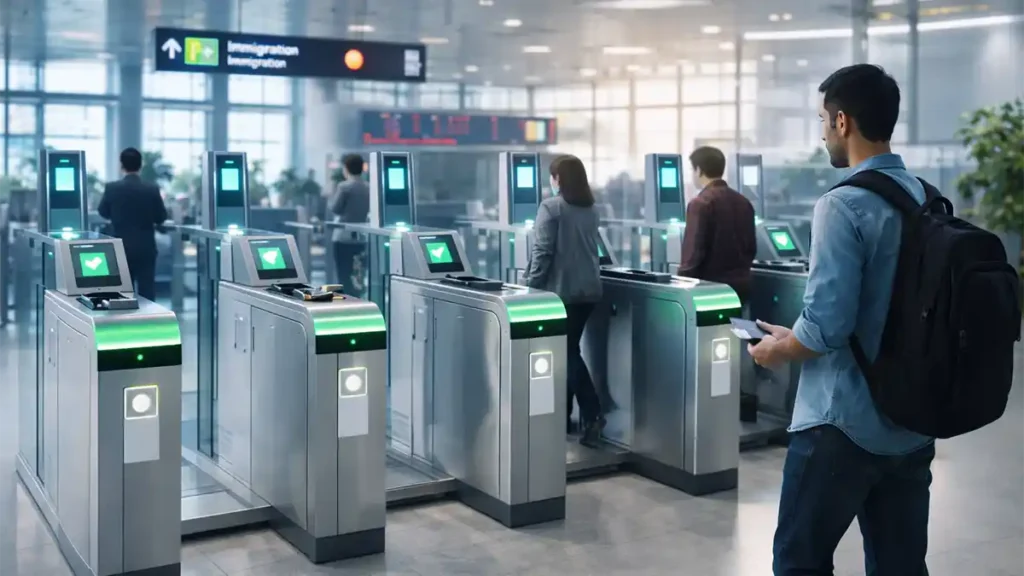
The e-gates factor: what changes when gates replace counters
E-gates are self-service lanes that typically combine:
- passport scan,
- data extraction,
- biometric verification for travel (often face matching),
- and instant clearance when requirements are met.
For travellers, the appeal is obvious: faster processing, less waiting, fewer repeated questions.
For airports, the benefits are operational:
- queues move steadily,
- counters handle exceptions instead of routine passengers,
- peak-time pressure becomes more manageable.
However, e-gates only succeed when the system is stable. If gates frequently fail, passengers flood back to counters, causing worse congestion than before. That’s why implementation quality matters more than marketing claims.
What AI does here and what it should NOT do
When people hear AI, they imagine a robot officer approving or rejecting travel. That’s not how a responsible border system should operate.
In this context, AI is better understood as:
- pattern detection (spotting combinations linked to fraud),
- risk support (helping officers prioritize cases),
- automation for low-risk flows (speeding up passengers who already match verified data).
AI should not become an unchallengeable “black box” that blocks travellers without explanation. If a system can stop your travel, it must also provide:
- a reason category,
- a correction pathway,
- and a human review option.
This is not just a “nice feature.” It’s how trust is built.
The real win for travellers: fewer surprises, clearer expectations
Many passengers don’t fear immigration itself they fear unpredictability.
A well-designed e-immigration app Pakistan can reduce this by:
- prompting travellers in advance for missing items,
- guiding them through what they need based on travel category,
- and flagging inconsistencies early.
That means the airport experience shifts from “I hope nothing goes wrong” to “I know what I’ve submitted and what will be checked.”
Even if a traveller is routed for manual review, the process feels more professional when:
- the passenger understands why,
- the officer sees pre-submitted details,
- and the conversation becomes verification not interrogation.
What EMI could mean for different traveller groups (realistic mini-scenarios)
(1) Students travelling abroad
Students often have valid travel intent but carry multiple documents. EMI can help by organizing their profile early and reducing confusion at the counter. If the system is smart, it will also standardize what “proof” looks like, which prevents random, inconsistent questioning.
(2) Workers travelling on employment visas
This is one of the categories most exploited by agents. For genuine workers, EMI can be protective: if their documents are authentic, early verification reduces the chance of chaos at departure. For fake cases, earlier detection is exactly the point.
(3) Families and elderly travellers
Families benefit most from shorter waiting time. But they also need assisted support lanes because not every traveller is comfortable with apps, scanning, or digital forms. EMI must include human help desks, not just “download and go.”
(4) Frequent flyers and business travellers
This group values predictability. If EMI creates a reliable fast lane, it can improve Pakistan’s airport experience for high-frequency travellers and signal modernization at an international standard.
The offloading issue: why transparency is the system’s biggest test
Offloading is where technology can either reduce pain or multiply it.
A fair digital system should aim for this outcome:
- If a passenger is likely to face trouble, they should discover it earlier,
- with clear steps to correct issues,
- rather than learning it at the airport gate.
But here’s the danger:
If EMI flags too many innocent travellers without clarity, the public will treat it as a “digital trap.” That perception spreads quickly, especially online.
To prevent that, Pakistan’s digital immigration must include:
- plain-language reasons (not confusing codes),
- visible guidance on what documents solve the issue,
- a support channel for urgent review,
- and a clear separation between “missing information” and “high-risk concern.”
When passengers feel respected, they cooperate. When they feel blindsided, they resist.
Privacy and security: the part that decides public trust
If EMI collects identity data, passport information, travel history, and biometrics, the system becomes extremely sensitive.
A strong privacy posture should include:
- encryption during storage and transfer,
- strict access control (only authorized officers can view),
- audit logs (who accessed what, when, and why),
- clear retention rules (data should not be kept forever),
- and public transparency about how data is used.
This isn’t only about legal compliance. It’s about protection from criminal misuse. Travel identity data has value in underground markets, so security is non-negotiable.
Common confusion: “official app” vs lookalikes
Whenever a travel-related app becomes popular, fake versions follow. Travellers should be cautious because scam pages often:
- mimic official names,
- use similar icons,
- and spread through WhatsApp forwards or random links.
How to verify you’re using the real EMI app
- Install only via Google Play or Apple App Store.
- Check the publisher name carefully.
- Avoid APK files shared on social media.
- Do not enter passport data into unverified apps.
- Follow official updates through credible sources.
A modern system must also help people recognize it through clear branding, consistent naming, and official verification signals inside app stores.
Practical preparation guide for travellers (before you go to the airport)
Even in an AI-supported system, the traveller still benefits from strong preparation.
Keep these essentials ready
- Passport (valid, undamaged)
- Visa page(s) where applicable
- Ticket and itinerary
- Return or onward booking (if relevant)
- Proof of accommodation or address (tourism and visit categories)
- Student documents (admission letter, fee proof, sponsor info if needed)
- Work documents (employment contract, related approvals where applicable)
Don’t rely on agents for “shortcuts”
If your travel depends on unclear paperwork, the system is designed to catch it earlier. EMI doesn’t replace rules it makes them harder to bypass.
What Pakistan must get right for EMI to succeed nationwide
Many digital government projects fail for predictable reasons: unclear processes, weak support, and unreliable systems. EMI can avoid that if it focuses on fundamentals.
(1) Simple eligibility rules
Who can use e-gates? Citizens only? Specific passport holders? Age limits? These rules must be public and easy to understand.
(2) Reliability under real airport pressure
The true test is peak season: Umrah traffic, summer holidays, Eid rush. If the system survives those periods without frequent breakdowns, it earns confidence.
(3) Clear support at airports
A visible help desk is essential, including:
- assisted registration,
- bilingual support,
- dedicated staff for first-time users.
(4) Fair handling of exceptions
Some passengers will always need manual review. The process must be professional, quick, and respectful. If exceptions become chaotic, the entire “fast system” feels pointless.
(5) Human oversight
AI can assist, but officers must remain responsible for final decisions. A system that hides behind automation will face backlash when errors occur.
Will EMI make immigration faster for everyone?
It will make immigration faster for many travellers, but not all by design.
A good system speeds up:
- passengers with clean verification,
- repeat travellers with consistent records,
- and travellers who submit complete information early.
A responsible system slows down:
- passengers with inconsistencies,
- cases that resemble known fraud patterns,
- and travellers missing required documentation.
That tradeoff is normal. The success factor is whether the system communicates clearly and treats travellers fairly during manual checks.
What to watch in the coming months
As rollouts expand, pay attention to these signs of maturity:
- Are airports publishing clear “how to use EMI” guides?
- Is app support responsive?
- Do travellers receive understandable status updates?
- Are e-gates stable and staffed with assistants?
- Is there a visible process for correcting errors?
A digital border system becomes credible when it behaves consistently, not when it makes big promises.
Quick FAQ
1. What is the Pakistan EMI App?
Pakistan EMI App is an e-immigration tool designed to support faster airport processing through pre-checks, verification, and smarter routing.
2. Is EMI only for big airports?
Early rollouts usually focus on major airports first. Expansion depends on infrastructure, staffing, and system stability.
3. Will EMI replace immigration officers?
No. Officers remain essential. EMI is meant to reduce routine load and improve consistency, not remove human decision-making.
4. What are e-gates and why do they matter?
E-gates are self-service immigration lanes that can speed up clearance by combining passport scanning with biometric verification.
5. Can EMI reduce offloading risk?
It can help by prompting early verification and highlighting missing or inconsistent information before a traveller reaches the airport.
6. What documents should I keep ready even if I use EMI?
Passport, visa pages, itinerary, and any supporting proof for your travel purpose (student/work/tourism) should still be accessible.
7. How do I avoid fake EMI apps?
Install only from official app stores, verify the publisher, and avoid APK links shared through social media.
8. What if the system flags me incorrectly?
A well-designed process should offer a clear reason and a human review route. Keep your originals ready and request guidance through official support channels at the airport.
Conclusion: faster immigration is great trust is the real goal
Pakistan EMI App represents a modernization attempt that could genuinely improve airport life for millions of travellers. If done properly, it can reduce queues, cut data-entry mistakes, and shift verification earlier creating a calmer, more predictable departure experience.
But the project’s success won’t be decided by speed alone. It will be decided by:
- fairness,
- transparency,
- privacy protection,
- reliable airport support,
- and a strong human review path for mistakes.
If Pakistan builds EMI around those principles, it can deliver a modern border experience that helps genuine travellers move smoothly while making it harder for fraud networks to exploit the system.






11 Comments