Health Tips 2026: Simple Habits for Real Results
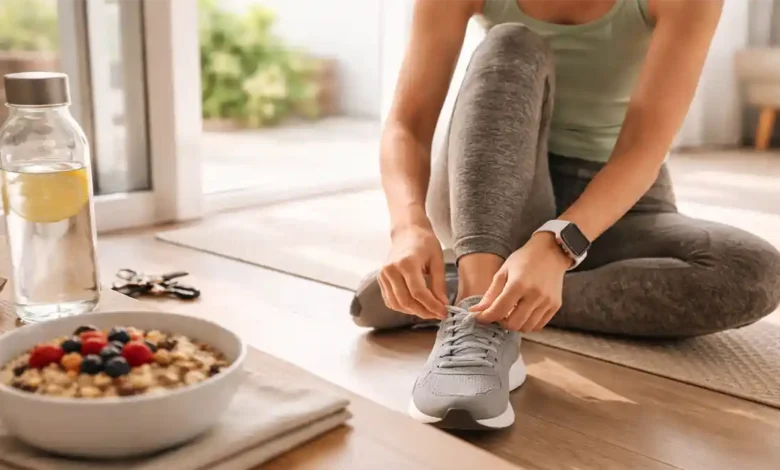
Health Tips 2026 isn’t about chasing perfection—it’s about building a few small habits that actually stick. If you’ve ever started a “new healthy lifestyle” on Monday and felt burned out by Thursday, you’re not alone. The wellness world is loud: supplements, hacks, intense workouts, strict meal plans, complicated routines.
But the truth is refreshingly simple: your body responds best to consistent basics.
In 2026, the most effective approach to health looks less like a dramatic transformation and more like a quiet upgrade—done daily. The habits that move the needle are the ones you can do on your busiest days, your tired days, and your “I can’t be bothered” days.
This guide is built on evidence-based principles: move more, sit less, sleep well, eat mostly real food, manage stress, and keep up with basic prevention. These aren’t trendy because they’re new. They’re trendy because they work—and people are tired of wasting energy on things that don’t.
Important note: This article is for general education, not medical advice. If you have a medical condition, take medication, or are pregnant, speak with a qualified healthcare professional before making major changes.
The 2026 mindset: “Minimum effective dose” wins
The biggest health shift happening right now is this: people want results without burning out.
A “minimum effective dose” mindset asks:
- What’s the smallest habit that creates a real benefit?
- What can I repeat consistently for months, not days?
- What helps my energy, mood, and health markers without taking over my life?
This matters because consistency beats intensity. A perfect routine you can’t maintain loses to a simple routine you repeat for years.
So instead of “I need a full reset,” aim for:
- 10–20 minutes of movement most days
- 7+ hours of sleep
- 1–2 healthier meals per day (not every meal)
- small stress resets
- basic health checks
These foundations align with global health guidance—like the World Health Organization’s recommendations for weekly activity (including strength training) and reducing sedentary time.
Habit 1: Walk daily (steps are the easiest fitness plan)
If you want one habit that improves health without complicated planning, it’s walking.
Walking supports:
- heart health
- blood sugar control
- mental health
- weight management
- sleep quality
And it’s surprisingly powerful at realistic step counts. Large analyses show more steps per day are linked with lower risk of death and better health outcomes, with benefits rising as steps increase (not only at the famous “10,000”).
Make it real in daily life
Try one of these “no-drama” walking routines:
- 10-minute walk after lunch (great for energy)
- 10-minute walk after dinner (great for blood sugar and digestion)
- Walk while on phone calls
- Park farther away
- Two short walks + normal day movement
A practical target for 2026
Instead of forcing a number, use a ladder:
- Start: add 1,000 steps to your current average
- Build: aim for 6,000–8,000 steps most days
- Bonus: if you enjoy it, go higher
Even small increases matter. The goal is repeatable, not heroic.
Habit 2: Strength train twice a week (your “future-proofing” habit)
Strength training is having a moment in 2026, and honestly… it deserves it.
Muscle isn’t just for looks. It supports:
- metabolism and insulin sensitivity
- bone health
- posture and joint stability
- aging well and staying independent
WHO guidance recommends muscle-strengthening activities on 2+ days per week, involving major muscle groups.
What “twice a week” can look like
You don’t need a fancy gym plan. You need basics:
- Squat pattern (sit-to-stand)
- Hinge pattern (hip movement)
- Push (wall push-ups)
- Pull (band rows)
- Carry (grocery-bag carry)
- Core stability (plank or dead bug)
Beginner-friendly plan (20 minutes):
- Sit-to-stand (3×10)
- Wall push-ups (3×8–12)
- Glute bridge (3×10–12)
- Band row or towel row (3×10)
- Short plank (3×20–30 sec)
That’s it. Twice weekly.
The secret ingredient: progression
To keep getting results, gently increase one thing over time:
- a few reps
- a little resistance
- an extra set
- improved form
Progression is how your body learns. Perfection isn’t required.
Habit 3: Break up sitting (movement snacks beat “all-day sitting”)
Here’s a surprising truth: you can exercise regularly and still be at risk if you sit for long stretches.
Health organizations emphasize reducing sedentary time because prolonged sitting is linked with higher health risks.
The 2026 solution: movement snacks
“Movement snacks” are tiny bursts of activity that interrupt sitting:
- stand up and stretch for 60 seconds
- walk to refill water
- climb stairs once
- do 10 squats
- do 10 calf raises while brushing teeth
Set a simple rule:
- Every 30–60 minutes: stand and move for 1–2 minutes.
This habit is small, but it compounds—especially for desk workers.
Habit 4: Sleep like it’s a health strategy (because it is)
Sleep is no longer a “nice to have.” It’s a health foundation.
CDC notes adults generally need at least 7 hours of sleep per night.
Consistently short sleep is linked with higher risk of chronic health problems in many studies.
The best sleep tip isn’t what you think
Most people focus on bedtime. A stronger lever is your wake time.
Pick a consistent wake time (even on weekends if possible). This stabilizes your internal clock, making sleep feel easier.
Build a simple sleep system
Try these high-impact habits:
- Morning light: get daylight in your eyes within 30–60 minutes of waking (even 5–10 minutes helps).
- Caffeine cutoff: stop caffeine 8–10 hours before bed if sleep is fragile.
- Wind-down routine (10–20 minutes): shower, stretch, read, calm music.
- Cool, dark room: small tweaks matter.
A quick test
If you’re sleeping 7–8 hours but still exhausted, consider:
- inconsistent sleep timing
- sleep apnea or snoring issues
- high stress
- late caffeine
- too much evening screen time
Sleep isn’t about being “disciplined.” It’s about building conditions where sleep happens naturally.
Habit 5: Eat “mostly real food” (the simplest nutrition rule)
Nutrition advice gets confusing fast, so let’s ground it.
A strong 2026 rule is:
Base your meals on minimally processed foods most of the time.
Why? Because higher intake of ultra-processed foods is associated with greater risk of multiple adverse health outcomes in large reviews of research.
That doesn’t mean “never eat packaged food.” It means ultra-processed foods shouldn’t be the base of your diet.
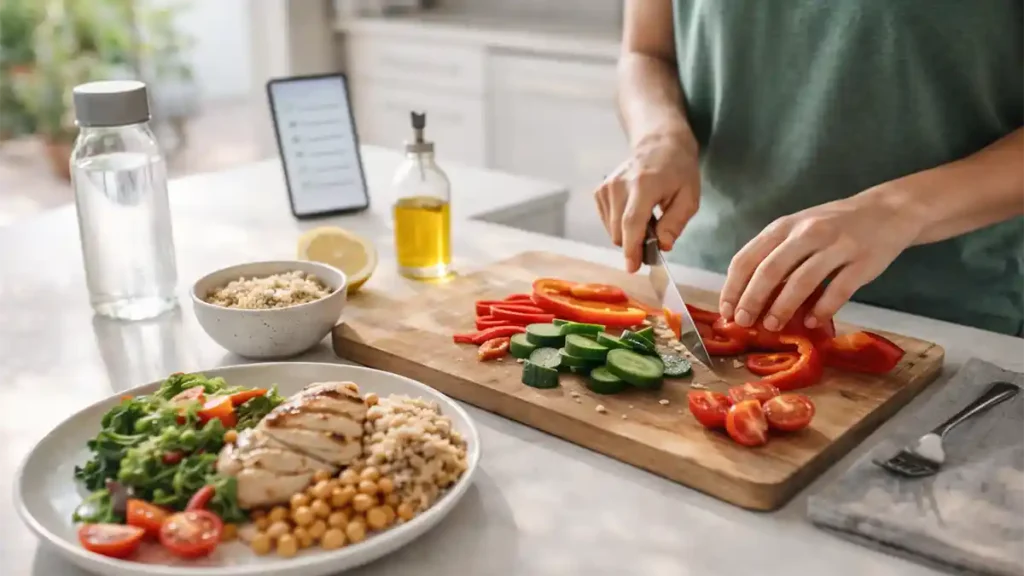
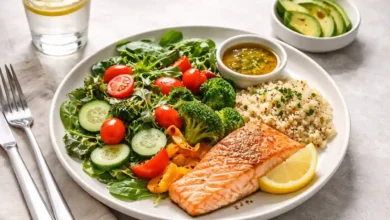
Use the “plate method” (works in any cuisine)
Aim for:
- ½ plate vegetables + fruit
- ¼ plate protein
- ¼ plate high-fiber carbs (whole grains, beans, starchy veg)
- plus healthy fats (olive oil, nuts, seeds)
One nutrition habit that delivers fast results
Add fiber and protein to breakfast.
Fiber recommendations commonly cited in major guidance are around 25g/day for women and 38g/day for men (varies by age and needs).
Most people fall short—so improving fiber intake often improves digestion, fullness, and blood sugar stability.
Easy upgrades:
- oatmeal + nuts + fruit
- eggs + whole-grain toast + salad/veg
- yogurt + berries + chia seeds
- lentil/bean breakfast bowl (yes, it works)
Habit 6: Reduce hidden salt and added sugar (without “diet culture”)
You don’t need to fear salt or sugar. You just need to avoid the invisible overload that comes from packaged foods and frequent takeout.
WHO recommends less than 2,000 mg sodium/day (about 5g salt/day) for adults.
And dietary guidelines often advise keeping added sugars under a certain limit (commonly less than 10% of daily calories in U.S. guidance).
Practical moves that don’t feel restrictive
- Choose “less salty” versions when possible
- Add flavor with lemon, garlic, herbs, chili, vinegar
- Swap sugary drinks for water or unsweetened tea most days
- Keep treats intentional (enjoy them, don’t “accidentally” eat them)
Your goal isn’t a perfect diet. It’s a better default.

Habit 7: Manage stress with micro-resets (not long routines)
Stress management in 2026 is getting more realistic. Instead of “meditate 30 minutes daily,” people are using micro-resets—short interventions that calm the nervous system.
Mindfulness-based interventions and stress reduction programs have been shown in research reviews to reduce symptoms like stress and depression in various groups.
The 60-second reset (do this anywhere)
Try:
- inhale 4 seconds
- exhale 6 seconds
- repeat 6–8 times
Longer exhales tell your body it’s safe.
Build a stress toolkit
Pick 2–3 that you actually enjoy:
- short walk outside
- prayer/quiet time
- journaling 5 lines
- stretching
- music
- talking to a friend
- a hobby with your hands (cooking, gardening)
Stress doesn’t disappear. But your recovery can improve.
Habit 8: Protect your blood pressure (the “silent” health habit)
High blood pressure is incredibly common worldwide. WHO estimates about 1.4 billion adults (ages 30–79) had hypertension in 2024, and many don’t know they have it.
This is why a simple 2026 habit is:
- Check your blood pressure (clinic, pharmacy, or home monitor)
- and take lifestyle steps that support it:
- more movement
- better sleep
- less excess sodium
- less ultra-processed food
- stress management
It’s not glamorous, but it’s one of the highest-return habits you can adopt.
Habit 9: Make social connection part of your health plan
We often treat relationships as “extra,” but research suggests social connection is strongly linked with better health outcomes. A major meta-analysis found people with stronger social relationships had a significantly higher likelihood of survival than those with weaker relationships.
What counts as connection?
Not just big social events. Try:
- 10-minute call with someone you care about
- tea with a family member
- walking with a friend
- joining a community group
- being consistent with one relationship
Your body benefits when you feel supported.
Habit 10: Use tech wisely (track less, act more)
Wearables and health apps are everywhere in 2026. They can help—if you use them as tools, not judges.
Good uses:
- step reminders
- sleep schedule consistency
- simple strength plan tracking
- hydration reminders
Not-so-helpful uses:
- obsessing over every metric
- chasing perfection
- letting “bad data” ruin your mood
Use tech to support daily health habits, not replace them.
A simple 30-day plan (realistic, repeatable)
If you want results quickly without chaos, try this:
Week 1: Movement
- Walk 10 minutes daily
- Stand up every hour for 1–2 minutes
Week 2: Sleep
- Set a consistent wake time
- Add a 10-minute wind-down routine
Week 3: Nutrition
- Add protein + fiber at breakfast
- Add 1 extra serving of vegetables daily
Week 4: Stress + connection
- Do a 60-second breathing reset daily
- Reach out to one person 2–3 times this week
This plan is simple on purpose. The goal is momentum.
Quick FAQ
What are the best Health Tips 2026 for beginners?
Start with walking daily, sleeping 7+ hours, eating mostly real food, and doing 2 short strength sessions weekly.
How long does it take to see real results from simple habits?
Many people notice energy and mood improvements within 1–2 weeks. Bigger changes (fitness, weight, labs) often take 8–12 weeks of consistency.
Do I need the gym to be healthy in 2026?
No. Walking plus simple at-home strength training twice weekly can meet key health needs.
What’s one nutrition change that helps fast?
Increase fiber and protein at breakfast and reduce ultra-processed foods as your “default.”
What’s the easiest way to reduce stress daily?
Use micro-resets: slow breathing, short walks, stretching, or 5 minutes of quiet time.
Conclusion: Real results come from repeatable basics
If 2026 has a health theme, it’s this: simple is powerful.
You don’t need an extreme plan. You need habits that survive real life:
- walk more and sit less
- strength train twice a week
- sleep 7+ hours consistently
- eat mostly real food and reduce ultra-processed defaults
- manage stress in small, repeatable ways
- stay connected
- check the basics (like blood pressure)
Your health is built in ordinary moments: what you do most days, not what you do once in a while.
If you want one starting point, choose this:
Take a 10-minute walk today—and do it again tomorrow.
That’s how real change begins.


2 Comments