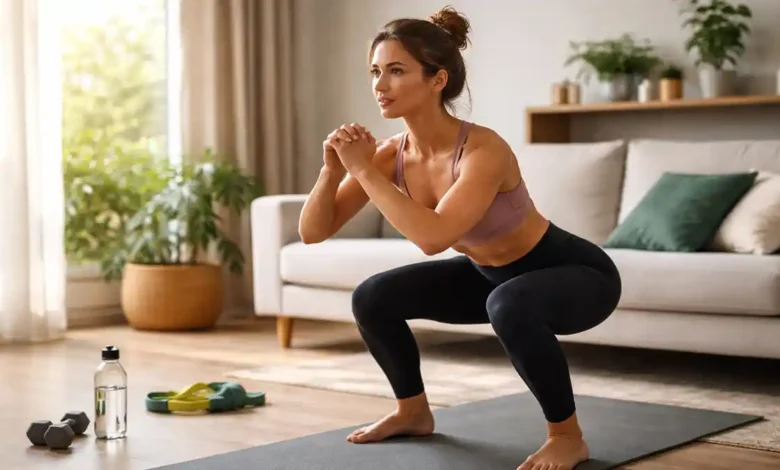
Home fitness routines are one of the most practical ways to get stronger, leaner, and more energized without paying for a gym membership, commuting, or waiting for equipment. If you’ve ever told yourself, “I’ll start when I have more time,” this is your sign: you can build a genuinely effective fitness plan with a small space, your bodyweight, and a smart routine that matches your goal.
And “effective” isn’t just motivation talk, it’s backed by what health organizations recommend. Adults generally benefit from regular aerobic activity plus muscle-strengthening work at least twice per week.
This guide will walk you through the best at-home routines (strength, cardio, HIIT, core, and mobility), how to choose the right one, and exactly how to structure your week, so your workouts stop feeling random and start creating results.
Why Home Fitness Routines Work (and How to Make Them Stick)
Let’s clear up a myth: home workouts are not “less serious.” They only become ineffective when they’re unstructured, when you do a few squats today, a YouTube video next week, then nothing for ten days.
Home fitness routines work when they follow the same rules gym programs follow:
- Consistency (frequency beats occasional intensity)
- Progressive overload (your body needs a reason to adapt)
- Balanced training (push, pull, squat, hinge, core, cardio, mobility)
- Recovery (sleep, rest days, and not going max effort every time)
Also: the world has a movement problem, not an equipment problem. The WHO reported that about 31% of adults worldwide did not meet recommended physical activity levels in 2022, that’s roughly 1.8 billion people.
A home plan removes many of the common barriers: time, access, and cost.
Before You Start: The 3-Step Setup for Better Results
1) Pick your primary goal (one, not five)
Choose the goal that matters most for the next 6–8 weeks:
- Fat loss / conditioning
- Strength & muscle
- Mobility, posture, and pain-free movement
- General health & energy
You can train multiple qualities, but picking a “main goal” stops you from doing everything randomly.
2) Choose your weekly minimum
A strong baseline for most adults is:
- Aerobic activity across the week
- Strength training at least 2 days/week
If your schedule is tight, a simple “minimum effective” plan could look like this:
- 3 workouts/week (30–45 minutes)
- plus short daily walks or 10-minute cardio blocks
3) Decide your equipment level
This article includes routines for:
- No equipment
- Resistance bands
- One pair of dumbbells or a kettlebell
- A chair + a backpack (DIY weights)
Your Warm-Up Blueprint (5-8 Minutes)
Before every routine, do this quick warm-up:
- March in place or step-ups (60 seconds)
- Arm circles + shoulder rolls (30 seconds each)
- Hip hinges (10 reps)
- Bodyweight squats (10 reps)
- Incline push-ups on a wall/counter (8–10 reps)
- World’s greatest stretch (3 reps per side)
This raises temperature, primes joints, and makes your first set feel smoother.
Routine 1: The Full-Body Bodyweight Strength Routine
Best for: beginners, fat loss, general fitness, building strength foundations
Time: 25-40 minutes
Frequency: 2-4x/week
How it works
You’ll train the big movement patterns:
- Squat
- Hinge
- Push
- Pull (yes, you can still pull at home)
- Core carry/stability
Workout (3–4 rounds)
Rest 45–75 seconds between exercises.
- Squat variation – 10–15 reps
- Beginner: box squat to a chair
- Intermediate: tempo squat (3 seconds down)
- Advanced: jump squats (8–12 reps)
- Push-up variation – 8–15 reps
- Wall → counter → knees → standard → decline
- Hip hinge – 12–20 reps
- Glute bridge (beginner)
- Single-leg glute bridge (intermediate)
- Hip thrust on couch (advanced)
- Back “pull” substitute – 10–15 reps
- Backpack row: load a backpack and row it
- Towel row: wrap towel around a sturdy pole and lean back (carefully)
- Core stability – 30–45 seconds
- Plank (standard) or dead bug (lower-back friendly)
Progression (how to get stronger without weights)
Pick one method per week:
- Add 1–2 reps per set, OR
- Add one extra round, OR
- Use a slower pace (lower for 3 seconds, hold for 1 second), OR
- Cut your rest breaks a little
This is progressive overload the same concept used in gym programs.
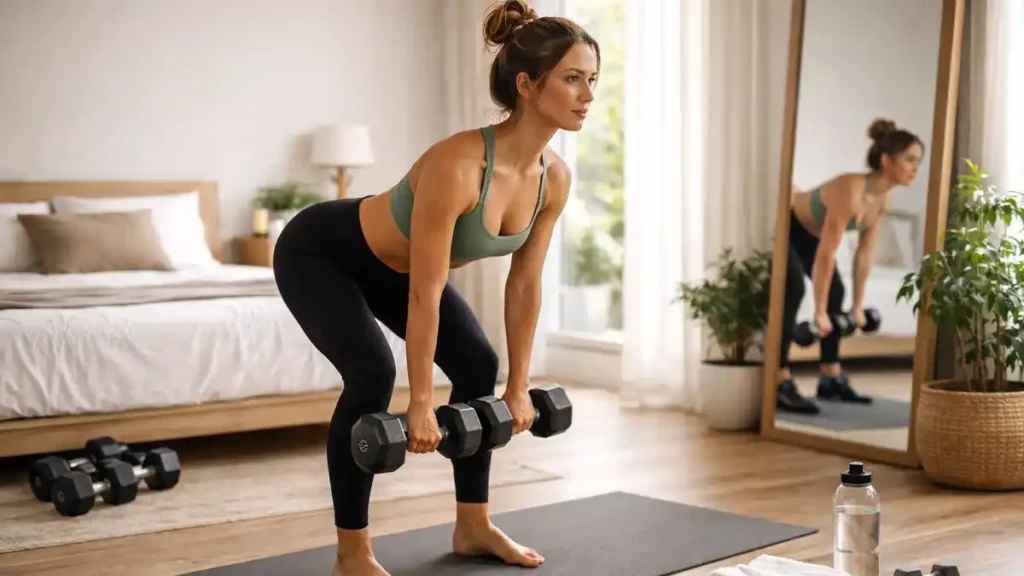
Routine 2: At-Home Strength Training With Dumbbells (or One Backpack)
Best for: muscle gain, strength, body recomposition
Time: 35–50 minutes
Frequency: 3x/week
Strength training guidelines commonly emphasize regular muscle-strengthening work across the week.
And classic resistance training position stands often recommend training frequency around 2–3 days/week for beginners (and more for advanced trainees).
Workout A (Full Body)
Do 3 sets each (rest 60–90 seconds).
- Goblet squat (dumbbell/backpack) – 8–12 reps
- Romanian deadlift – 8–12 reps
- Floor press (dumbbells) or push-ups – 8–12 reps
- 1-arm row (dumbbell/backpack) – 10–12 per side
- Overhead press – 8–12 reps
- Farmer carry (walk holding weights) – 30–60 seconds
Workout B (Full Body)
- Split squat (rear foot on chair optional) – 8–10/side
- Hip thrust – 10–15
- Incline press (floor press alternative) – 8–12
- Row variation – 10–12
- Lateral raises (light) – 12–20
- Core: dead bug or side plank – 30–45 sec
Schedule idea: Mon A / Wed B / Fri A next week switch.
Routine 3: HIIT Workouts at Home (Fast Conditioning)
Best for: conditioning, fat loss, busy schedules
Time: 12–25 minutes
Frequency: 1–3x/week (not daily)
HIIT is powerful but it’s also stressful. The goal is quality bursts, not endless suffering.
HIIT Option 1 (Beginner-Friendly, Low Impact)
Work 30 seconds / Rest 30 seconds, 3–5 rounds:
- Marching high knees
- Bodyweight squats
- Incline push-ups
- Mountain climbers (slow)
- Plank shoulder taps
HIIT Option 2 (Intermediate)
Go for 4 rounds of 40 seconds on, 20 seconds off:
- Jump rope (real or “invisible rope”)
- Reverse lunges
- Push-ups
- Squat to knee drive
- Fast mountain climbers
HIIT Option 3 (Advanced)
Work 20 seconds / Rest 10 seconds (Tabata), 8 rounds:
- Burpees (or half-burpees)
Rest 2 minutes, then repeat with: - Jump squats or skaters
Tip: If your form collapses, the interval is too aggressive. HIIT should feel hard, but controlled.
Routine 4: The Low-Impact Cardio Circuit (No Jumping, No Noise)
Best for: apartments, joint sensitivity, beginners, steady fat loss
Time: 20–40 minutes
Frequency: 3–6x/week
This routine helps you rack up weekly cardio minutes without destroying your knees.
Circuit (repeat 4-8 rounds)
- Step-ups on a stable chair/step – 45 sec
- Shadow boxing – 45 sec
- Glute bridge march – 45 sec
- Side steps + reach – 45 sec
- Rest – 30-60 sec
This pairs beautifully with strength days. Also, it supports the broader weekly activity targets often recommended (like ~150 minutes moderate activity).
Routine 5: The Core + Posture Routine (Stronger Midsection, Better Back)
Best for: desk workers, back comfort, athletic base
Time: 12-20 minutes
Frequency: 2-5x/week
Core training isn’t just crunches. Think: anti-extension, anti-rotation, and stability.
Core Circuit (3-4 rounds)
- Dead bug – 8 reps/side (slow)
- Side plank – 20–40 sec/side
- Glute bridge – 12-15
- Bird dog – 8 reps/side
- Hollow hold (or bent-knee version) – 15–30 sec
Posture add-on (2-3 minutes)
- Wall slides – 10 reps
- Chin tucks – 8 reps
- Doorway chest stretch – 30 sec
Do this after strength workouts or on “off” days.
Routine 6: The Mobility and Stretching Routine (Recovery That Actually Helps)
Best for: stiffness, stress, injury prevention, better squats/hips/shoulders
Time: 10–25 minutes
Frequency: daily or 3–5x/week
Mobility isn’t just “flexibility.” It’s controlled range of motion.
Mobility Flow (10–15 minutes)
- Cat-cow – 6 reps
- Thoracic rotations – 6/side
- Hip flexor stretch – 45 sec/side
- Hamstring stretch (band/towel) – 45 sec/side
- Deep squat hold (hold something if needed) – 45 sec
- Shoulder opener (towel pass-throughs) – 10 reps
- Child’s pose breathing – 60 sec
This routine is also ideal if you’re older or returning after a long break because building strength and stability is a long game.
The “Top 7” Exercise Shortlist (If You Want the Best ROI Moves)
If you do nothing else, build your home program around these:
- Squat variation
- Hip hinge (deadlift pattern)
- Push-up or press
- Row or pull substitute
- Lunge/split squat
- Carry (farmer hold/walk)
- Plank/dead bug (core stability)
Master these, progress them, and your body will change.
Weekly Plans You Can Copy-Paste
Plan A: Beginner (3 Days/Week)
- Mon: Bodyweight Strength Routine (Routine 1)
- Wed: Low-Impact Cardio (Routine 4) + Mobility (Routine 6)
- Fri: Strength With Backpack/Dumbbells (Routine 2 light)
Optional: 10–20 min walks on Tue/Thu/Sat
Plan B: Fat Loss + Toning (4 Days/Week)
- Mon: Strength (Routine 2)
- Tue: Low-impact cardio (Routine 4)
- Thu: Strength (Routine 1 or 2)
- Sat: HIIT (Routine 3) + Mobility (Routine 6)
Plan C: Strength Focus (4 Days/Week)
- Mon: Routine 2 (Workout A)
- Tue: Core + Mobility (Routine 5 + 6)
- Thu: Routine 2 (Workout B)
- Sat: Routine 2 (Workout A) + short walk
Plan D: Busy Schedule (5 x 12–20 minutes)
- Mon: HIIT (short)
- Tue: Core + posture
- Wed: Strength (bodyweight)
- Thu: Mobility flow
- Fri: Low-impact cardio
This is how you win when life is busy: smaller workouts, done consistently.
Common Mistakes That Stall Results (and Easy Fixes)
Mistake 1: Going too hard, too soon
Fix: keep 2–3 reps “in the tank” for most sets during week 1–2.
Mistake 2: Only doing cardio (or only doing strength)
Fix: combine both across the week. Many major hea
rt-health and public-health recommendations include aerobic activity plus muscle strengthening.
Mistake 3: No progression
Fix: track one thing, reps, rounds, time, or load and improve it gradually.
Mistake 4: “Random workouts” with no weekly structure
Fix: pick one weekly plan above and commit to it for 6 weeks.
Nutrition + Recovery (Simple, Non-Extreme)
You can out-train a bad program, but you can’t out-train bad recovery forever.
- Protein: include a protein source at each meal (eggs, chicken, fish, lentils, yogurt)
- Sleep: aim for consistent sleep/wake timing
- Steps: walking is underrated for fat loss and recovery
- Hydration: dehydration makes workouts feel harder than they should
If you want visible results, treat recovery like part of training.
Quick FAQs
How long should home workouts be?
If you train with focus, 20–45 minutes is enough for most goals. Consistency matters more than marathon sessions.
Can I build muscle with home workouts?
Yes; especially with progressive overload using tempo, range, reps, and load (dumbbells, bands, backpack).
How often should I train each week?
A practical range is 3-5 days/week, plus light movement (like walking). Many adult guidelines emphasize regular weekly activity with both cardio and strengthening.
Is HIIT necessary?
Not necessary but useful. If you hate it, do steady low-impact cardio instead.
Conclusion: The Best Routine Is the One You’ll Repeat
The secret to long-term fitness isn’t a perfect workout, it’s a repeatable system. Home fitness routines give you the freedom to train on your schedule, in your space, with zero excuses about equipment or time.
Start with one plan, stick to it for 6 weeks, and track small wins: one extra rep, one extra round, better form, less rest, stronger core control. Those tiny upgrades compound fast and suddenly, your “home workouts” don’t feel like a backup plan anymore. They feel like your lifestyle.
4 Comments