Look at the Deep History of Peshawar City (City of Men)
The name Peshawar is derived from the Sanskrit word Purushapura, meaning “City of Men.”
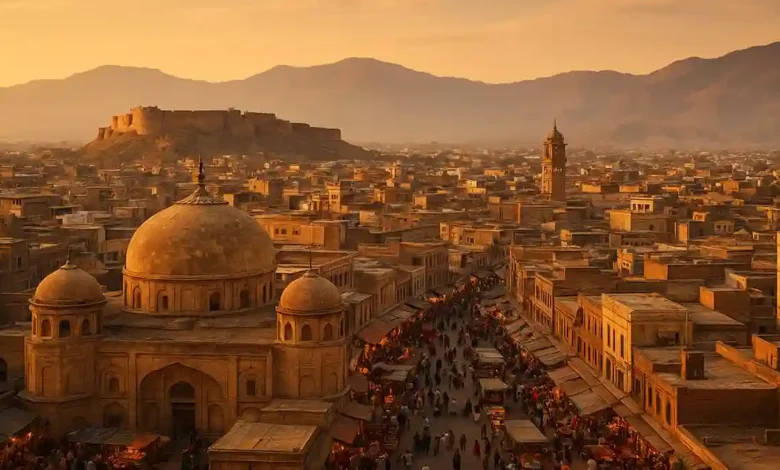
Peshawar, the capital city of Khyber Pakhtunkhwa province in Pakistan, stands as one of the oldest continuously inhabited cities in South Asia. Known for its rich cultural heritage, strategic location, and remarkable resilience, Peshawar has witnessed countless civilizations rise and fall over thousands of years. From its early Buddhist roots to its Mughal grandeur and Afghan influence, the city remains a living museum of history and tradition.
The Origins of Peshawar
The name Peshawar is derived from the Sanskrit word Purushapura, meaning “City of Men.” Historical records trace its existence back to at least the 2nd century BCE, when it served as the capital of the ancient Gandhara Civilization. This civilization was famous for its fusion of Greek and Buddhist art, known as Gandhara Art, which flourished under the Kushan Empire.
During the reign of King Kanishka the Great (circa 127–150 CE), Peshawar became an important Buddhist center. The city was home to the magnificent Kanishka Stupa, one of the tallest structures of the ancient world, attracting pilgrims from across Asia.
Peshawar in the Islamic and Mughal Eras
By the 7th century, Islamic influence began to spread into the region through trade and conquest. The arrival of Mahmud of Ghazni in the 10th century marked the beginning of Peshawar’s Islamic chapter. The city later came under the control of the Mughal Empire in the 16th century, transforming it into a vital frontier outpost.
The Mughals left a deep imprint on Peshawar’s architecture and culture. Emperor Babur admired the city’s beauty and climate, while Emperor Akbar fortified it to protect the empire’s northwestern border. The Qissa Khwani Bazaar (the “Market of Storytellers”) became a hub of culture and trade, where merchants, travelers, and storytellers from Central Asia shared tales and goods.
Afghan and British Periods
In the 18th century, after the decline of Mughal rule, Peshawar became part of the Durrani Empire under Ahmad Shah Durrani, marking the beginning of strong Afghan cultural and political influence. This influence remains visible today in the Pashto language, tribal traditions, and local architecture.
By the 19th century, Peshawar fell under British colonial rule, following the annexation of Punjab in 1849. The British developed it into a garrison town due to its proximity to the Khyber Pass, a key route between Central Asia and the Indian subcontinent. Many colonial-era buildings, such as Edwardes College and Cunningham Clock Tower, still reflect that era’s architectural legacy.
Peshawar in Modern Pakistan
After the creation of Pakistan in 1947, Peshawar became the provincial capital of Khyber Pakhtunkhwa. The city played a crucial role during the Afghan-Soviet War (1979–1989), serving as a refuge for millions of Afghan refugees. Despite rapid urbanization, Peshawar has managed to preserve its historical essence through landmarks such as Bala Hissar Fort, Mohabbat Khan Mosque, and Gor Khatri.
Today, Peshawar stands as a vibrant blend of the ancient and the modern. It serves as a cultural, educational, and economic hub of northwest Pakistan while continuing to honor its centuries-old traditions.
Cultural Significance and Heritage
Peshawar’s culture is deeply rooted in Pashtun traditions, hospitality, and folklore. The city’s bazaars including Qissa Khwani, Chowk Yadgar, and Karkhano Market are alive with the fragrance of spices, the glow of traditional crafts, and the voices of traders speaking in Pashto, Urdu, and Persian.
The Peshawar Museum, founded in 1907, houses one of the largest collections of Gandhara art in the world, making it a must-visit site for historians and tourists alike.
Conclusion
Peshawar is not just a city; it is a living chronicle of civilizations that have shaped South Asia’s identity. From the Gandhara Buddhists to the Mughal emperors and Afghan kings, every layer of its history contributes to the soul of Pakistan’s northwest frontier. To walk through Peshawar’s streets is to walk through time itself a journey through the heart of ancient and modern heritage.





2 Comments